


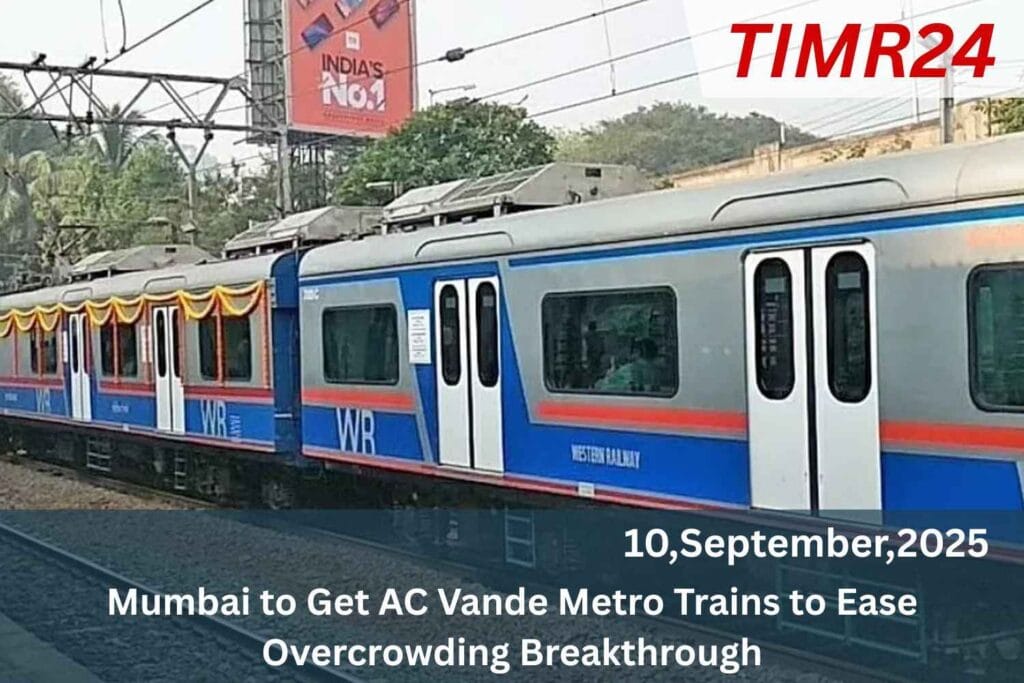
Mumbai’s suburban railway network is set to undergo a significant upgrade with the introduction of fully air-conditioned Vande Metro local trains in 12, 15, and 18-coach configurations. The Mumbai Railway Vikas Corporation Ltd (MRVC) has launched a global tender worth around Rs 21 billion for the procurement and maintenance of 2,856 air-conditioned coaches. The new coaches will be fully vestibular, air-conditioned, and optimised for suburban service, offering safety systems, enhanced braking technology, and passenger-friendly flow designs. Mumbai, one of India’s most populous cities, is on the verge of a transformative upgrade in its urban transport network with.
The introduction of AC Vande Metro trains. This initiative, led by Indian Railways in coordination with the Mumbai Metropolitan Region Development Authority (MMRDA), aims to address the long-standing problem of overcrowding on suburban trains, which has been a persistent challenge for daily commuters. With a daily passenger load exceeding seven million across the Mumbai suburban network, traditional local trains often struggle to maintain safety and comfort standards. The Vande Metro project seeks to provide a faster, more efficient, and technologically advanced alternative to ease the strain on existing infrastructure The Vande Metro trains are designed as semi-high-speed.
Urban trains, capable of reaching speeds up to 160 km/h, making them significantly faster than conventional local trains. This speed advantage is expected to reduce commute times dramatically for passengers traveling between distant suburbs and the city center. Unlike standard local trains, these modern trains feature fully air-conditioned coaches, spacious seating arrangements, and ergonomic interiors that prioritize passenger comfort during peak hours. In addition to comfort, the trains come equipped with real-time passenger information systems, automated announcements, and modern safety features such as CCTV surveillance, emergency intercoms, and fire-resistant.
Materials, making the commuting experience safer for women, senior citizens, and differently-abled passengers Mumbai’s suburban railway system has been a lifeline for the city for decades, connecting major hubs such as Churchgate, CST, Dadar, Thane, and Virar. However, rapid population growth and urban expansion have led to extreme congestion, particularly during peak travel hours. The introduction of AC Vande Metro trains complements ongoing metro projects like the (Mumbai Metro) and the creating a more integrated and sustainable urban transit ecosystem. By linking key high-density corridors, the Vande Metro trains will ensure faster interconnectivity between suburban.
Rail and metro networks, reducing reliance on road transport and helping to mitigate traffic congestion and pollution in the city The initial phase of the Vande Metro project will focus on high-demand routes such as Churchgate to Virar and CST to Panvel. These corridors are notorious for heavy passenger loads during peak hours, with trains often operating beyond their seating and standing capacity. By introducing modern, air-conditioned trains on these routes, authorities aim to provide a more comfortable alternative to commuters who currently endure overcrowded conditions. The trains are expected to operate at a frequency that complements existing local services, ensuring.
Minimal waiting times and efficient passenger distribution across different routes. Internal links to our section can provide travellers with the latest schedules, ticketing options, and operational details for these routes The technological sophistication of the Vande Metro trains extends to energy efficiency and environmental sustainability. These trains employ regenerative braking systems, which recover energy during braking and feed it back into the system, reducing overall power consumption. Energy-efficient motors and lightweight aluminium coaches further contribute to lower operational costs and a smaller carbon footprint. By adopting such green technologies.
Mumbai sets an example for other metropolitan cities in India and globally, highlighting the potential for combining speed, comfort, and sustainability in public transport solutions. The initiative aligns with broader national goals of promoting eco-friendly urban mobility, as outlined in India’s In addition to technological and operational advancements, the Vande Metro project is expected to have a substantial socio-economic impact. During the construction and operational phases, the project will create numerous employment opportunities in engineering, manufacturing, operations, and maintenance. Furthermore, by improving connectivity and reducing.
Travel times, it is likely to enhance productivity for millions of Mumbai residents who commute daily for work, education, and other essential activities. Businesses along the metro and suburban corridors may also benefit from increased footfall and easier access for employees and customers, creating a multiplier effect on the local economy The Vande Metro project draws inspiration from the success of the India’s premier semi-high-speed train service. By adopting similar design principles, safety protocols, and passenger amenities, the Vande Metro ensures a premium travel experience within the urban context. Unlike intercity trains, the Vande Metro is tailored for frequent stops and rapid.
Acceleration and deceleration, making it ideal for the densely populated corridors of Mumbai. Features such as mobile charging ports, digital information screens, and ergonomic seating contribute to a commuter-friendly environment, which has long been a missing aspect of suburban rail travel in the city Public-private partnerships are also being explored to enhance service quality, introduce smart ticketing solutions, and ensure efficient maintenance of the trains. Contactless payment systems, integrated with metro and suburban rail ticketing, are expected to make daily commuting seamless, reducing queues and transaction times. Additionally, safety measures, including real-time.
Monitoring of train conditions, emergency response protocols, and crowd management systems at stations, will be implemented to address the challenges posed by high passenger volumes The phased rollout of the AC Vande Metro trains is scheduled to begin in late 2025, with real-time updates available through official portals and Commuters are encouraged to stay informed about operational timings, route details, and ticketing procedures to make the most of the enhanced transport facilities. Over time, as more trains are introduced and routes expanded, the Vande Metro is expected to transform the overall commuting experience in Mumbai, offering a reliable, fast, and comfortable alternative to conventional local trains.
In conclusion, the introduction of AC Vande Metro trains represents a significant step forward in modernizing Mumbai’s suburban rail system. By combining high speed, comfort, technology, and sustainability, the project addresses multiple urban transport challenges simultaneously. It promises to reduce overcrowding, shorten travel times, and enhance commuter safety while contributing positively to the city’s economy and environmental goals. As Mumbai continues to grow, initiatives like the Vande Metro will play a pivotal role in shaping the future of urban mobility, ensuring that the city’s residents can travel efficiently, comfortably, and sustainably across one of the world’s busiest metropolitan regions.
Q1. When will Mumbai’s AC Vande Metro trains start?
They are expected to begin phased operations in late 2025.
Q2. Which routes will the Vande Metro cover initially?
High-traffic routes like Churchgate-Virar and CST-Panvel will be prioritized.
Q3. Are the trains fully air-conditioned?
Yes, all coaches will be air-conditioned with modern comfort features.
Q4. Will the Vande Metro help reduce overcrowding?
Yes, it aims to significantly decongest existing local trains.
Q5. Where can I find official updates and ticketing info?
Visit (MMRDA)