


















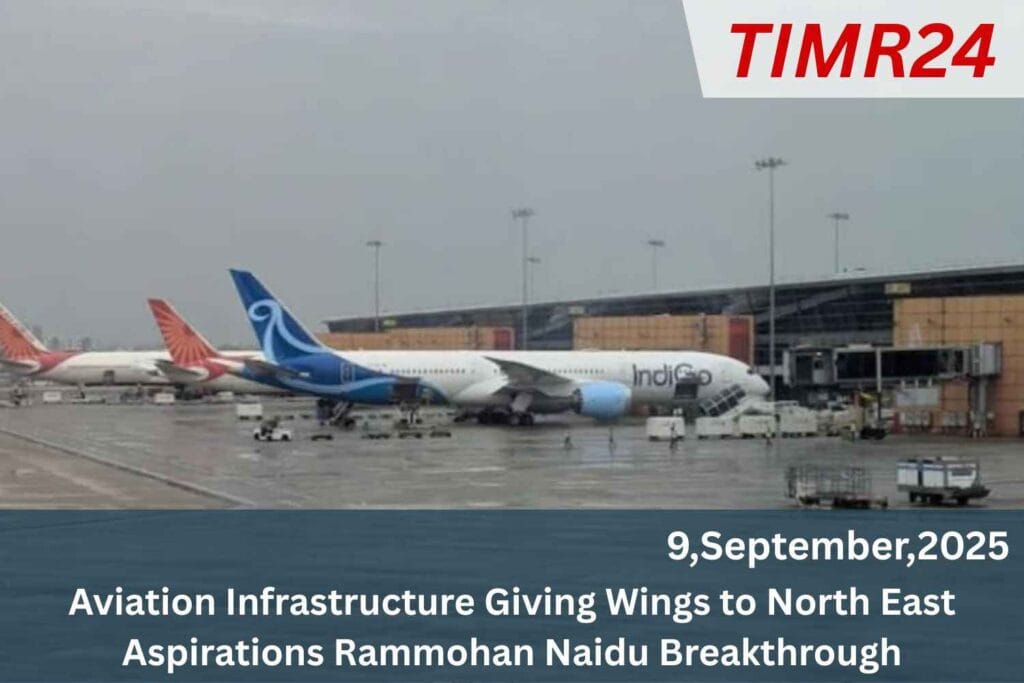
The Ministry of Civil Aviation held the North East Region Ministers’ Conference on Civil Aviation 2025 and the 3rd North East Summit in Arunachal Pradesh. The event highlighted the importance of connectivity, aviation infrastructure expansion, and collaboration between the Centre, State, and Industry for faster growth. State leaders called for faster airport operationalization, cargo facility expansion, and policy support to attract private investment. Key sessions covered airport and helipad development models, UDAN, skilling, and Helicopter Emergency Medical Services. The summit also highlighted India’s rise as the world’s third-largest domestic aviation market.
The North East of India has always been described as a land of beauty, culture, and potential, but for decades, its growth was held back by the challenge of connectivity. With difficult terrain, long travel times, and limited access to mainstream markets, development remained uneven compared to other regions. Now, with a renewed focus on aviation infrastructure, the region is witnessing an unprecedented transformation. Under the leadership of Civil Aviation Minister Rammohan Naidu, the government is working to unlock the aspirations of the North East through modern airports, enhanced regional routes, and international linkages. Much like the (AURIC) that show.
Government Push and Policy Support
How infrastructure transforms cities, is set to redefine opportunities for the North East. The government’s UDAN scheme, designed to connect underserved and unserved airports, has played a crucial role in making affordable flights a reality in this region. According to the more than a dozen airports across the North East have been brought into active service, with plans to expand further. Guwahati, Imphal, and Agartala are already witnessing expansion works, while smaller airports like Tezpur and Pasighat are now on the map. This mirrors India’s commitment to balanced development, similar to the breakthroughs seen in, where policy support drives regional transformation.
Airports in the North East are not only growing in number but also being modernized with advanced passenger handling systems, cargo terminals, and eco-friendly designs. Guwahati airport, for instance, is being redeveloped into a world-class terminal, capable of handling millions of passengers annually. Agartala recently got a new terminal building that enhances both capacity and passenger experience. Shillong, Aizawl, and Dimapur are being prioritized for runway extensions and night-landing facilities, making them more attractive for commercial airlines. These projects highlight how aviation is being positioned as a central pillar of regional development, just as.
Tourism as a Key Beneficiary
The North East has always been a dream destination for nature lovers and adventure seekers, but limited access restricted its true potential. With improved aviation infrastructure, tourists can now fly directly to places like Imphal, Guwahati, and Silchar, cutting down travel times significantly. Eco-tourism in Meghalaya, cultural festivals in Nagaland, and trekking in Arunachal Pradesh are now more accessible than ever before. The role of aviation in boosting tourism is similar to how enhanced global trade; aviation is unlocking global tourism flow into the region. To explore how tourism is positioned globally, resources like outline how connectivity is essential for tourism-led growth.
Beyond passengers, infrastructure is giving the North East a new identity as a trade hub. Cargo terminals are being developed to help exporters of tea, bamboo products, handloom, and organic produce reach markets in mainland India and abroad. With Guwahati expected to emerge as a regional cargo hub, farmers and small businesses can benefit from faster logistics. The region’s geographical location makes it a natural gateway to Southeast Asia, opening up new international trade corridors. This is much like how is opening trade opportunities through maritime logistics. To understand larger logistics opportunities provides valuable insights into how aviation and trade are being aligned for India’s growth.
Job Creation and Local Empowerment
Every new airport in the North East is not just about flights but also about opportunities. Thousands of jobs are created in construction, ground handling, hospitality, and retail. The service sector thrives when airports expand, and allied industries like hotels, transport, and tour operators see a surge in demand. This integrated employment model is reminiscent of which created over 5,000 jobs, showing that infrastructure has a multiplier effect on livelihoods. For the North East, aviation is not just an economic enabler but a tool for social empowerment The North East has always been geographically positioned as India’s link to Southeast Asia, but only now is aviation unlocking its true potential.
With initiatives to start international flights from Guwahati to Bangkok and Singapore, the region can become a hub for both passenger and cargo movement. Imphal and Agartala are also being explored as potential international gateways. This aligns perfectly with India’s Act East Policy, which envisions the North East as the bridge to ASEAN countries. In a way is doing for the region what is doing for industrial logistics strengthening integration into national and global networks An important part of aviation development today is sustainability. The North East, with its pristine environment, cannot afford infrastructure that harms nature. That is why new airports are being designed.
Sustainability and Green Aviation Goals
With green building standards, solar energy integration, and waste management systems. This approach is similar to the where infrastructure is aligned with eco-friendly practices. To know more about sustainable development in aviation, provide a global perspective on how aviation can grow responsibly Looking ahead, aviation will be the defining force of North East growth. The expansion of Guwahati as an international hub, the inclusion of regional towns under UDAN, and the setting up of cargo corridors will shape a new economic identity for the region. Tourism will flourish, trade will expand, and local employment will grow, making aviation not just a mode of transport but a lifeline for aspirations.
Just like showcased how energy infrastructure can bring global relevance, aviation is positioning the North East as a central player in India’s future growth story Aviation infrastructure is proving to be the most transformative force for the North East in recent decades. By connecting remote valleys to (Smart City) bustling metros, and by linking local markets to global destinations, aviation is giving wings to aspirations that were once grounded by geography. Under the leadership of Rammohan Naidu, this momentum is gaining speed, ensuring that the North East is not just a part of India’s growth story but a leader in it. With modern airports, international flights, sustainable practices, and strong.
Q1. How is aviation infrastructure transforming the North East region?
Aviation infrastructure is improving connectivity, boosting trade, enhancing tourism, and creating job opportunities in the North East.
Q2. What role does the government play in North East aviation development?
The Ministry of Civil Aviation, under leaders like Rammohun Naidu, is investing in new airports, upgrading terminals, and strengthening air routes.
Q3. Which cities in the North East are witnessing major aviation growth?
Guwahati, Imphal, Agartala, and Dibrugarh are at the forefront, with upcoming projects in Shillong, Aizawl, and Dimapur.
Q4. How does aviation boost tourism in the North East?
Direct connectivity attracts more domestic and international tourists, supporting eco-tourism, cultural tourism, and adventure tourism.
Q5. What future opportunities does aviation hold for the North East?
Cargo hubs, regional airline expansion, and international flight connectivity are expected to accelerate economic growth.