





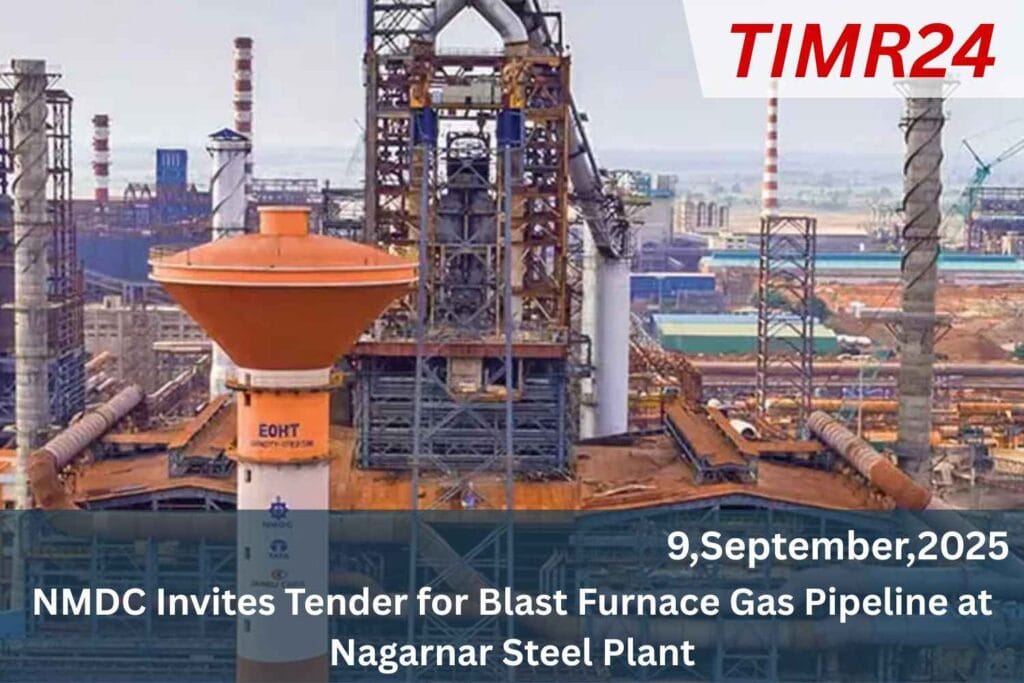
NMDC has launched a tender for the installation of a blast furnace gas pipeline, gas mixing station, and piping for the mixed gas heating system at its upcoming integrated steel plant in Nagarnar, Chhattisgarh. NMDC Limited, India’s largest iron ore producer and a key player in the country’s mining and steel sector, has invited tenders for the construction of a blast furnace gas (BFG) pipeline at its ambitious Nagarnar Steel Plant in Chhattisgarh, a project that has long been viewed as a cornerstone for India’s domestic steel growth and regional development in Bastar. This tender is not merely a procurement exercise but a strategic step in ensuring that the plant operates with.
World-class efficiency, sustainability, and alignment with India’s broader industrial goals. The Nagarnar Steel Plant (NSP) itself, conceived as a 3 million tonnes per annum integrated steel plant, is one of the largest greenfield steel projects undertaken by NMDC and has been designed to significantly reduce India’s dependence on steel imports while boosting local employment, industrial activity, and infrastructure in one of the most underdeveloped regions of the country. The addition of a blast furnace gas pipeline is central to this strategy because blast furnaces inherently generate large volumes of gas during the smelting of iron ore, and instead of wasting this by flaring.
NMDC is moving towards harnessing it as an alternative fuel source for power generation, reheating, and other auxiliary processes, thereby optimizing plant efficiency and reducing carbon emissions The project is highly significant when seen in the context of India’s National Steel Policy and the Atmanirbhar Bharat mission, both of which emphasize the need for self-reliant, energy-efficient, and environmentally responsible steel production. Similar to how (JNPA) to keep pace with global trade demands, NMDC’s move to introduce a BFG pipeline at Nagarnar signals how infrastructure expansion directly translates to higher efficiency and competitiveness.
It also places India on par with global steel producers that increasingly emphasize green steel initiatives, where by-products and emissions are repurposed into productive resources. The technical and commercial opportunities embedded in this tender are equally noteworthy; the call opens doors for engineering, procurement, and construction (EPC) firms with specialized expertise in gas pipeline construction, steel plant utilities, and industrial gas handling systems. Much like the opportunities created by (Port) NMDC’s pipeline tender will attract companies eager to establish a footprint in India’s expanding steel infrastructure.
The sustainability dimension of this tender deserves emphasis, especially at a time when the global steel industry is under scrutiny for its carbon footprint. Blast furnace gas reuse has been proven to reduce greenhouse gas emissions substantially, cutting reliance on external fuel sources while lowering costs. This mirrors initiatives across industries, such as which demonstrate how Indian companies are responding to environmental challenges with innovative resource management. For NMDC, the BFG pipeline not only enhances the efficiency of the Nagarnar Steel Plant but also represents a practical application of circular economy principles in heavy industry.
Setting an example for other state-owned and private enterprises in India From a policy perspective, this tender also aligns with India’s vision of becoming a 300 million tonnes steel-producing nation by 2030, a target that will only be achievable through technological adoption, cost reduction, and infrastructure expansion. Just strengthened India’s logistics competitiveness, NMDC’s move strengthens the backbone of the steel supply chain. Moreover, the Nagarnar project itself has been a point of regional pride, expected to transform Bastar’s socio-economic landscape by generating thousands of direct and indirect jobs, spurring local businesses, and creating new markets for goods and services.
The gas pipeline will accelerate this transformation by making operations more cost-efficient, ensuring that the plant can remain viable and profitable in the long term, even in the face of global market fluctuations An equally important aspect is how this tender contributes to energy security. By utilizing blast furnace gas, the plant reduces its dependency on external electricity or natural gas supplies, thereby stabilizing production costs and insulating itself from volatile energy prices. This mirrors how aimed at creating long-term stability in the energy sector. Furthermore, the use of by-product gas means that NMDC can allocate resources saved from energy procurement into other strategic investments.
Whether in technology upgrades, research and development, or workforce training, all of which collectively strengthen India’s steel sector The tender is also expected to attract interest from global EPC contractors who see India as a lucrative market for steel and infrastructure expansion. Just as international companies collaborated in NMDC’s tender will encourage partnerships that blend global expertise with local execution. Such collaborations often bring in advanced technologies, project management methodologies, and safety standards that benefit the entire ecosystem. The Nagarnar Steel Plant, through this tender, may well become a case study of how Indian state-owned.
Enterprises can integrate global best practices into domestic projects Another dimension of the tender is its potential to inspire other Indian steel plants to adopt similar pipelines, creating an industry-wide shift toward resource optimization and green manufacturing. This resonates with the SEMICON India 2025 event where India positioned itself as a global semiconductor hub by emphasizing sustainability and efficiency. Much like the semiconductor sector, steel too needs to innovate continually to remain competitive, and the BFG pipeline is an innovation that demonstrates foresight The socio-economic impacts for Bastar district cannot be overstated.
Located in a tribal-majority region that has historically lagged behind in industrial development, the Nagarnar Steel Plant is already viewed as a game-changer. By ensuring sustainable and efficient operations through the BFG pipeline, NMDC not only secures the future of the plant but also guarantees a steady inflow of ancillary industries, infrastructure projects, and skill development initiatives in the area. The ripple effects can be compared to the local transformation spurred by where a single infrastructure success story triggered regional growth and trade activity the NMDC tender for a blast furnace gas pipeline at the Nagarnar Steel Plant is not just a technical addition.
But a strategic move that intertwines industrial efficiency, sustainability, energy security, and socio-economic development. It demonstrates how India’s state-owned enterprises are responding to the dual challenge of meeting domestic steel demand while adhering to global sustainability standards. By inviting global and domestic EPC contractors to participate, NMDC sets the stage for technology transfer, innovation, and competitive bidding that will benefit the steel sector at large. The pipeline will ensure that the Nagarnar Steel Plant is not only a symbol of industrial pride but also a model of responsible, future-ready steel production. Much like which aim at systemic.
Improvements in transportation, this project underscores that long-term progress in infrastructure requires foresight, sustainability, and continuous innovation. With this tender, NMDC reaffirms its commitment to building a steel industry that is globally competitive, environmentally responsible, and deeply integrated with India’s broader developmental vision.
q1. What is the purpose of the NMDC tender at Nagarnar Steel Plant?
The tender is for setting up a blast furnace gas pipeline to utilize by-product gas for energy efficiency and steelmaking operations.
q2. Where is the Nagarnar Steel Plant located?
The plant is located in Bastar district, Chhattisgarh.
q3. How will the pipeline benefit the steel plant?
It will reduce energy costs, improve sustainability, and enhance production efficiency.
q4. Who can participate in the NMDC tender?
Engineering, procurement, and construction (EPC) firms with experience in gas pipeline projects are eligible.
q5. How does this tender support India’s steel industry goals?
It aligns with India’s National Steel Policy and Atmanirbhar Bharat vision by promoting efficient, self-reliant, and eco-friendly steel production.