













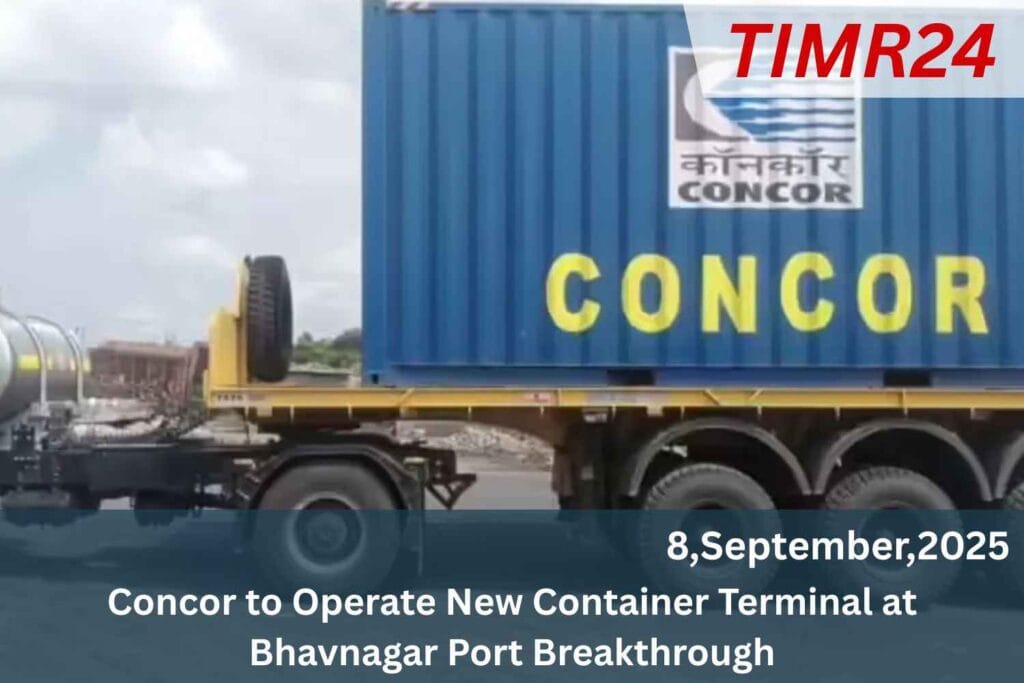
The Container Corporation of India (Concor) has signed a Memorandum of Understanding (MoU) with Bhavnagar Port Infrastructure (BPIPL) to operate and maintain a new container terminal in Bhavnagar Port, Gujarat. Concor will oversee operations, management, and marketing of the facility, aligning with its goal of forward integration in the logistics value chain. The terminal is expected to serve the logistics needs of Central Gujarat, the Dholera Industrial Belt, and the National Capital Region. Concor, a key player in India’s logistics sector, also manages air cargo complexes and co-facility facilities. The announcement that the Container Corporation of India (Concor) will operate.
The new container terminal at Bhavnagar Port marks a major milestone in India’s logistics and maritime growth. Concor, a pioneer in multimodal logistics, has long been recognized for its network of inland container depots and rail-linked facilities. With this new role, the company is deepening its presence in coastal logistics, creating a direct impact on Gujarat’s economic growth. The move also aligns with India’s broader strategy to strengthen its coastal trade infrastructure under Bhavnagar Port has historically played a significant role in Gujarat’s maritime ecosystem. Located along the Gulf of Khambhat, it has been a hub for ship recycling, salt exports, and regional coastal trade.
Boost to Regional Trade and Exports
The establishment of a modern container terminal here adds a new dimension to its capabilities, making it a competitive player alongside bigger ports like Mundra and Pipavav. By diverting containerized cargo to Bhavnagar, the government and Concor are reducing the pressure on major ports and creating more balanced trade flows. This is similar to the expansion seen at where container capacity has doubled to manage rising trade volumes. The operationalization of Bhavnagar’s container terminal is expected to significantly benefit industries in Gujarat’s hinterland. Textile manufacturers in Surat, ceramic clusters in Morbi, chemical plants in Dahej, and agriculture.
Producers across Saurashtra will have a closer and more cost-effective outlet for exports. Currently, many exporters rely on distant ports, increasing transportation costs and transit times. With Bhavnagar as a direct gateway, cargo will move faster, reducing logistics costs and improving international competitiveness. This development also complements India’s Make in India initiative, enabling local manufacturers to access global markets more efficiently. Similar benefits have been noted which provided industries with alternate shipping routes Concor’s involvement is not limited to port operations; its strength lies in integrating rail, road, and shipping networks into a seamless logistics.
Chain The company operates over 60 inland container depots across India and has strong connectivity with the Delhi-Mumbai Industrial Corridor (DMIC). By linking Bhavnagar to this corridor, Concor will provide exporters in northern and western India with an additional maritime exit point (Port) This multimodal integration will ensure faster cargo movement, reduce congestion on road networks, and improve overall efficiency. The strategy reflects the government’s PM GatiShakti Master Plan vision of synchronized infrastructure development.
Alignment with National Infrastructure Vision
India’s logistics sector is undergoing rapid modernization, with port-led development being a key priority. The Sagarmala Programme emphasizes coastal shipping, industrial clusters near ports, and reduced logistics costs. By assigning Concor to Bhavnagar, the government is reinforcing the vision of creating multiple gateways for exports, thereby boosting the country’s competitiveness in global trade. In addition, the PM GatiShakti initiative integrates ports, highways, airports, and industrial zones into a single planning grid. Bhavnagar’s new terminal fits into this vision, bridging the gap between Gujarat’s hinterland industries and global shipping lanes. This breakthrough is comparable to.
The large-scale infrastructure boost witnessed in, where connectivity and efficiency were at the core of planning The new container terminal will have a direct and indirect economic impact on Gujarat and the wider region. The port will generate employment opportunities in cargo handling, warehousing, transportation, and allied services. In addition, value-added facilities such as cold chain logistics, container freight stations, and bonded warehouses are expected to develop around the port. Such an ecosystem attracts private investments and strengthens the overall supply chain. Local businesses will benefit from reduced dependency on larger ports, and smaller exporters will gain easier access to international trade, improving their profit margins.
Environmental and Sustainability Angle
Modern container terminals are increasingly designed with sustainability in mind. The Bhavnagar terminal, operated under Concor, is expected to deploy energy-efficient cargo handling systems and adopt digital solutions for reducing paperwork and turnaround times. Reducing road dependency and shifting cargo to rail-linked solutions will also cut down carbon emissions. This aligns with India’s broader environmental commitments and mirrors similar steps taken by companies such as The port’s eco-friendly design will not only reduce environmental pressure but also attract global clients who prioritize green logistics in their supply chains With its new container terminal, Bhavnagar will position.
Itself as a competitive alternative to nearby ports. While Mundra and Pipavav continue to dominate, Bhavnagar offers proximity advantages for certain industrial clusters. The Concor brand also brings credibility, ensuring global shipping lines and exporters trust the port’s efficiency. Over time, this competitiveness could reshape cargo flows in western India, creating a more diversified and resilient logistics network Looking ahead, Bhavnagar Port’s expansion under Concor may pave the way for additional infrastructure investments. Industrial parks, special economic zones, and logistics hubs could emerge around the port, creating a self-sustaining ecosystem. The port is also expected to improve coastal shipping within India.
Connecting to ports in Maharashtra, Goa, and southern states, reducing dependency on road transport. Over time, Bhavnagar could evolve into a regional hub for not just exports but also import-driven industries that rely on efficient supply chain The decision to hand over operations of Bhavnagar Port’s new container terminal to Concor is more than a routine administrative move; it represents a significant step in India’s logistics transformation. By combining port efficiency with inland connectivity, the project will reduce costs, improve (Sagarmala Programme) export competitiveness, and create new opportunities for businesses across Gujarat and beyond.
Q1. What is the significance of Concor operating Bhavnagar Port’s new terminal?
The operation will enhance trade efficiency, logistics capacity, and Gujarat’s maritime growth.
Q2. How will this terminal benefit exporters and importers?
It will reduce logistics costs, improve cargo handling, and provide faster shipping connectivity.
Q3. When will the Bhavnagar container terminal become operational?
The terminal is expected to be operational soon, aligned with Concor’s expansion plans.
Q4. Which industries will gain the most from this development?
Chemical, textile, agricultural, and manufacturing sectors in Gujarat will see direct benefits.
Q5. How does this project align with India’s maritime vision?
It supports Sagarmala and PM GatiShakti initiatives, driving port-led development.