

















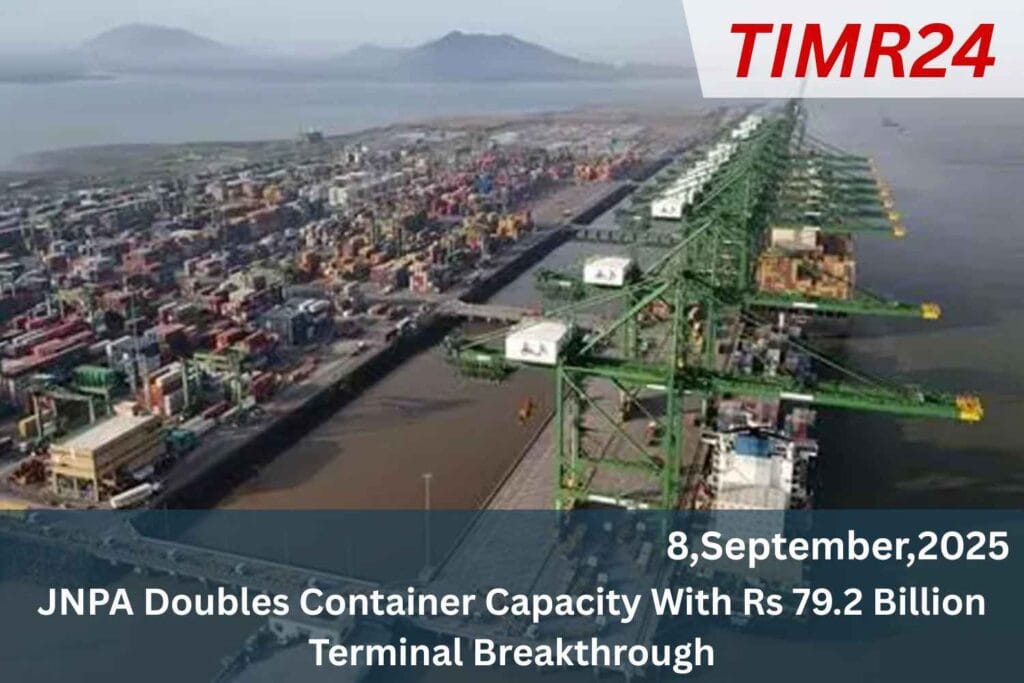
India’s Prime Minister Narendra Modi and Singaporean Prime Minister Lawrence Wong inaugurated the second phase of the PSA Bharat Mumbai Container Terminal (BMCT) at Jawaharlal Nehru Port Authority (JNPA), doubling its handling capacity from 2.4 million TEUs to 4.8 million TEUs. The Rs 79.2 billion project, developed under a 30-year public-private partnership between JNPA and PSA International, marks the largest single foreign direct investment (FDI) in India’s port sector to date. The terminal was completed ahead of schedule, and the expansion is expected to elevate Maharashtra’s position in the maritime sector. The Jawaharlal Nehru Port Authority (JNPA), India’s busiest.
Container port, has taken a historic step forward by doubling its container handling capacity with the commissioning of a Rs 79.2 billion terminal project. This breakthrough expansion marks a turning point for India’s maritime sector, setting the stage for greater efficiency in global trade while advancing the country’s long-term infrastructure and logistics vision. Located in Navi Mumbai, JNPA has always been a vital link between Indian exporters and international markets, but the latest development transforms it into an even more competitive player in the shipping.
Industry This move not only boosts the port’s handling power but also strengthens India’s ambition of becoming a leading hub for global maritime commerce under the government’s Sagarmala initiative The importance of JNPA in India’s economic journey cannot be overstated. It already handles a significant share of India’s containerized cargo, supporting industries across manufacturing, pharmaceuticals, automotive, textiles, and FMCG. With the new terminal coming online, JNPA reduces India’s reliance on foreign transshipment hubs like Colombo, Singapore, and Dubai, allowing Indian goods to move more directly to global destinations. According to the (Ministry of Ports) strengthening.
Domestic ports like JNPA is critical to cutting logistics costs and boosting export competitiveness. The Rs 79.2 billion investment also reflects how public-private partnerships and long-term policy support are reshaping India’s infrastructure growth story A deeper look at the operational upgrades shows that the new terminal is designed with state-of-the-art technologies for cargo management and vessel handling. Faster clearance procedures, AI-driven scheduling, and smart automation make it possible to reduce turnaround times for ships, ensuring that cargo spends less time idling at the port. This is a big win for exporters in Maharashtra, Gujarat, and even landlocked northern.
States who depend on seamless logistics chains. The reduction in delays directly translates into cost savings and improved reliability for businesses trading with markets in Europe, Africa, the Middle East, and Southeast Asia. For those interested in global benchmarks illustrates how such upgrades help nations climb higher in trade efficiency rankings What makes the JNPA expansion even more noteworthy is its emphasis on sustainability. Ports have traditionally faced criticism for contributing to pollution and congestion, but JNPA has placed green growth at the core of its strategy. The new terminal integrates electrified cranes, energy-efficient equipment, and digitized processes to.
Lower carbon emissions These steps resonate with India’s larger commitment to net-zero goals by 2070 and the growing expectation from global shipping lines for environmentally responsible port operations. Reports from (UNCTAD) highlight how future-ready ports worldwide are prioritizing sustainability, and JNPA’s move aligns perfectly with these global trends. By balancing growth with ecological care, the port strengthens its long-term resilience. Another major dimension of the breakthrough is its alignment with the Sagarmala initiative. Launched by the Government of India, Sagarmala aims to modernize port infrastructure, improve connectivity, and develop coastal.
Economic zones that can fuel trade and manufacturing. JNPA’s expansion directly supports this vision by providing world-class facilities and reducing logistics bottlenecks. It also links with multimodal transport networks, including dedicated freight corridors and inland waterways, ensuring that goods move more efficiently between ports, production centers, and consumer markets. More details about the policy can be found on. By integrating seamlessly with these national projects, JNPA positions itself as a cornerstone of India’s economic transformation The impact on industries will be wide-ranging. For the automotive sector, which relies heavily on exports to Europe and Africa.
The ability to move vehicles and components faster will enhance global competitiveness. Pharmaceutical companies shipping life-saving drugs will benefit from reliable turnaround times that reduce risks of delay. Textiles, chemicals, electronics, and FMCG products will also see cost efficiencies as container availability improves. Moreover, this capacity upgrade makes JNPA more attractive for major global shipping lines, encouraging them to increase direct services to India, which reduces dependency on transshipment hubs This development also creates ripple effects across employment, skill development, and regional economic activity. The port expansion will generate new.
Opportunities for logistics professionals, shipping agents, and service providers while boosting ancillary industries such as warehousing, packaging, and transportation. For example, the government has consistently emphasized how ports can be hubs of local development, and JNPA’s move mirrors the growth seen in projects like the Together, these expansions show a broader trend of India preparing for the future of global trade through resilient port infrastructure From a global perspective, doubling capacity at JNPA is not just about serving Indian industries but also about positioning India as a strategic hub in international supply chains. The disruptions caused by the COVID-19 pandemic and geopolitical.
Tensions have forced many global players to rethink their sourcing and shipping strategies. Ports that can guarantee efficiency, reliability, and sustainability will become preferred gateways for international trade. JNPA, with its upgraded capacity, smart systems, and eco-friendly approach, is well-placed to seize this opportunity The expansion also encourages stronger integration between JNPA and India’s industrial corridors, such as the Delhi-Mumbai Industrial Corridor (DMIC). Improved port facilities mean that large-scale manufacturers setting up in these regions can rely on smoother export pathways. This will play a crucial role in attracting foreign direct investment (FDI), as.
Global companies often factor logistics infrastructure into their decision-making when selecting new production bases. Internal connections to projects like show how interconnected infrastructure improvements strengthen the national growth ecosystem In terms of digitalization, JNPA’s new terminal reflects a global shift towards smart ports. Automation, blockchain-enabled trade documentation, and integrated tracking systems enhance transparency and reduce human error. This directly benefits customs clearance processes and strengthens India’s fight against logistical inefficiencies. The adoption of such cutting-edge solutions keeps JNPA competitive against international.
Peers like Singapore, Rotterdam, and Shanghai Looking forward, the Rs 79.2 billion breakthrough is not an isolated milestone but part of a larger journey. JNPA will continue to evolve with further expansions, digitization, and connectivity projects that complement India’s rise as a manufacturing and trade powerhouse. The success of this terminal is a reminder that ports are more than just gateways for cargo they are engines of growth that support industries, generate employment, and connect India to the world the doubling of container capacity at JNPA is a story of ambition, execution, and vision. It highlights how India is not only keeping pace with global trade.
Q1. What is the significance of JNPA’s new terminal expansion?
The Rs 79.2 billion expansion doubles container handling capacity, making JNPA a stronger player in global shipping and logistics.
Q2. How will the terminal benefit India’s trade sector?
It reduces vessel turnaround time, supports faster cargo movement, and strengthens export-import operations.
Q3. Does the expansion support sustainability?
Yes, JNPA’s new terminal incorporates green practices and advanced digital solutions to reduce its environmental footprint.
Q4. How does this project fit into India’s Sagarmala initiative?
It aligns with the government’s vision of building world-class ports to boost maritime trade and logistics infrastructure.
Q5. Which industries will benefit the most from JNPA’s expansion?
Manufacturing, automotive, textiles, and FMCG sectors will see smoother trade flows and reduced logistics costs.