


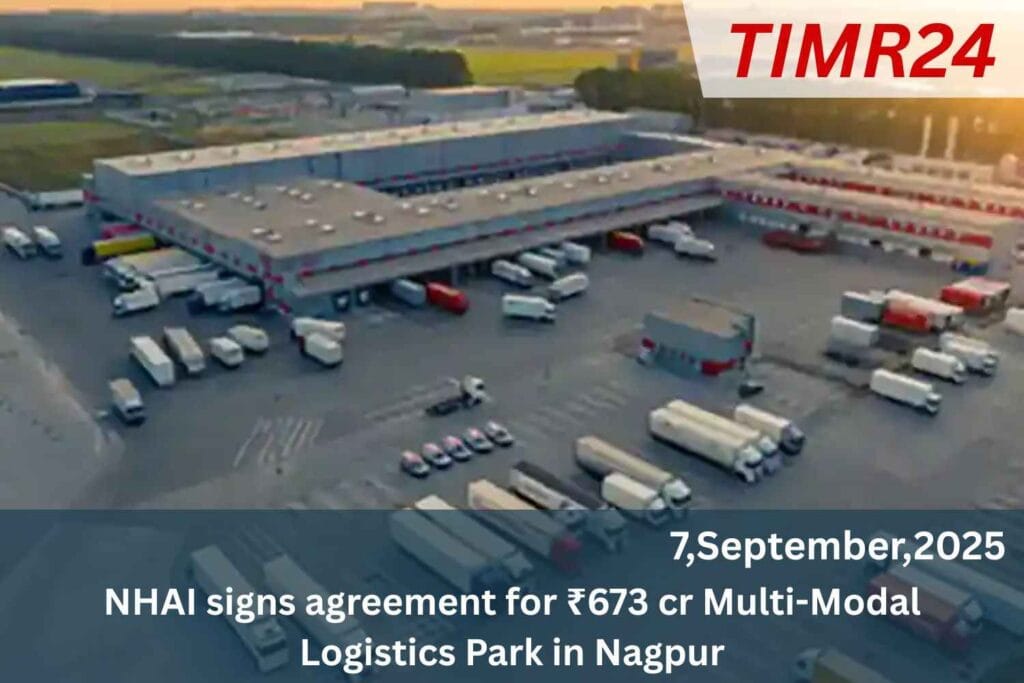
The National Highways Authority of India (NHAI) has partnered with Delta Bulk Shipping India to develop a 150-acre Multi-Modal Logistics Park in Nagpur, marking the first MMLP in Maharashtra under the PM Gati Shakti National Master Plan, with a government investment of ₹50,000 crore. The National Highways Authority of India (NHAI) has recently taken a significant step towards strengthening India’s logistics and transportation infrastructure by signing an agreement to develop a ₹673 crore Multi-Modal Logistics Park (MMLP) in Nagpur, Maharashtra. This initiative represents one of the largest and most strategically important logistics projects in the region and is being implemented.
Under the guidance of the PM Gati Shakti National Master Plan, which aims to enhance multimodal connectivity across India. The MMLP in Nagpur will be executed in collaboration with DC Multi Modal Park (Nagpur) Limited, a Special Purpose Vehicle (SPV) formed by Delta Bulk Shipping India Pvt. Ltd., bringing together public and private sector expertise to develop a comprehensive logistics hub (MSRDC) The strategic location of the park, in Sindi near Wadha district, has been selected to optimize connectivity to both road and rail networks. The park is situated approximately 3 km from the Nagpur–Mumbai Maha-Samruddhi Mahamari, which forms part of India’s national highway network.
As well as being close to the Howrah–Nagpur–Mumbai rail line, enabling seamless transfer of goods between various modes of transport. This integration of multiple transportation channels is central to the concept of a Multi-Modal Logistics Park and reflects the government’s vision of reducing logistics costs and improving supply chain efficiency nationwide The development of the Nagpur MMLP will occur in three distinct phases, with the first phase requiring an investment of ₹137 crore and targeted for completion within the next two years. The phased approach has been adopted to ensure that the infrastructure is scalable and can accommodate increasing freight volumes over time.
By the completion of all three phases, the park is expected to handle around 9.47 million metric tonnes of cargo over a 45-year horizon. This capacity will not only cater to the industrial zones within Nagpur but also extend its benefits to surrounding districts such as Wardha, Chandrapur, and Gondiya. By facilitating more efficient movement of goods, the park is set to stimulate local industries, encourage new business investments, and generate employment opportunities for both skilled and semi-skilled workers in logistics, warehousing, and transportation sectors. The economic impact of such a large-scale infrastructure project is anticipated to be transformative, positioning Nagpur as a central hub for industrial and commercial activities in central India.
The MMLP will be equipped with world-class facilities to meet modern logistics requirements. These will include expansive warehousing complexes capable of accommodating bulk cargo and break-bulk consignments, cold storage units for perishable goods, intermodal transfer terminals for efficient handling between rail, road, and possibly air freight, and container handling facilities. Additional features will comprise bonded warehouses, customs clearance facilities, and offices for freight forwarders and transporters, ensuring that the park functions as a self-contained logistics ecosystem. Such comprehensive infrastructure is designed to reduce transit times.
Improve cargo handling efficiency, and lower freight costs. This approach aligns with the government’s broader goals to make Indian logistics globally competitive and attract foreign and domestic investment in the sector. The park will also incorporate technological innovations such as real-time tracking systems, automated cargo handling equipment, and digitized warehouse management, contributing to more sustainable and reliable logistics operations One of the most significant benefits of the MMLP is its potential to generate employment and foster skill development in the region. Beyond the direct employment of workers for construction, operations, and administration.
The park is expected to create a ripple effect in related industries, including transportation, packaging, supply chain services, and local manufacturing. Educational and vocational training programs are likely to emerge in tandem with the development to provide a skilled workforce capable of managing the park’s advanced logistics operations. This integrated development approach is expected to catalyze economic growth in the Vidarbha region, attracting ancillary businesses such as transport companies, warehouses, cold chain operators, and service providers, which will collectively enhance the region’s economic ecosystem.
From a national perspective, the Nagpur MMLP is part of a larger effort to establish 35 multi-modal logistics parks across India under the Bharatmala Project, aimed at transforming the logistics sector through the creation of hubs strategically located to improve connectivity between production centers, consumption hubs, and export gateways. The park exemplifies the government’s efforts to optimize freight corridors, reduce dependency on road transport alone, and minimize environmental impact through modal shifts. By leveraging rail and road connectivity, the MMLP is expected to reduce carbon emissions associated with cargo transport, aligning with India’s commitment to.
Sustainable infrastructure development. The project’s integration with the PM Gati Shakti initiative highlights the government’s emphasis on coordinated planning across highways, railways, ports, and urban infrastructure to ensure efficient movement of goods The implementation of the MMLP in Nagpur will also have implications for regional industrial clusters. Industries in Nagpur and adjoining districts often face challenges in transporting raw materials and finished goods efficiently, leading to higher logistics costs and delayed supply chains. The presence of a state-of-the-art logistics park is expected to mitigate these challenges by providing centralized warehousing, consolidation, and distribution points.
Companies operating in sectors such as textiles, manufacturing, automotive, agriculture, and food processing will directly benefit from the availability of cold storage, bonded warehousing, and customs clearance facilities. The park will enable businesses to optimize inventory management, reduce lead times, and expand market reach, thereby enhancing competitiveness and profitability the ₹673 crore Multi-Modal Logistics Park in Nagpur signifies a landmark development in India’s logistics infrastructure landscape. With its strategic location, comprehensive facilities, and phased development model, the park is set to enhance connectivity, reduce logistics costs, create employment, and stimulate economic growth in central India.
As part of a broader national vision under PM Gati Shakti and Bharatmala, this MMLP represents a model for modern, integrated logistics solutions capable of meeting the growing demands of domestic and international trade. Its successful execution will not only position Nagpur as a central logistics hub but (NHAI) will also contribute to India’s long-term economic growth and sustainability goals, making it a cornerstone in the nation’s journey towards efficient, multimodal transportation networks.