
















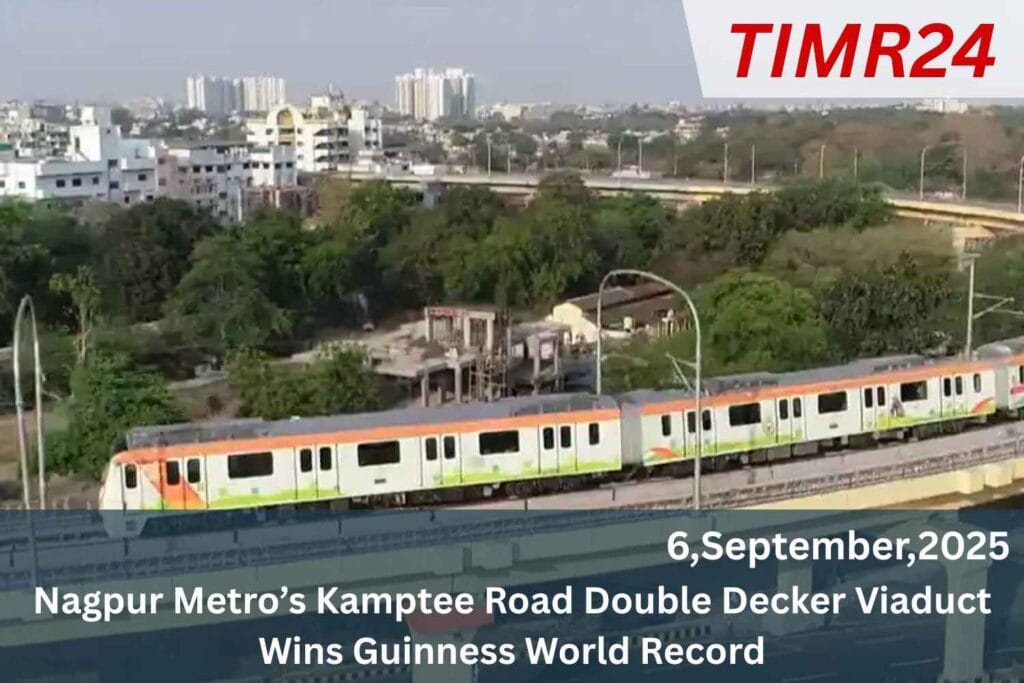
MahaMetro’s Kamptee Road Double Decker Viaduct in Nagpur has been certified as the world’s longest in the metro category by Guinness World Records, following a rigorous eight-month evaluation and verification process. The project was shortlisted for recognition. Nagpur, often called the “Orange City,” has once again made its mark on the global stage with the Nagpur Metro’s Kamptee Road Double Decker Viaduct, which has officially entered the Guinness World Records as the longest structure of its kind. Stretching over 3.14 kilometres, this engineering marvel is more than just an achievement for Nagpur it is a symbol of India’s growing strength in innovative.
Infrastructure and sustainable urban transport. The record-breaking viaduct carries the metro rail on the upper deck while simultaneously accommodating a four-lane highway on the lower deck, creating a space-saving, cost-effective, and future-ready solution for urban mobility. To truly understand the significance of this milestone, it is important to explore the various aspects of its design, engineering, impact on the city, and the broader implications for India’s transport sector. At the heart of this achievement lies the concept of maximizing limited urban space, a challenge that growing cities across India constantly face. The decision to build a double-decker viaduct along Kamptee Road, one of the busiest
stretches of Nagpur, was born out of the need to provide efficient metro connectivity while simultaneously easing the burden on road infrastructure. Instead of acquiring vast tracts of land for two separate projects, the design merged the metro and the highway into one seamless structure, proving that necessity truly drives innovation. This decision has reduced not only land acquisition costs but also the environmental impact, since fewer resources were consumed compared to building two standalone corridors. Readers can also explore similar success stories in (Metro Expansion) where innovations are reshaping urban landscapes nationwide.
Engineering such a massive structure required precision, skill, and collaboration across multiple agencies. The project was executed under the guidance of MahaMetro, which has already gained recognition for delivering metro projects on time with high standards of quality. The viaduct’s design demanded cutting-edge techniques in construction, including pre-cast segments, special bearings to manage load distribution, and innovative safety features to ensure both metro commuters and road users travel without risks. What makes the achievement even. more notable is that despite the challenges posed by urban density, traffic management, and even pandemic-related.
Disruptions, the viaduct was completed within deadlines. To understand the broader role of technology in metro systems, readers can refer to which highlights how engineering feats transform mobility in Indian cities The impact of this viaduct on Nagpur’s daily life is already visible. For road users, the lower deck has significantly eased traffic congestion on Kamptee Road, which earlier struggled with bottlenecks during peak hours. On the upper deck, the Nagpur Metro offers a fast, eco-friendly, and affordable commuting option that connects key points of the city efficiently. This dual-use infrastructure has thus multiplied the benefits for citizens, who now experience reduced.
Travel time, enhanced safety, and smoother connectivity. Moreover, the viaduct stands as a symbol of pride for the people of Nagpur, who see their city emerging as a Smart City model for others to follow. Those interested in learning more about related developments can check updates on (Nagpur Projects) where similar transformations are underway Recognition from Guinness World Records adds a global dimension to this achievement. It is not simply about creating the longest double-decker viaduct but about showing the world that Indian infrastructure is capable of setting international benchmarks. For young engineers, architects, and city planners.
The viaduct represents a case study in innovation efficiency, and bold decision-making. It has sparked discussions across India on replicating such projects in cities like Pune, Bengaluru, and Mumbai, where limited urban land and rising populations demand unconventional solutions. This recognition also strengthens India’s reputation as a hub of infrastructure excellence, similar to how the Delhi Metro revolutionized urban travel years ago. For context, one can explore the section to see how cities are adopting innovative strategies for mobility. The project also carries immense symbolic weight for Nagpur itself. As the geographical center of India.
Nagpur is often seen as a testing ground for pilot projects and innovative ideas, and the success of the Kamptee Road viaduct only cements this reputation further. It signals to policymakers that smaller Tier-2 cities can also deliver world-class infrastructure, not just the metropolitan giants. This achievement further enhances Nagpur’s profile as a Smart City, complementing other initiatives in renewable energy, traffic management, and digital services. Readers may dive deeper into see how urban centers are blending tradition with technology to redefine city living Looking beyond the immediate benefits, the viaduct represents a broader shift toward sustainable infrastructure.
With rising concerns about climate change and air quality, cities cannot afford to expand road networks without integrating greener alternatives like metro rail. By stacking the metro above the highway, the viaduct provides a blueprint for combining sustainability with practicality. This is especially relevant in the context of India’s commitment to reducing carbon emissions, as efficient public transport can significantly cut dependence on private vehicles. For a larger perspective on government policies shaping such projects, readers can consult section, where policy frameworks and green mobility are discussed. Globally, very few countries have attempted similar double-decker.
Designs, which makes Nagpur’s success all the more remarkable. The viaduct is now a case study that will likely be referred to by global infrastructure think tanks, universities, and policy forums. The fact that it has found a place in the Guinness World Records ensures that it will remain a reference point for years to come, inspiring cities around the world to think beyond traditional infrastructure models. This recognition brings immense prestige not only to Nagpur but also to India, showcasing how the country is no longer merely catching up with global standards but is setting them the story of the Kamptee Road Double Decker Viaduct is also about people the engineers, planners.
Workers, and citizens who believed in the project and contributed to its realization It highlights how ambition, when paired with vision and collaboration, can turn even the most complex ideas into reality. The viaduct stands not just as a bridge of steel and concrete but as a bridge to a future where Indian cities are smarter, more sustainable, and globally admired. For those who wish to stay updated on similar breakthroughs provides more stories of how India continues to shine on the world stage.
Q1. What Guinness World Record did Nagpur Metro achieve?
Nagpur Metro’s Kamptee Road double-decker viaduct has been recognized as the longest double-decker viaduct by Guinness World Records.
Q2. Why is the double-decker viaduct significant?
It combines metro and highway infrastructure on a single structure, saving space, cost, and time, making it a unique engineering feat.
Q3. How long is the Kamptee Road double-decker viaduct?
The viaduct stretches nearly 3.14 km, integrating metro rail above and road transport below.
Q4. Which organizations were involved in its construction?
MahaMetro collaborated with top engineering firms and government authorities to complete this project.
Q5. How does this project benefit Nagpur city?
It improves urban mobility, reduces congestion, and sets a model for future infrastructure projects in India.