










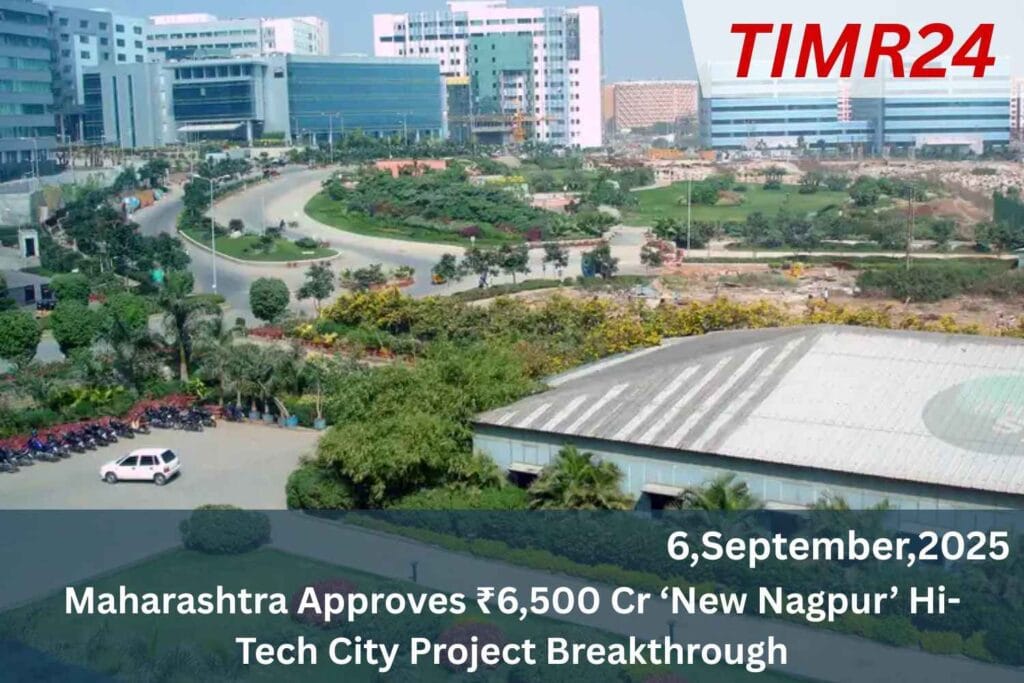
The Maharashtra Cabinet Approves has approved the ₹6,500-crore ‘New Nagpur’ project, a futuristic hi-tech city in Hengan taluka, to transform the region into a major business hub. The project, spanning 692.06 hectares, will feature an International Business and Finance Centre, an IBFC, and stamp duty waivers. Maharashtra has taken a decisive step towards reshaping its economic and technological landscape by approving the ₹6,500 crore New Nagpur Hi-Tech City Project, a futuristic initiative designed to transform Nagpur into a global innovation hub. This mega development signals not just urban expansion but a structural shift in how Vidarbha positions itself in the national growth story.
The government’s intent is clear: combine technology, infrastructure, and sustainability to build a city that will rival established tech corridors like Bengaluru’s Electronic City or Hyderabad’s HITEC City. By drawing inspiration from successful models yet adapting them to local strengths, New Nagpur is set to be a cornerstone in Maharashtra’s long-term vision. For context, you can also read about the (Pune Metro) which represents another ambitious infrastructure project that aims to enhance urban mobility while driving regional development At the heart of this project lies Nagpur’s strategic advantage. Located centrally in India, Nagpur is often called the Zero Mile City.
Making it ideal for logistics, IT services, and connectivity-led industries. With the presence of institutions like IIM Nagpur and AIIMS Nagpur, the city already has an educational and healthcare backbone, but the Hi-Tech City will add another layer of dynamism by integrating research, digital infrastructure, and industrial clusters. This positioning is expected to mirror the success of which has been central to India’s economic corridors policy. What makes Nagpur unique is its ability to merge logistics with digital technology, thus creating a fertile ground for AI-powered warehouses, fintech startups, and global IT outsourcing companies The core features of the New Nagpur Hi-Tech.
water conservation and eco-friendly
City revolve around cutting-edge infrastructure and sustainability. Business parks will be designed with energy-efficient green buildings, data centers will ensure high-speed connectivity, and AI-enabled transport systems will redefine mobility. Drawing lessons from the project ensures that environmental responsibility is not side-lined. Renewable energy sources like solar power will drive operations, while waste-to-energy plants will help manage urban waste responsibly. A strong emphasis on water conservation and eco-friendly construction materials will further highlight the project’s sustainability goals. Readers interested in similar eco-friendly projects can look at the (NHAI’s) which show how infrastructure and green goals can align.
From an economic standpoint, the ₹6,500 crore investment has the potential to trigger a ripple effect across multiple industries. The project is expected to generate tens of thousands of direct jobs in IT, finance, and manufacturing, while indirect employment will benefit local service providers, construction workers, and ancillary industries. As seen in our coverage large-scale investments do not just create physical assets but stimulate regional economies by attracting new businesses. Nagpur’s local population, particularly its youth, will find opportunities in startups, global firms, and research institutions, reducing migration to metros like Mumbai or Pune.
This balanced regional growth will also align with India’s which encourages local manufacturing and employment. In terms of priority sectors, the Hi-Tech City will focus on IT services, AI research, fintech, biotechnology, renewable energy, and logistics. These sectors were carefully chosen to ensure resilience and alignment with global trends. For example, fintech and AI are projected to be among the fastest-growing industries worldwide, and Maharashtra wants Nagpur to be an early adopter. Similarly, renewable energy facilities will not only make the city eco-friendly but also provide opportunities for startups in clean tech. To compare approved by the Cabinet reflects India’s broader shift toward self-reliance in futuristic industries.
Another fascinating aspect of the New Nagpur Hi-Tech City is its potential to attract global investments. The Maharashtra government is actively pitching the project to foreign investors, encouraging them to set up research centers, global capability hubs, and IT campuses. Given that cities like Hyderabad and Pune have already attracted multinational corporations, Nagpur will benefit from being the next frontier of growth. This is also aligned with India’s which seeks to position the nation as a digital superpower. In addition, improved connectivity through will make commuting easier for employees and strengthen the city’s appeal to global talent pools.
Sustainability and smart living will be another pillar of this project. Housing in the Hi-Tech City will be designed to be affordable yet technologically enabled, with smart meters, integrated transport apps, and e-governance facilities. AI-driven traffic management will reduce congestion, while EV charging stations will encourage the adoption of electric vehicles. This balanced approach ensures that while the project pursues technological advancement, it remains inclusive for common citizens. Readers may also compare this with our feature on which highlights how planning and policy shape modern city living.
Perhaps the most important long-term impact of the project will be its ability to redefine Vidarbha’s image. For decades, this region was associated mainly with agriculture and resource-based industries. The New Nagpur Hi-Tech City aims to break that stereotype, putting Vidarbha on the map as a destination for high-value industries. This shift is not only about economic growth but also about social transformation creating opportunities for women in IT, encouraging startups by young entrepreneurs, and fostering a research-oriented culture. Much like how Gujarat’s GIFT City reshaped Gandhinagar into a financial hub, New Nagpur has the potential to create a legacy for Maharashtra.
In conclusion, the ₹6,500 crore New Nagpur Hi-Tech City Project is more than just a construction plan; it is a blueprint for the future of urban India. By weaving together technology, sustainability, investment, and social transformation, it reflects both local aspirations and global ambitions. Nagpur’s central location, combined with strong government support and investor interest, makes this project uniquely positioned for success. As India moves forward with projects like the role of cities like Nagpur will only become more significant. Ultimately, this project will not only transform Vidarbha but also contribute to India’s journey toward becoming a global economic powerhouse.
Q1. What is the New Nagpur Hi-Tech City Project?
It is a ₹6,500 crore project to develop a state-of-the-art hi-tech city in Nagpur, Maharashtra, focusing on IT, startups, and global investment.
Q2. Who is funding the New Nagpur project?
The Maharashtra government is leading the project with private sector participation and potential international investment.
Q3. How will Nagpur benefit from this project?
The city will gain advanced infrastructure, global business opportunities, thousands of jobs, and a stronger IT ecosystem.
Q4. What sectors will be prioritized in the New Nagpur Hi-Tech City?
IT, AI, fintech, renewable energy, data centers, and advanced manufacturing will be the main focus areas.
Q5. When will the project be completed?
The timeline is expected to span 5–7 years, with phased development to attract early investors and businesses.