














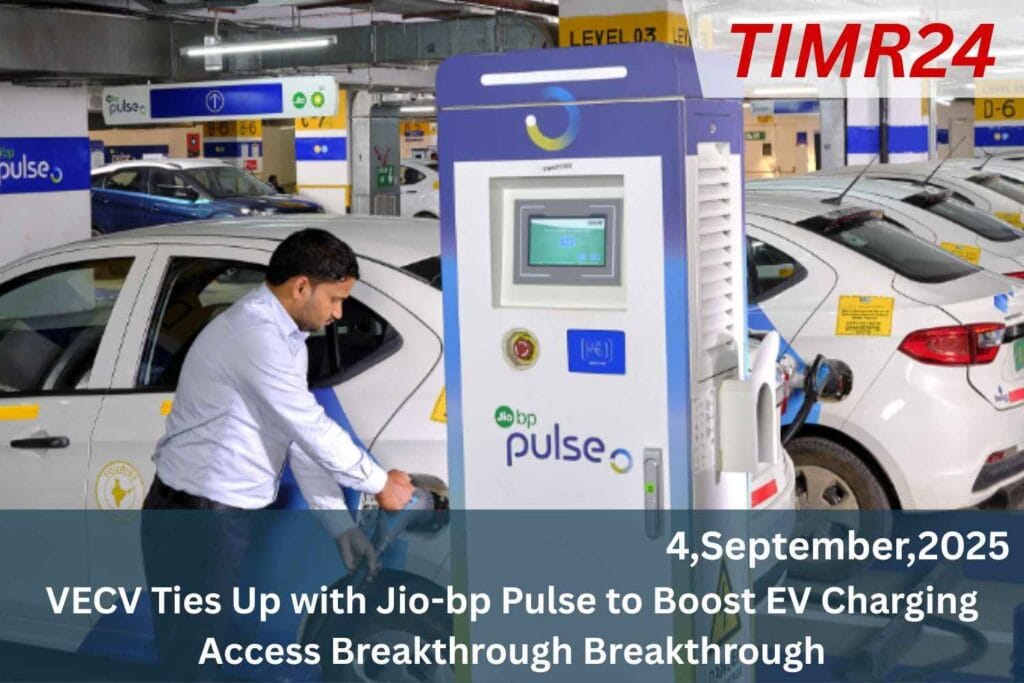
VE Commercial Vehicles (VECV), a subsidiary of Volvo Group-Eicher Motors JV, has signed an MoU with Jio-bp pulse to offer electric truck and bus customers seamless charging access. The partnership will connect Eicher EVs to Jio-bp’s 6,000+ DC fast-charging points across cities, highways, and EV hubs. The collaboration will also integrate charger discoverability into the My Eicher app, providing fleet operators with real-time visibility of charging locations. This partnership aims to accelerate the transition to zero-emission logistics in India. India’s electric mobility revolution is gathering speed, and collaborations between key industry players are shaping its trajectory.
One such milestone development is the strategic partnership between VE Commercial Vehicles (VECV) and Jio-bp Pulse, aimed at enhancing electric vehicle charging accessibility across the country. This move signifies more than just a corporate tie-up; it represents a breakthrough in sustainable mobility (Make in India) ensuring that commercial and passenger EVs can rely on a robust and reliable charging infrastructure. As the country pushes towards decarbonization and net-zero targets, alliances like this will determine how fast and efficiently the transition happens. To understand the broader sustainability journey, you can also read our feature on.
The Role of EV Charging in India’s Transition
One of the biggest hurdles in EV adoption remains the availability of charging points. While the growth in passenger EVs is visible in urban clusters, commercial vehicles require long-haul solutions and high-power charging options on highways, logistic parks, and industrial hubs. Without such infrastructure, fleet operators face operational bottlenecks and potential downtime. The partnership between VECV and Jio-bp Pulse aims to solve this problem by creating an ecosystem where charging is no longer a concern, thereby removing range anxiety for commercial operators. This development mirrors the broader infrastructural transformation we also covered in where connectivity investments go hand in hand with sustainability efforts.
VECV, a joint venture between Volvo Group and Eicher Motors, has consistently been at the forefront of innovation in the commercial vehicle segment. With its emphasis on reliability, efficiency, and cutting-edge engineering, VECV has been gradually integrating electric technology into buses and trucks, positioning itself as a leader in sustainable transport solutions. Its collaboration with Jio-bp Pulse goes beyond mere convenience; it reflects a broader vision of building an ecosystem where EVs are not just manufactured but also effectively operated with accessible charging solutions. The company’s forward-looking approach complements India’s evolving EV policy and ensures that its customers can embrace cleaner technologies without worrying about support infrastructure.
Jio-bp Pulse Powering the EV Revolution
Jio-bp Pulse, the energy joint venture between Reliance Industries Limited and bp, has already established itself as a prominent player in India’s EV charging segment. Known for its digital-first solutions, Jio-bp Pulse offers users real-time updates on the availability and status of chargers through its mobile app, making the charging experience seamless. With this collaboration, Jio-bp Pulse is expected to scale its reach across major transport corridors, industrial belts, and urban mobility hubs, ensuring that both passenger and commercial EVs have easy access to reliable power. For readers wanting to explore further.
For fleet operators and logistics businesses, every minute of downtime translates into lost revenue. This is where the VECV–Jio-bp Pulse partnership becomes truly impactful. By ensuring fast charging stations are available across the country, EV fleets can cut operating costs, reduce dependency on fossil fuels, and enhance efficiency. Moreover, the financial benefits of transitioning to EVs, such as reduced fuel expenses and lower maintenance costs, are amplified when supported by reliable infrastructure. The tie-up thus acts as a catalyst for businesses to transition faster, contributing not just to their bottom line but also to the national agenda of reducing emissions.
This development complements similar green infrastructure investments, such as which highlights India’s multi-sectoral push towards energy efficiency. The Government of India has laid out ambitious plans to make the country a global leader in electric mobility by 2030. Initiatives under FAME-II, production-linked incentives, and renewable energy commitments all point toward the urgent need to accelerate EV adoption. The VECV and Jio-bp Pulse collaboration directly aligns with these policies by addressing the most critical gap: charging infrastructure. With a well-spread network of charging points, India will be able to attract more investments.
EV manufacturing and encourage faster adoption across both passenger and commercial segments. To explore the policy framework in greater detail, you can check (NITI Aayog’s) which provide insights into India’s official roadmaps for electric mobility Beyond economics and efficiency, the biggest gain from such partnerships is the positive environmental impact. By enabling more EVs on Indian roads, especially in the heavy-duty commercial segment, the country can significantly reduce greenhouse gas emissions, improve urban air quality, and lower its dependence on imported oil. This not only helps cities battle rising pollution levels but also ensures that highways and logistic.
Corridors become greener transit zones. In the long run, the availability of reliable charging networks will make EVs the default choice for businesses and individuals alike, moving India closer to its net-zero vision The tie-up between VECV and Jio-bp Pulse is not just a corporate agreement; it is a transformative move for India’s electric mobility ecosystem. It symbolizes the merging of manufacturing excellence with energy innovation, creating a foundation where EV adoption can flourish without infrastructural limitations. As India continues to strengthen its green economy, such partnerships will play an integral role in shaping the transport and logistics sector of tomorrow.
Q1. What is the partnership between VECV and Jio-bp Pulse about?
It focuses on expanding EV charging infrastructure for commercial and passenger vehicles across India.
Q2. How will this tie-up benefit EV users?
It ensures better access to fast and reliable EV charging stations, reducing range anxiety.
Q3. Which areas will see the first rollout of EV chargers?
Highways, logistic hubs, and urban centers are expected to be prioritized.
Q4. Why is this partnership important for India’s EV ecosystem?
It supports India’s green mobility mission and accelerates adoption of electric vehicles.
Q5. Will VECV EVs get exclusive benefits?
VECV’s commercial EV fleet will gain priority access to Jio-bp Pulse charging stations.