



















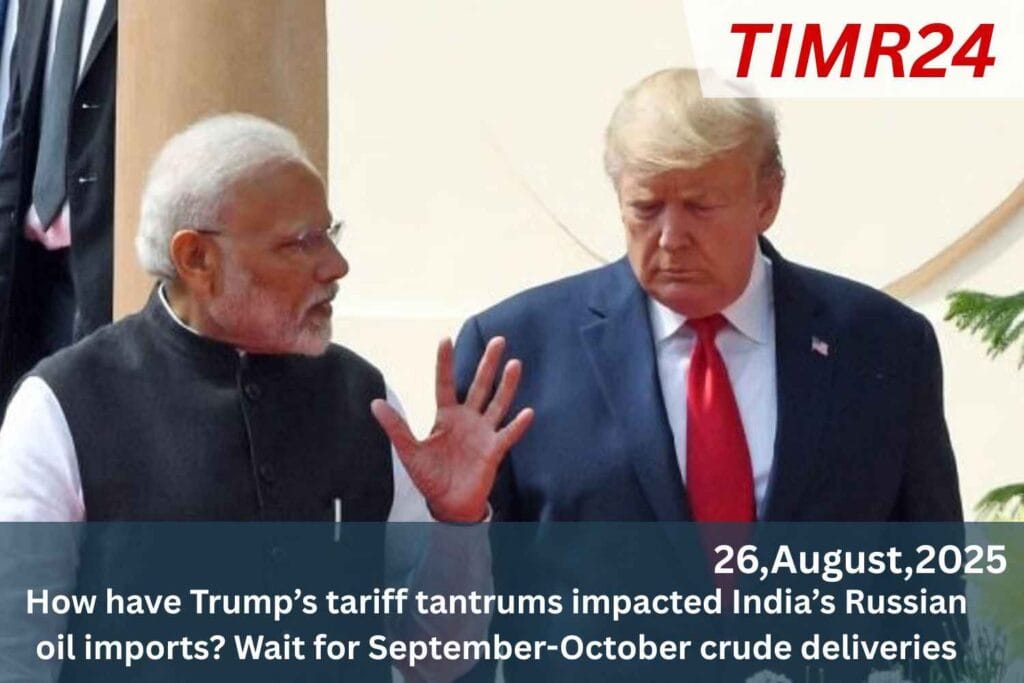
Indian refiners are considering whether to cut their appetite for Russian crude amid Trump US rhetoric against India’s Russian oil imports. While deliveries of Russian crude have declined in July and August, industry insiders attribute this to shrinking discounts on Moscow’s oil, not American pressure. Russian oil deliveries scheduled for September and October would provide a clearer picture on the impact of Trump’s tariff tantrums over India’s hefty imports of Russian crude. Initial tanker data suggests a slump in loadings of Russian crude to India, likely to be discharged at Indian ports in September and October. However, it may still be too early to say whether Trump’s pressure tactics
Have led to a marked change in Indian refiners’ Russian oil imports. India’s public sector refiners have not received any directive or indication from the government regarding their Russian oil imports, and their strategy on buying Moscow’s crude is dictated by economic and commercial (Energy & Infrastructure) Considerations. Global energy markets have rarely been stable, but Donald Trump’s tariff-driven approach to trade has added a fresh layer of uncertainty. India, the world’s third-largest oil importer, has leaned heavily on discounted Russian crude since the Ukraine conflict. However, with tariffs reshaping supply chains, the September-October 2025 crude deliveries are being closely monitored as a key inflection point for India’s energy policy.
India’s Dependence on Russian Crude
Since 2022, India has become one of the largest buyers of Russian oil, benefiting from deep discounts amid Western sanctions. Russian imports made up nearly 40% of India’s crude basket in 2024. Refiners in Gujarat and Maharashtra found Russian grades like Urals and ESPO attractive due to both price and compatibility with refining technology. Trump’s return to protectionist trade measures has unsettled not just China and Europe but also energy-importing nations like India. While tariffs are not directly targeted at oil imports from Russia, the cascading effect on shipping, insurance, and currency settlements has made Russian shipments riskier and costlier. For Indian refiners, this means rethinking procurement strategies ahead of September-October 2025 deliveries.
Industry experts view the upcoming September-October shipments as a test of resilience. If Russian volumes decline, India may turn to trusted suppliers like Saudi Arabia, the UAE, and Iraq. This could strengthen ties with (OPEC) members but at a higher cost compared to Russian crude. Recognizing the risks of overdependence, India is actively diversifying its energy sources. Recent deals with African nations, LNG contracts with the U.S., and discussions on renewable alternatives highlight a broader shift. Readers can explore India’s evolving renewable strategy through. The biggest domestic concern lies in inflation. Higher crude prices may directly impact petrol and diesel costs, influencing food supply chains and consumer inflation faces the challenge of balancing forex reserves against rising energy import.
Balancing Diplomacy and Pragmatism
India’s tightrope walk between Washington and Moscow is becoming sharper. While the U.S. remains a key strategic partner in defense and technology, Russia continues to provide reliable energy supplies. This dual policy reflects India’s tradition of non-alignment and pragmatic diplomacy. For more on India’s foreign relations, explore our (Geopolitics) While crude remains central, India’s policy also emphasizes solar, wind, and green hydrogen. Trump’s tariffs, paradoxically, may accelerate India’s renewable transition, reducing exposure to external shocks. As September-October crude deliveries unfold, India will showcase whether it can maintain its delicate balance between affordable energy security and global diplomatic pressures.
Q1. How have Trump’s tariffs affected India’s Russian oil imports?
Trump’s tariffs have increased uncertainty, making shipments costlier and complex for refiners relying on Russian crude.
Q2. Why are September-October deliveries important for India?
These months will reflect whether India maintains Russian imports or shifts towards Middle Eastern and African suppliers due to tariff pressures.
Q3. Is India diversifying beyond Russian oil?
Yes, India is actively engaging with Gulf nations and exploring U.S. LNG and African crude alternatives.
Q4. Could Trump’s tariffs impact fuel prices in India?
Higher import costs could push up domestic fuel prices, straining consumers and India’s inflation control measures.
Q5. How is India balancing diplomacy and energy needs?
India is adopting a dual-track approach: securing affordable energy from Russia while maintaining strategic ties with the U.S. and EU.