













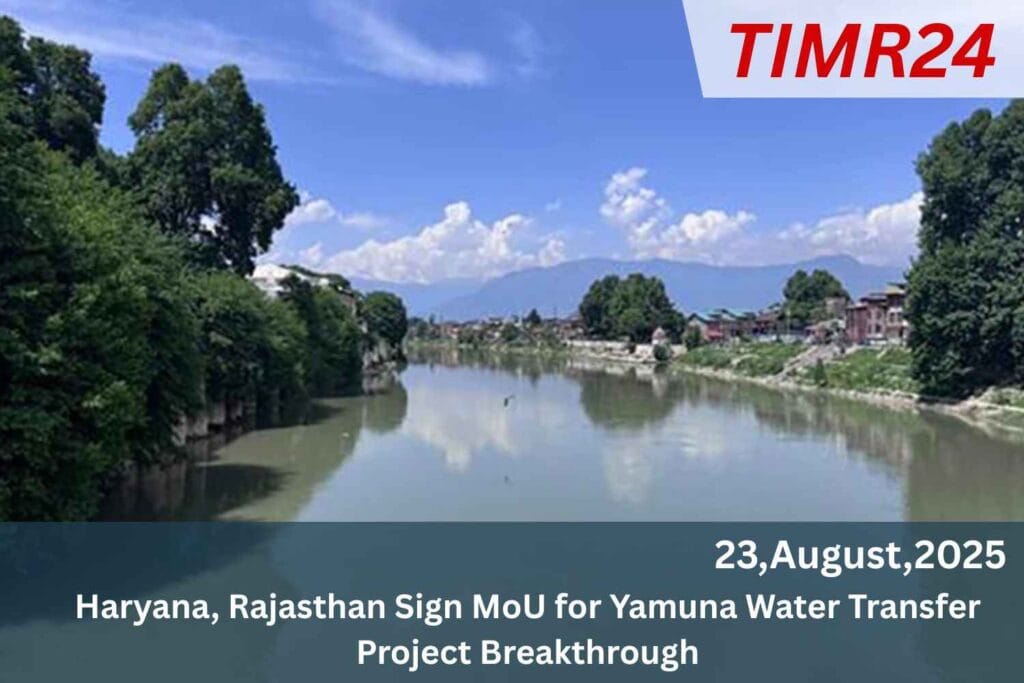
Haryana and Rajasthan have signed an MoU to jointly prepare a Detailed Project Report for transferring Yamuna water from Hathnikund to Rajasthan districts via underground pipelines. The project aims to transfer up to 577 MCM of water from July-October. In a significant development aimed at addressing the water scarcity issues in Rajasthan, the governments of Haryana and Rajasthan have signed a Memorandum of Understanding (MoU) to facilitate the transfer of Yamuna River water from Haryana to Rajasthan. This initiative is set to benefit several districts in Rajasthan, including Sikar, Churu, and Jhunjhunu, by providing them with a more reliable and sustainable water supply.
The primary objective of this project is to ensure that Rajasthan receives its allocated share of Yamuna Water, which has often been underutilized due to various logistical and infrastructural challenges. Under the terms of the MoU, the two states have agreed to jointly prepare a Report (Yamuna Water) for the construction of an underground pipeline system that will transport water from the Hathnikund Barrage in Haryana to the designated areas in Rajasthan. This collaborative effort aims to create a robust framework for the equitable distribution of water resources between the two states. The project is planned to be executed in multiple phases.
The first phase focuses on transferring up to 577 Million Cubic Meters (MCM) of water during the period from July to October, aligning with the monsoon season when water availability is higher. This phase is expected to meet the drinking water and irrigation needs of the affected districts in Rajasthan. Subsequent phases will involve the construction of additional infrastructure to support year-round water supply, thereby ensuring a consistent and dependable water source for the region. Both Haryana and Rajasthan have established a joint Task Force to oversee the planning and implementation of the project. This Task Force is responsible for coordinating activities, resolving any inter-state issues, and ensuring that the project progresses according to the agreed timelines.
Additionally, Rajasthan has sanctioned an initial amount of ₹95 crore for the construction works under the Yamuna Water Agreement, which includes contributions towards the development of the Renukaji and Lakhwar Dams, located in the upper Yamuna basin. These dams are integral to the overall water management strategy, as they will help in augmenting the water supply for both states. The transfer of water through underground pipelines is expected to have minimal environmental impact compared to traditional open canal systems. However, the project will still undergo rigorous environmental assessments to ensure that it does not adversely affect the local ecosystems.
Socially, the project is anticipated to have a positive impact by improving water availability for agriculture and drinking purposes, thereby enhancing the quality of life for residents in the beneficiary districts. The signing of the MoU between Haryana and Rajasthan marks a pivotal moment in (Detailed Project) inter-state water resource management. By collaborating on the Yamuna Water Transfer Project, both states are taking proactive steps towards ensuring sustainable water supply solutions that cater to the needs of their populations. This initiative not only addresses the immediate water scarcity concerns but also sets a precedent for future cooperative efforts in managing.
Q1. What is the Yamuna Water Transfer Project?
It’s a collaborative effort to transfer Yamuna river water from Haryana to Rajasthan for irrigation and water supply.
Q2. Why did Haryana and Rajasthan sign the MoU?
To ensure equitable water distribution, enhance agricultural productivity, and strengthen regional cooperation.
Q3. When will the project begin?
The project timeline will be defined in the MoU, with phased implementation expected in the coming years.
Q4. Who will benefit from this project?
Farmers, local communities, and regions facing water scarcity in both states will benefit.
Q5. What is the environmental impact?
The project aims to manage water efficiently while minimizing ecological disruption, with environmental safeguards in place.