







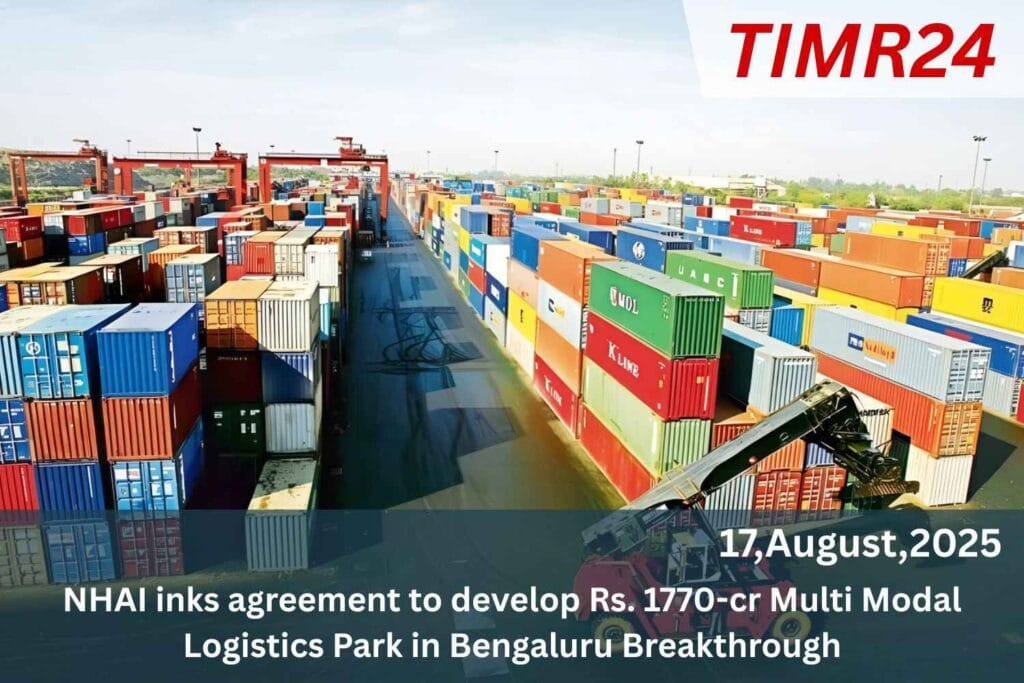
National Highways Logistics Management Ltd (NHLML), a NHAI-owned company, has signed an agreement for the development of a 400-acre Multi Modal Park (MMLP) in Bengaluru, Karnataka. The project, estimated to cost Rs 1,770 crore, will be the first and largest MMLP implemented in India under the PM Gati Shakti National Master Plan. The project will cater to 30 million MMT cargo by 45 years. The National Highways Authority of India (NHAI) has taken a significant step in advancing India’s logistics infrastructure by signing an agreement to develop a state-of-the-art Multi Modal Logistics Park (MMLP) in Bengaluru. With an estimated investment of ₹1770 crore, this ambitious project aims to revolutionize freight movement and logistics efficiency in southern India.
The initiative is aligned with the Bharatmala Pariyojana program, which focuses on reducing costs, enhancing supply chain competitiveness, and boosting trade through modern infrastructure Multi Modal Logistics Parks are designed as integrated hubs that facilitate seamless freight transfer across different modes of transport, including road, rail, air, and waterways. The Bengaluru project will not only improve cargo handling capacity but also provide advanced warehousing, cold storage, and value-added services to businesses. By consolidating logistics activities, such parks reduce transportation time, cut operational costs, and decrease vehicular congestion on highways. To understand the broader scope of this development,
The Bengaluru MMLP is strategically planned near the industrial and IT corridors, making it a central point for both domestic and international trade. Its proximity to National Highways, Bengaluru International Airport, and major railway lines will ensure smooth cargo movement to various parts of the country. The park will act as a gateway for exports and imports from Karnataka, further strengthening India’s logistics network. For comparison, projects like the (Metro Project) also highlight how connectivity infrastructure is becoming a key enabler for urban and industrial growth. This project is expected to bring tremendous economic benefits to Karnataka, particularly Bengaluru, which is already a hub for manufacturing, IT, and e-commerce.
Sustainability and Green Logistics
The MMLP will create thousands of direct and indirect jobs, attract private investments, and support small and medium enterprises (SMEs) in reaching wider markets By lowering logistics costs and improving efficiency, it will enhance the competitiveness of Indian goods in global markets. The development can be viewed alongside other large-scale infrastructure projects One of the core elements of the MMLP plan is sustainability. NHAI aims to integrate eco-friendly solutions such as renewable energy, energy-efficient warehouses, and digital tracking systems that reduce carbon emissions. The shift from road-only freight to multi-modal transport, particularly rail and waterways, will also significantly cut down on greenhouse gas emissions. This aligns with India’s commitment to reducing carbon intensity and promoting green infrastructure.
Similarly, initiatives like the before the monsoon season show how infrastructure development is also focusing on resilience and environmental balance. India’s logistics sector has long struggled with high costs, estimated to be around 13–14% of GDP, much higher than developed nations. By building MMLPs, the government aims to bring these costs down to 8–9% of GDP, thereby increasing the efficiency of supply chains. The Bengaluru MMLP is among the key projects that will drive this transformation. It will also complement other multimodal hubs planned under the Bharatmala Pariyojana, strengthening India’s position as a global logistics hub. For instance, the upcoming are being designed with similar objectives to reduce congestion and improve cargo efficiency.
Once operational, the Bengaluru Multi Modal Logistics Park will serve as a model for other regions in India. It will integrate advanced digital technologies such as AI-driven inventory management, blockchain for supply chain transparency, and real-time tracking systems. This futuristic approach will not only improve operational efficiency but also provide businesses with better control over their logistics processes. The long-term vision is to create a network of interconnected logistics parks across India, ensuring faster, greener, and more cost-effective transportation solutions. The signing of the agreement for the Bengaluru MMLP marks a breakthrough in India’s infrastructure journey. By investing ₹1770 crore into this modern logistics hub,
NHAI is laying the foundation for a more competitive and sustainable logistics ecosystem. This project will not only benefit Karnataka’s economy but also contribute significantly to the national goal of making India a leading global trade and logistics destination. As seen in related infrastructure initiatives like the (Central Railway tunnel) and urban transport systems, India is clearly prioritizing integrated, future-ready infrastructure that can support both economic growth and environmental goals.
Q1. What is the cost of the Bengaluru Multi Modal Park?
The project is valued at ₹1,770 crore.
Q2. Who is developing the park in Bengaluru?
The National Highways Authority of India (NHAI) is leading the project.
Q3. Where will the Multi Modal Logistics Park be located in Bengaluru?
It will be developed near Bengaluru to boost connectivity and trade.
Q4. What is the main purpose of the logistics park?
To improve cargo movement, reduce transport costs, and enhance efficiency.
Q5. When is the project expected to be completed?
The completion timeline will be shared by NHAI in project updates.