









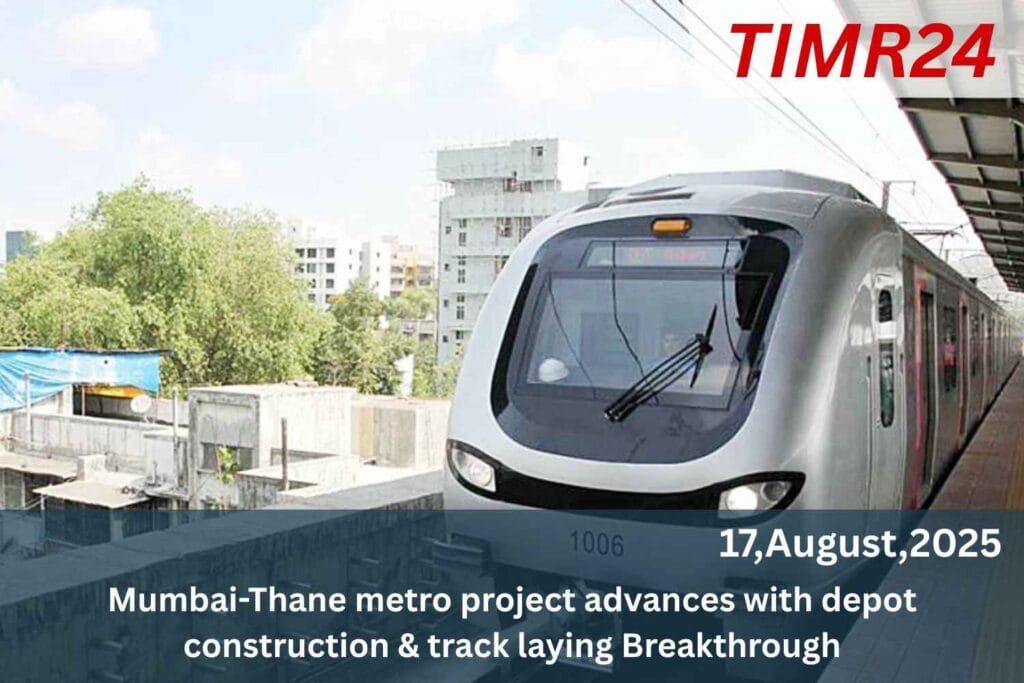
The Mumbai Metropolitan Region Development Authority (MMRDA) has completed the 4 and 4A project connecting Mumbai to Thane and its suburbs. Contractors have been appointed for the construction of a depot at Magarpatta and for laying tracks between Mulund and Thane. The project, which has been awaited due to delays, is progressing well, with 58% completion on the Kasarvadavali-Wadala 4 route and 61% on the 4A line. The Mumbai-Thane metro project has entered a significant breakthrough phase with rapid progress in depot construction and track laying activities. This ambitious infrastructure project is designed to strengthen the backbone of urban mobility in the Mumbai Metropolitan Region (MMR), easing congestion on roads and providing commuters with faster and
more sustainable travel options. With work advancing steadily, the metro is poised to change the way people move between two of the busiest zones of Maharashtra Mumbai and Thane. The Mumbai-Thane belt has long been recognized as one of the busiest commuter routes in India. With millions traveling daily for work, education, and business, the pressure on existing rail and road networks has been immense. The introduction of the metro is expected to drastically reduce travel time, decongest arterial roads, and offer a reliable alternative to suburban trains. This aligns with broader goals of promoting sustainable urban transportation while reducing dependence on private vehicles. For more context on metro development in the state, you can also explore updates on
One of the most critical components of any system is its depot, which functions as the operational hub for train maintenance, inspection, and storage. The Mumbai-Thane depot construction is progressing at a rapid pace, with state-of-the-art facilities being integrated to ensure smooth functioning of the network. Once completed, the depot will play a central role in maintaining rolling stock and ensuring uninterrupted services for commuters. Similar advances were recently observed in the (Delhi Metro) where depot modernization accelerated the efficiency of operations. Track laying is another milestone achieved in the Mumbai-Thane metro project, signaling that the project is moving closer to the testing and trial phase. Precision engineering and modern technology are being deployed to.
Ensure the tracks meet global safety and performance standards. The alignment of tracks is designed to seamlessly integrate with stations and interchange hubs, creating a smooth commuter experience. A comparable development can be seen in the where advanced track-laying techniques reduced construction delays and enhanced durability. The completion of the Mumbai-Thane metro is expected to be a game-changer for daily commuters. Travel times, which currently stretch beyond an hour during peak traffic, will be reduced to under 30 minutes once the becomes operational. Additionally, the metro will provide air-conditioned, safe, and efficient travel, giving commuters relief from overcrowded trains and unpredictable road traffic. This development is likely to mirror the transformative
Impact observed in which significantly improved the urban commute scenario in southern India Beyond travel convenience, the project is also poised to deliver substantial economic benefits. Enhanced connectivity between Mumbai and Thane will spur real estate growth, attract investments, and boost local businesses. Moreover, improved mobility often leads to better job opportunities as professionals can commute efficiently across city zones. On the social front, the project contributes to lowering carbon emissions by reducing vehicle dependency, aligning with India’s climate action goals. Such large-scale urban infrastructure projects also generate thousands of jobs during the construction phase, strengthening the regional economy.
Future Outlook and Timeline
While the depot construction and track laying mark a crucial breakthrough, authorities are also focusing on completing other associated works, including electrification, signaling, and station development. Trial runs are expected to begin once a substantial stretch of the line is completed, paving the way for partial operations in the near future. If timelines are maintained, the Mumbai-Thane metro will likely be open to the public within the next few years. This follows the pattern of successful project rollouts like the (Nagpur Metro), which was completed in record time compared to other major metro initiatives The Mumbai Metropolitan Region Development Authority (MMRDA) is spearheading the project with the support of state and central government initiatives. Public-private partnerships.
PPPs are also being explored to ensure funding and operational sustainability. Transparent monitoring mechanisms are in place to avoid delays, and the government has assured citizens of timely delivery. A similar governance model was used in the where coordinated efforts between multiple stakeholders ensured smoother progress. The Mumbai-Thane metro project is not just an infrastructure development; it represents a new chapter in urban mobility for Maharashtra. With depot construction and track laying progressing rapidly, the project is well on its way to reshaping the daily lives of millions of commuters. The successful implementation of this corridor will set a benchmark for future metro projects across India, reinforcing the vision of sustainable, fast, and inclusive public transport systems.
Q1. What is the current status of the Mumbai-Thane Metro project?
The project has advanced with depot construction and track laying work underway.
Q2. How will the Mumbai-Thane Metro benefit commuters?
It will reduce travel time, ease traffic congestion, and improve connectivity between key hubs.
Q3. When is the Mumbai-Thane Metro expected to be operational?
Authorities aim to make the line partially operational within the next few years.
Q4. Which areas will be connected through this metro line?
The line will connect Mumbai and Thane with multiple important stations along the route.
Q5. Who is executing the Mumbai-Thane Metro project?
The project is being developed by the Mumbai Metropolitan Region Development Authority (MMRDA).