













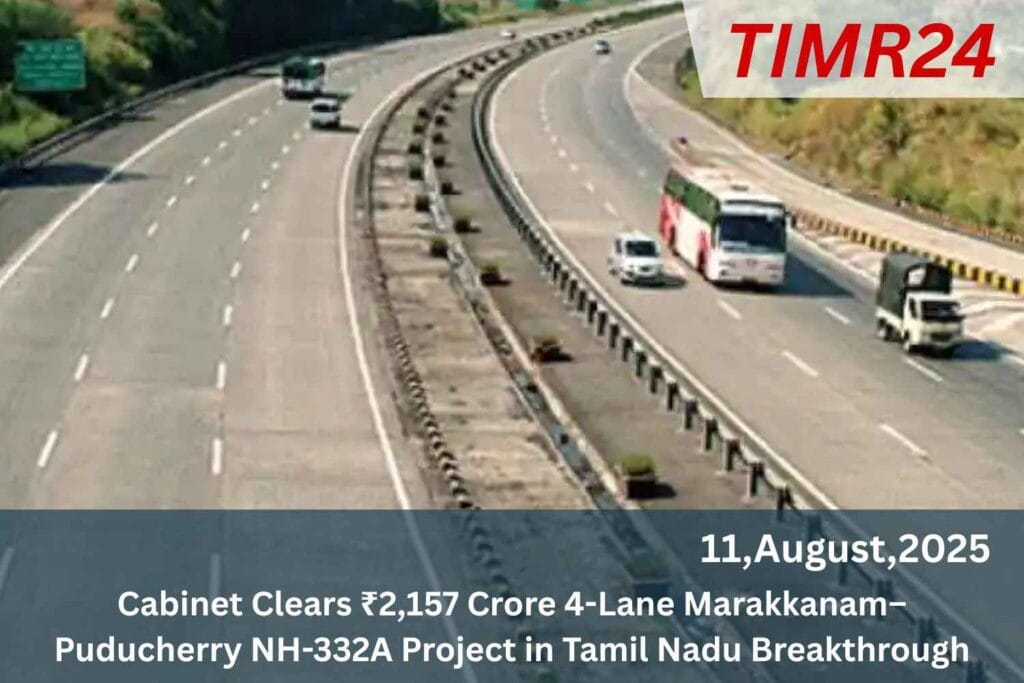
The Marikana Cabinet Committee on Economic Affairs has approved the construction of a 4-lane Marikana–Puducherry section in Tamil Nadu, aiming to improve connectivity between Chennai, Puducherry, Villupuram, and Navaratnam. The project, which will upgrade the existing 2-lane National Highway 332A from Marikana to Puducherry, will decongest the existing corridor, improve safety, and cater to the mobility needs of rapidly growing towns. The upgraded corridor will also enhance multi-modal integration and contribute to regional economic growth, tourism, and trade and industrial development. The Government of India’s Cabinet has recently approved a significant.
Infrastructure project aimed at enhancing connectivity and boosting economic growth in Tamil Nadu the ₹2,157 crore expansion and upgrade of the National Highway NH-332A. This project involves widening the existing roadway to a four-lane highway from Marikana to Puducherry, which is expected to bring multiple benefits to the region in terms of transport efficiency, safety, and regional development. The NH-332A project covers a vital stretch connecting Marikana, located near Chennai, to the union territory of Puducherry, a popular coastal city known for tourism and commerce. The road upgrade involves converting the existing two-lane highway into a four-lane corridor, facilitating smoother traffic flow and accommodating increasing vehicular movement (MoRTH).
This highway corridor serves as a critical route for commuters, freight transport, and tourists traveling between Tamil Nadu and Puducherry. The Cabinet’s approval allocates ₹2,157 crore for this ambitious infrastructure endeavour, which includes construction, land acquisition, and associated development works. The expansion aims to reduce travel time significantly, improve road safety standards, and provide better connectivity for industrial zones and residential areas along the route. NH-332A is strategically important for connecting the southern states and union territories, serving as a key artery for trade, tourism, and daily commuting. Enhancing this highway will not only facilitate quicker movement of goods and people but will also boost economic activities by improving access to ports, markets, and industrial hubs (Road Transport).
With the four-lane upgrade, logistics operators and transport companies can expect smoother transit, reducing operational costs and delivery times. For tourists visiting Puducherry’s serene beaches and heritage sites, the improved highway will offer a more comfortable and safer travel experience. Additionally, the project is expected to promote new business opportunities, attracting investment in the region and supporting Tamil Nadu’s broader infrastructure development goals. Upgrading NH-332A to a four-lane highway is also aimed at enhancing road safety. The existing two-lane road, often congested and narrow, has witnessed traffic bottlenecks and accidents. The four-lane design will include safety features such as proper medians, road signage, pedestrian crossings, and better lighting to reduce accidents and improve overall road discipline.
Safety and Environmental Benefits
Furthermore, the project planners have committed to environmental sustainability. The highway expansion will incorporate green belts and tree plantations along the route to minimize environmental impact and maintain ecological balance. Proper drainage systems and soil conservation measures will also be part of the construction plan to prevent erosion and flooding during monsoon seasons. The ₹2,157 crore investment is expected to have a multiplier effect on the local economy. Construction activities will generate thousands of direct and indirect jobs, benefiting laborers, contractors, and suppliers in Tamil Nadu and Puducherry. In the long term, improved connectivity will help industries by easing raw material supply and finished goods distribution, thus fostering industrial growth and competitiveness.
Economic Impact and Job Creation
Improved infrastructure typically attracts investments in manufacturing, warehousing, retail, and tourism sectors. The highway upgrade will likely encourage new commercial developments along the corridor, boosting real estate values and enhancing quality of life for residents. The project is currently in the pre-construction phase, with detailed surveys, land acquisition, and tendering underway. Authorities aim to commence construction shortly after completion of the preliminary activities, targeting phased completion within the next 3 to 4 years. The government is focused on timely execution to ensure that the benefits reach citizens without undue delays. Coordination among central agencies, state government departments, and contractors is crucial for the smooth progress of the NH-332A.
This highway project aligns with Tamil Nadu’s broader agenda to upgrade its transport infrastructure, which includes the ongoing expansions of metro rail networks, new expressway developments, and modernization of ports. The recent inauguration of metro projects in Karnataka and introduction of new Vande Bharat trains reflect a regional momentum towards improved connectivity.
Q1. What is the ₹2,157 crore Marikana–Puducherry NH-332A project?
It is a government-approved project to widen the Marikana to Puducherry National Highway NH-332A into a four-lane highway to improve connectivity and traffic flow.
Q2. How will the four-lane upgrade benefit Tamil Nadu and Puducherry?
The expansion will reduce travel time, enhance road safety, support economic growth, and improve freight and commuter movement between the two regions.
Q3. When will the NH-332A four-lane project be completed?
The project is expected to be completed within 3 to 4 years, following land acquisition and construction phases.
Q4. What safety features are planned for the upgraded highway?
The project will include safety barriers, proper signage, pedestrian crossings, and improved lighting to minimize accidents.
Q5. How does this project fit into Tamil Nadu’s broader infrastructure plans?
It complements other state initiatives like metro expansions and expressway developments aimed at modernizing transport infrastructure and boosting regional development.