















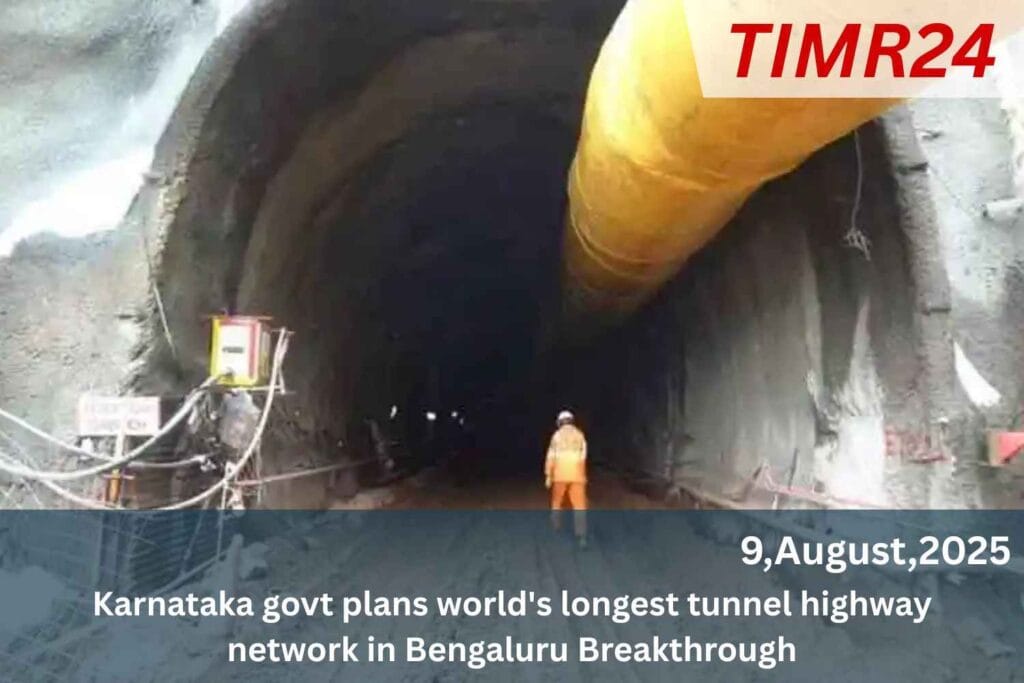
The Karnataka government plans to construct the world’s longest tunnel highway network in Bengaluru, consisting of three major corridors spanning 99km. The North-South Corridor will connect Bellary Road to Hosur Road, while the East-West Corridor will have two sections. The project, estimated to cost Rs 22,000 crore, will be implemented through a public-private partnership (PPP) model, partially funded by a hybrid annuity model. Karnataka government has unveiled an ambitious plan to construct the world’s longest tunnel highway network in Bengaluru, aiming to address the city’s persistent traffic congestion and enhance urban connectivity. This groundbreaking infrastructure project promises to revolutionize Bengaluru’s transportation landscape by providing an innovative, efficient, and sustainable solution to its growing mobility challenges.
Vision Behind the Tunnel Highway Network
The primary goal of this project is to decongest Bengaluru’s surface roads by shifting a significant portion of vehicular traffic underground. With rapid urbanization and an increasing number of vehicles on the roads, Bengaluru has witnessed severe traffic jams, impacting daily commuters and economic productivity. The tunnel highway network is envisioned to create seamless, high-speed corridors connecting key parts of the city, reducing travel time drastically. Spanning several kilometres, the tunnel highway will be designed to accommodate multiple lanes of traffic, ensuring smooth flow and safety. Advanced engineering techniques and state-of-the-art tunnel construction methods will be employed to build durable, eco-friendly tunnels equipped with proper ventilation.
Impact on Bengaluru’s Traffic and Economy
lighting, and emergency response systems. The project also emphasizes minimizing environmental impact during construction and operation. Once operational, the tunnel highway network is expected to alleviate surface road congestion, significantly cutting down travel times for daily commuters and freight movement. This improvement in connectivity will boost economic activities by facilitating quicker movement of goods and people across the city. Additionally, reducing surface traffic will contribute to lowering air pollution levels, making Bengaluru a cleaner, healthier city. (Bangalore Development Authority)
Collaboration and Funding
The Karnataka government plans to collaborate with national and international engineering firms, leveraging global expertise to ensure the project meets world-class standards. The funding model may include public-private partnerships (PPP) to accelerate construction and efficient project management. The tunnel highway network is envisioned as a core part of Bengaluru’s future urban transport ecosystem. Integration with existing metro lines, ring roads, and bus rapid transit systems will ensure a multi-modal transport framework, enhancing overall accessibility and commuter convenience. This project aligns with Karnataka’s broader infrastructure development goals to transform Bengaluru into a smart, sustainable city.
Future Prospects and Integration
In Karnataka’s plan to develop the world’s longest tunnel highway network in Bengaluru marks a significant breakthrough in urban infrastructure development. It demonstrates a forward-thinking approach to solving urban mobility challenges and sets a precedent for other rapidly growing cities in India and beyond. The successful execution of this project will position Bengaluru as a global leader in innovative transport solutions, fostering economic growth and improved quality of life for its residents. (Metro)
One of the crucial advantages of this tunnel highway network is its potential to cut down travel time dramatically. Commuters currently stuck in hours-long gridlocks during peak hours can expect a faster, more reliable journey across the city. The time savings will not only benefit daily travellers but also have a positive ripple effect on the city’s economic productivity, as quicker transportation of goods and services leads to enhanced business efficiency. Moreover.
Q1. What is the Karnataka government’s new infrastructure plan in Bengaluru?
The government plans to build the world’s longest tunnel highway network to ease traffic congestion.
Q2. How will the tunnel highway benefit Bengaluru commuters?
It will reduce travel time by diverting traffic underground, easing surface road congestion.
Q3. What features will the tunnel highway include?
The tunnel will have multiple lanes, advanced ventilation, lighting, and safety systems.
Q4. How will this project impact Bengaluru’s environment?
By reducing surface traffic, it is expected to lower air pollution and improve urban air quality.
Q5. When is the tunnel highway network expected to be completed?
The timeline is under planning; the project will be executed in phases with collaboration from expert firms.