

















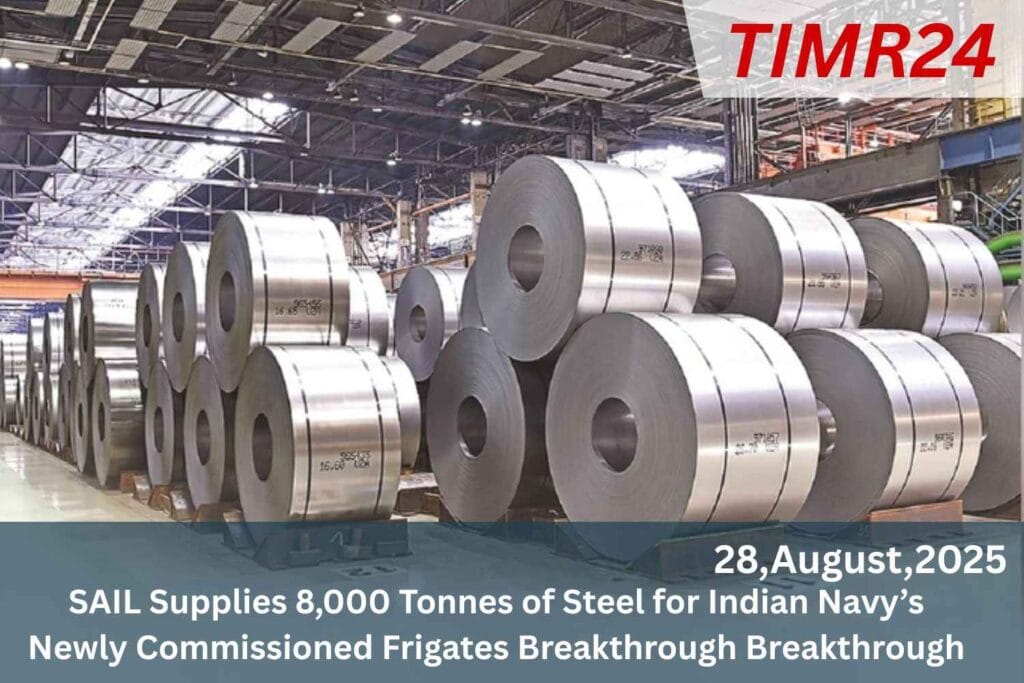
Steel Authority of India Limited (SAIL), India’s largest public sector steel producer, has supplied 8,000 tonnes of critical-grade steel for the Indian Navy’s advanced frontline frigates, INS Udaygiri and INS Hangiri. The frigates were commissioned into the Indian Navy at Visakhapatnam on August 26, 2025. SAIL’s partnership with Mazagon Dock Shipbuilders Limited and Garden Reach Shipbuilders & Engineers Limited has contributed to import substitution and defense self-reliance, supporting initiatives like ‘Atmanirbhar Bharat’ and ‘Make in India’. The commissioning of these frigates demonstrates India’s strength in its defense ecosystem. The commissioning of new-generation frigates into the Indian Navy marks a remarkable achievement for the country’s defense preparedness, and one of the silent yet.
Critical contributors to this success is the Authority of India Limited (SAIL), which has supplied 8,000 tonnes of specialized steel for their construction. This development is not only an example of industrial capability but also an illustration of India’s growing emphasis (Highway Project) on indigenous defense production under the vision of Atmanirbhar Bharat. SAIL’s supply included high-strength and corrosion-resistant steel grades that are essential for shipbuilding, particularly in ensuring durability and resilience in hostile marine environments. These frigates, designed to enhance surveillance, combat efficiency, and maritime security in the Indian Ocean Region, carry strategic importance at a.
Time when global naval dominance is becoming increasingly contested. What makes this milestone even more significant is that the steel is entirely produced in India, giving the Navy both strategic autonomy and cost efficiency. The Indian government has been consistently promoting the use of domestic materials in defense manufacturing, and this collaboration between SAIL and the Navy strengthens that resolve. By reducing dependence on imported alloys and ensuring supply consistency, India safeguards its national security while simultaneously uplifting its industrial sector. Similar trends can also be seen in infrastructure development, such as the progress made in where indigenous industries play a pivotal role in driving investments and boosting long-term resilience.
The role of in naval construction cannot be overstated because it forms the backbone of a warship’s structure. The newly commissioned frigates required steel capable of withstanding extreme pressure, high salinity levels, and operational stress during long deployments. SAIL’s Bhili and Rourkela steel plants have been the backbone of producing such advanced grades, which were earlier dependent on imports from European or East Asian suppliers. This shift towards local production has created a ripple effect, generating employment, supporting ancillary industries, and ensuring that technological know-how remains within the country. It is similar to how India has been prioritizing Green Mobility Initiatives to align industrial strength with sustainability.
Proving that industrial innovation and national priorities go hand in hand. For SAIL, this defense supply adds to its long-standing legacy of contributing to India’s strategic projects, as the company has earlier supplied steel for the construction of the indigenously built aircraft carrier INS Vikrant and several submarines. Beyond defense, this achievement has far-reaching implications for India’s industrial ecosystem. By ensuring that such high-grade steel is produced domestically, SAIL strengthens India’s position in the global steel market, where competition from countries like China, Japan, and South Korea remains high. At the same time, the economic benefits of such collaborations.
Extend across multiple sectors, since the demand for advanced steel grades fosters innovation in research and production. It further highlights how India’s large-scale projects, whether in transport, defense, or urban infrastructure, are increasingly relying on indigenous capacity to support long-term growth. The for instance, also demonstrates how industrial inputs and infrastructure projects are tightly interlinked, shaping both economic and strategic outcomes The commissioning of new frigates with indigenous steel also represents a milestone in India’s maritime vision. With growing tensions and strategic challenges in the Indo-Pacific, the Indian.
Navy is expected to play a central role in safeguarding trade routes, countering threats, and ensuring freedom of navigation. The use of Indian steel gives the Navy a cost-effective advantage, as maintaining and upgrading vessels becomes easier when materials are sourced domestically. This strengthens India’s resolve to establish itself as a maritime power, not only through fleet expansion but also by embedding self-reliance at every stage of the supply chain. The vision is aligned with global practices, as nations like the United States also emphasize domestic production of critical defense materials, something highlighted.
Looking ahead, the collaboration between SAIL and the Indian Navy is likely to expand further as India continues to invest in building advanced destroyers, aircraft carriers, and submarines. The continuous innovation in steel production, such as incorporating hybrid alloys and specialized treatments for enhanced durability, will play an essential role in meeting these ambitious naval projects. It is also expected that public sector enterprises like SAIL will partner with private shipyards and global technology providers to create a robust defense-industrial base in India. By bridging the gap between industrial supply and defense demand, India is building a resilient ecosystem where strategic capability is not dependent on external players.
This long-term vision not only strengthens the nation’s defense forces but also contributes to overall industrial growth, much like the progress seen in Steel & Cement, which shows how government-led demand can transform industries. Ultimately, the supply of 8,000 tonnes of high-grade steel by SAIL is not just a transaction; it is a symbolic leap towards industrial maturity, national security, and strategic self-reliance, reinforcing the idea that India’s strength lies in building its future with its own resources.
Q1. How much steel did SAIL supply for the Indian Navy’s frigates?
SAIL supplied 8,000 tonnes of high-grade steel for the newly commissioned frigates.
Q2. What type of steel does the Navy require?
The Navy requires corrosion-resistant, high-strength steel capable of withstanding marine and combat conditions.
Q3. How does this contribute to Atmanirbhar Bharat?
By sourcing domestically from SAIL, India reduces reliance on imported steel and boosts defense self-reliance.
Q4. Has SAIL contributed to defense projects before?
. Yes, SAIL has supplied steel for aircraft carriers, submarines, and other defense projects in the past.
Q5. Why is steel so important for warships?
Steel provides durability, stability, and resilience, making it essential for warship construction.