



















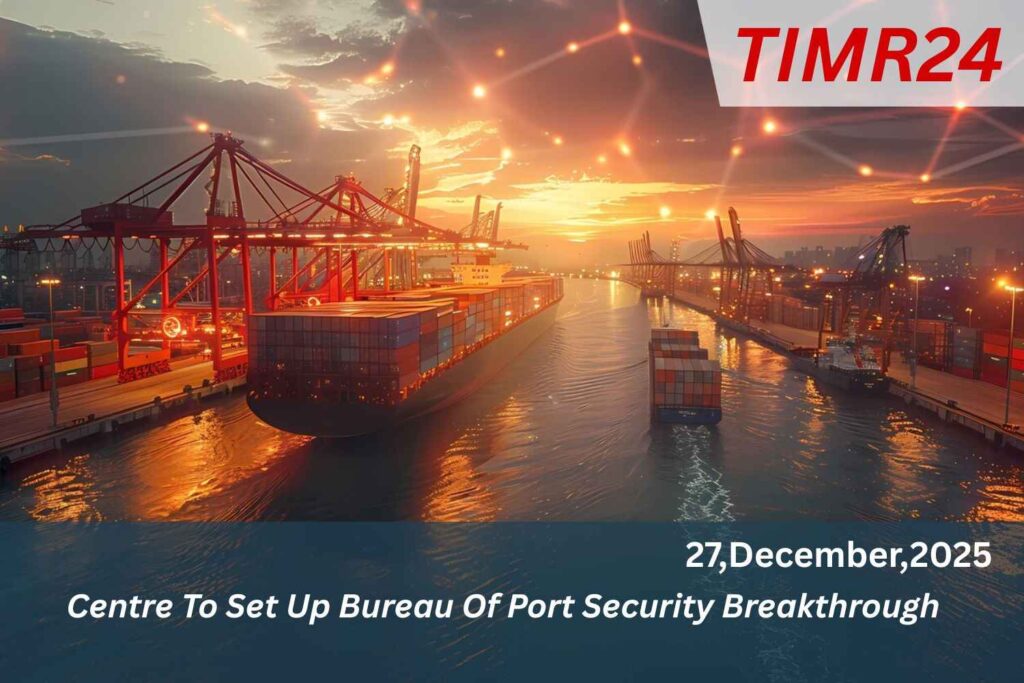
The Indian government will establish a Bureau of Port Security (BoPS) to enhance the security of vessels and facilities. Chaired by Union Home Minister Amit Shah, the meeting highlighted the need for a specialized framework, directing that security measures be risk-based and tailored to vulnerabilities and geographic factors. BoPS will focus on the analysis and exchange of security information and will include a cybersecurity division. It will operate as a statutory body under the Merchant Shipping Act, 2025, led by a Police Service officer at Pay Level-15, with the Director General of Shipping serving as its initial head during a one-year transition.
Establish Bureau of Port Security
The Bureau will also incorporate regulatory measures for private security agencies and seek to apply best practices from maritime to aviation security. The Government of India’s decision to set up a dedicated Bureau of Security (BPS) marks a significant transformation in the country’s maritime governance framework. With India handling nearly 95 percent of its trade by volume through sea routes, have become strategic national assets that require advanced and centralized security oversight. The proposed bureau is expected to function as a specialized agency focusing exclusively on safeguarding ports, terminals, cargo systems, and digital infrastructure.
Against evolving threats This move reflects India’s growing emphasis on maritime security in alignment with its expanding global trade ambitions and the development of the blue economy India’s have witnessed unprecedented growth over the past decade, driven by industrial expansion, containerization, and multimodal logistics development. While modernization has improved efficiency, it has also increased exposure to risks such as cyberattacks, smuggling, terrorism, and unauthorized access to critical port facilities. Existing security arrangements are currently distributed across multiple agencies, leading to coordination gaps.
Role of Bureau of Security in National Maritime
The Bureau of Port Security aims to address this challenge by creating a single nodal authority responsible for planning, monitoring, and enforcing standardized security protocols across all major and non-major ports. The Bureau of Port Security is envisioned as a strategic body that will (Airport) integrate physical security, cyber resilience, and intelligence-based threat assessment. It will work closely with port authorities, the Indian Coast Guard, customs officials, and intelligence agencies to establish real-time monitoring systems and risk-response mechanisms. By developing uniform security guidelines, the bureau will ensure that both government-owned and private ports.
Cybersecurity and Smart Protection
Operate under consistent national security standards. This centralized approach is expected to enhance India’s preparedness against cross-border threats and maritime crimes. With Indian increasingly adopting smart technologies, automation, and digital cargo management systems, cybersecurity has become a critical concern. The Bureau of Security will likely focus on protecting operating systems, vessel traffic management platforms, and logistics databases from cyber intrusions. Recent global incidents involving ransomware attacks on ports have highlighted the vulnerability of digital infrastructure. By introducing cybersecurity audits, threat simulations, and emergency response protocols, the bureau will strengthen India’s digital maritime ecosystem while supporting the government’s Digital India vision.
Impact on Trade, Logistics, and Investor Confidence
A secure environment directly contributes to smoother trade flows, reduced insurance costs, and enhanced investor confidence. International shipping lines and logistics operators prefer ports that meet global security benchmarks. The establishment of the Bureau of Security will help Indian ports comply with international maritime safety norms set by organizations such as the International Maritime Organization. This initiative is also expected to complement government programs like Sagarmala, which focus on port-led development and logistics efficiency.
Coordination with Central and State Agencies
One of the bureau’s key responsibilities will be to improve coordination between central and state authorities managing and coastal infrastructure. Since ports fall under both central and state jurisdictions, security planning often involves complex administrative structures. The Bureau of Security will act as a bridge, ensuring seamless communication, unified threat response, and effective crisis management. This collaborative framework will strengthen coastal security while supporting state-led development initiatives India’s growing role in global shipping corridors such as the Indo-Pacific region demands robust maritime security architecture.
The Bureau of Security will enhance India’s credibility as a reliable maritime partner and trade hub. Secure not only protect national interests but also facilitate international cooperation in shipping, logistics, and supply chain resilience. This development aligns with India’s long-term (India) vision of becoming a leading maritime nation by 2047 Over the long term, the Bureau of Security is expected to evolve into a center of excellence for maritime security research, training, and innovation. By investing in advanced surveillance technologies, artificial intelligence-driven monitoring systems, and skilled manpower, India can build a future-ready port security framework.
Q1. What is the Bureau of Security?
It is a proposed central agency to oversee and strengthen security at all Indian ports.
Q2. Why is the Bureau of Security important?
It ensures unified security standards and protects ports from physical and cyber threats.
Q3. Will it cover both major and minor?
Yes, the bureau is expected to cover all across India.
Q4. How will it impact trade?
Improved security will boost trade efficiency and investor confidence.
Q5. Which ministries will be involved?
Primarily the Ministry of, Shipping and Waterways, along with security agencies.