













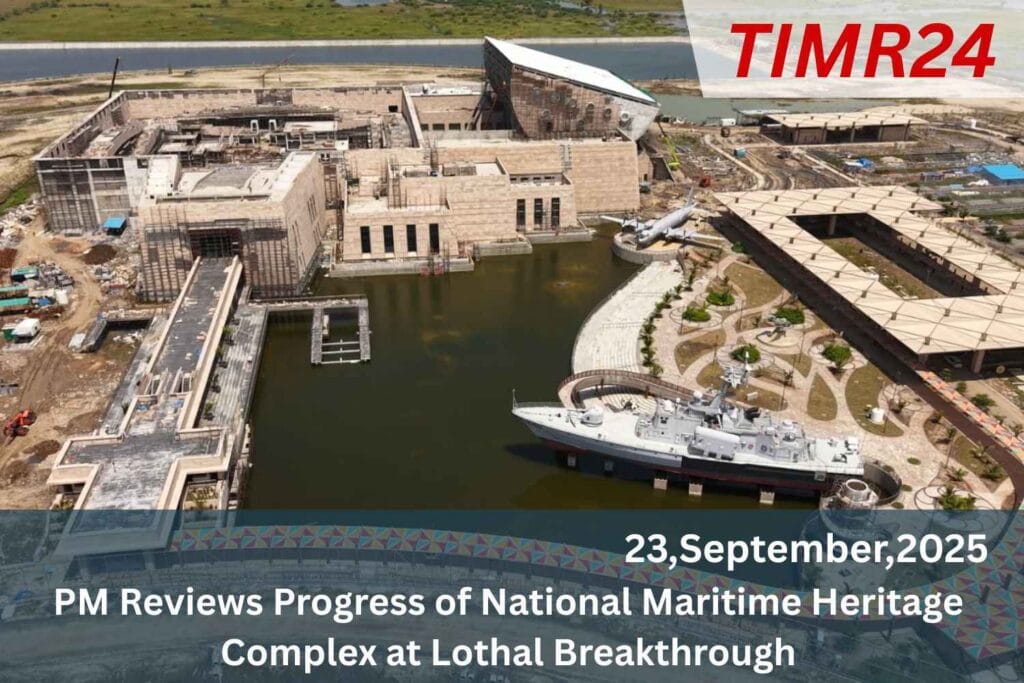
Prime Minister Narendra Modi announced the completion of the National Maritime Heritage Complex in Gujarat, which will become the world’s largest maritime museum. The Prime Minister’s recent review of the National Maritime Heritage Complex (NMHC) at Lothal, Gujarat marks an important milestone in India’s vision to celebrate its rich maritime history while positioning itself as a modern global player in heritage tourism. The project, located at the iconic Harappan site of Lothal, is not just about building a tourist attraction; it is about reviving the story of India’s seafaring traditions, shipbuilding skills, and cultural exchanges that shaped trade for centuries.
The review emphasized the importance of timely completion, adoption of world-class technologies, and collaboration with global experts to make NMHC a hub of knowledge, culture, and sustainable tourism Lothal, one of the most significant sites of the Indus Valley Civilization, stands as a testament to India’s advanced maritime and trade systems more than 4,000 years ago. It is known for housing the world’s oldest known dockyard, showcasing the brilliance of Harappan engineering. By situating the National Maritime Heritage Complex here, the government seeks to highlight how ancient India played a crucial role in shaping international commerce. For readers interested in the.
Archaeological background of this city, you can explore for detailed insights into excavation reports and Harappan sites. On our platform, you can also explore a detailed article on (Indus Valley) The NMHC is envisioned as a world-class maritime museum complex that integrates knowledge, culture, and entertainment. The project includes multiple galleries and theme-based sections that will allow visitors to explore India’s maritime evolution from the Harappan era to modern times. Plans include digital immersive experiences, a maritime research center, coastal community exhibits, and even heritage theme parks. Special attractions will showcase traditional.
Linking Past to Present: Maritime Heritage and Modern India
Shipbuilding techniques, naval warfare strategies, and India’s maritime connections with Southeast Asia, Africa, and the Middle East. The inclusion of interactive learning hubs ensures that this is not only a tourist destination but also an academic center. To learn about similar cultural tourism initiatives The maritime story of India is not confined to the past; it continues to influence the nation’s trade and strategic identity today. India’s ports, shipping industry, and naval strength are critical to its modern economy. By establishing NMHC at Lothal, the government aims to create a living bridge between past glory and present aspirations. For more details on ongoing maritime development projects in.
Gujarat has emerged as one of India’s fastest-growing cultural tourism hubs, with landmarks like the Statue of Unity, Somnath Temple, and Gir National Park attracting millions of visitors annually. The addition of NMHC at Lothal is expected to significantly boost Gujarat’s position on the global tourism map. Increased footfall will benefit local businesses, handicraft industries, and hospitality services, while also creating direct and indirect employment. The project complements the state’s larger vision of sustainable tourism development. To explore Gujarat’s offerings, check the For readers on our site, you can also explore a connected feature on (Statue of Unity Tourism)
Academic and Research Opportunities
One of the unique aspects of the NMHC is its commitment to research and education. It will host specialized centers for maritime archaeology, oceanography, and ancient trade route studies. Collaborations with international universities and heritage institutions will ensure the exchange of global knowledge and advanced methodologies. This creates opportunities not only for historians and archaeologists but also for young students in India to explore career paths in heritage and maritime studies. Interested readers can follow developments on, which regularly publishes updates on academic collaborations and cultural policies.
The project is also leveraging the latest technologies such as augmented reality, virtual simulations, and 3D recreations. Visitors will be able to experience Harappan dockyards, shipbuilding workshops, and ancient trade voyages through immersive experiences. The adoption of these tools is part of India’s broader vision of making heritage accessible to new generations in engaging ways. International (Statue of Unity) collaboration with maritime museums in countries like Portugal, Oman, and Indonesia is also being explored to showcase shared histories. On our website, you can also read more on that are integrating technology with tradition.
Economic Impact and Employment Generation
The National Maritime Heritage Complex is not merely a cultural initiative; it is also an economic catalyst. The project is expected to generate large-scale employment during its construction and operational phases, with jobs in tourism, hospitality, transport, and local industries. Enhanced connectivity to Lothal will also stimulate infrastructure development in surrounding areas, further uplifting rural communities. This aligns with India’s broader agenda of using heritage-driven tourism as a tool for inclusive growth During the recent review, the Prime Minister stressed the need for world-class quality and timely delivery of the NMHC project. He highlighted its potential to become a global.
Heritage attraction that celebrates India’s maritime strength while attracting scholars, tourists, and investors alike. The project also resonates with the government’s Azadi Ka Amrit Mahotsav vision, where India celebrates 75 years of independence by reflecting on its civilizational strengths and cultural diversity Statue of Unity The review of the National Maritime Heritage Complex at Lothal is a reaffirmation of India’s resolve to honor its past while preparing for the future. By weaving together history, culture, research, and tourism, NMHC promises to become a landmark that not only educates but also inspires. It will remind the world that India’s identity as a maritime nation did not begin in modern.
Q1 What is the National Maritime Heritage Complex at Lothal?
It is a mega heritage and tourism project in Gujarat showcasing India’s ancient maritime history and Harappan legacy.
Q2 Why was Lothal chosen for NMHC?
Lothal was a major Indus Valley port city, making it an ideal location to highlight India’s maritime heritage.
Q3 What facilities will the complex include?
Museums, theme parks, research centers, maritime galleries, and immersive digital experiences.
Q4 How will NMHC benefit India?
It will boost tourism, create jobs, encourage research, and position India as a global maritime heritage hub.
Q5 When is the project expected to be completed?
The government aims for timely completion in phases, aligning with India’s cultural and tourism growth agenda.