















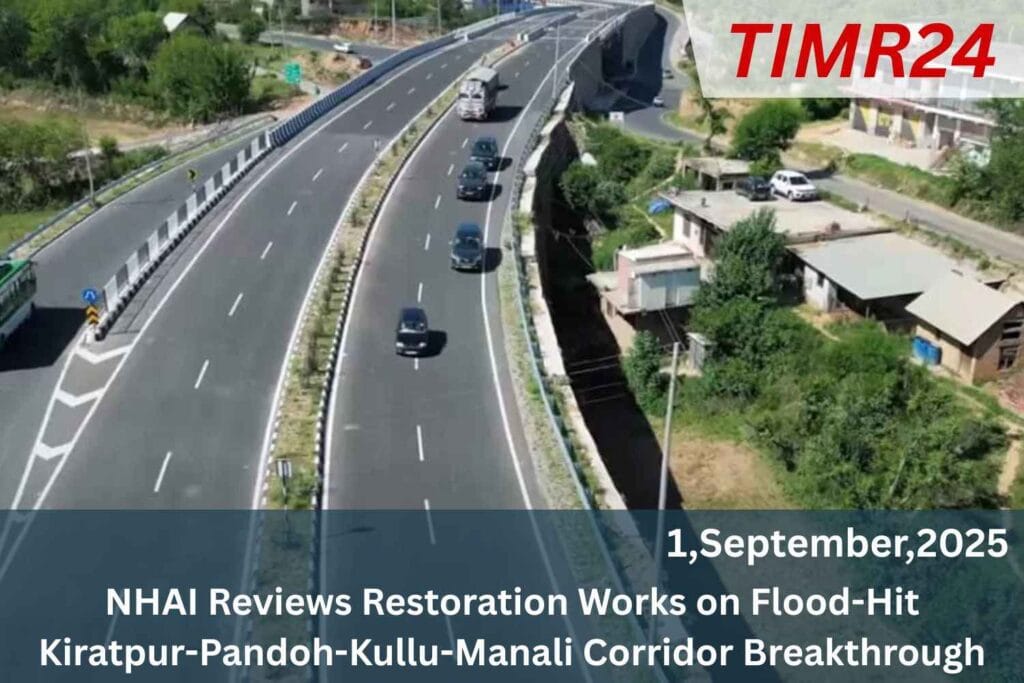
NHAI Chairman Shri Santosh Kumar Yadav has held a review meeting with senior officials to discuss the immediate restoration and improvement works on NH-21 in Himachal Pradesh. The Kullu-Manali stretch has been severely damaged, disrupting connectivity to Manali. NHAI has decided to provide financial support to Himachal Pradesh PWD for the urgent restoration and maintenance of the road, which now carries National Highway traffic Temporary restoration measures will be undertaken, and permanent restoration of other locations will be undertaken. NHAI is working on restoration and safety measures to ensure quick recovery and minimize further impact on travel and commerce in vulnerable areas.
The Kiratpur-Pandoh-Kullu-Manali corridor has emerged as one of the most significant stretches of road infrastructure in North India, acting as a lifeline for trade, tourism, and local connectivity across Himachal Pradesh. In recent months, this crucial route has faced severe disruptions due to torrential rains, floods, and multiple landslides that caused heavy damage to the road surface, embankments, and bridges. The impact of these natural disasters has been felt not only by the residents of Himachal Pradesh but also by thousands of tourists who rely on this road to reach destinations like Kullu, Manali, and the Atal Tunnel leading to Lahaul-Spiti. Recognizing the urgency.
Importance of the Kiratpur-Pandoh-Kullu-Manali Corridor
The National Highways Authority of India (NHAI) has reviewed ongoing restoration works on the flood-hit corridor to ensure that connectivity is restored at the earliest and future disruptions are minimized. The corridor is a key component of India’s national highway network, linking the plains of Punjab to the Himalayan towns of Himachal Pradesh. It supports economic activities by enabling smooth transport of agricultural produce, handicrafts, and essential goods, apart from boosting the tourism economy. For Himachal Pradesh, where tourism contributes significantly to state revenues, the corridor is vital for maintaining year-round accessibility to hill stations and adventure destinations. With thousands of travellers journeying towards.
Manali, Rohtang Pass, and Leh-Ladakh, the route holds immense economic and cultural value. To understand how such highways play a pivotal role in the broader road infrastructure landscape, you can explore (NHAI) The Himalayan terrain, though scenic, is highly vulnerable to natural disasters. Continuous rainfall in the monsoon season often triggers landslides, flash floods, and sinking of road stretches. The recent floods severely damaged parts of the Kiratpur-Pandoh section, leaving cracks in retaining walls, clogging drainage systems, and washing away entire sections of road. This not only disrupted local traffic but also stranded tourists for hours, leading to large-scale inconvenience.
According to reports from multiple vehicles were stuck in long traffic jams as emergency teams cleared debris and restored temporary connectivity. Such frequent disruptions highlight the urgent need for engineering solutions that are tailored to fragile hill ecosystems. NHAI has deployed its technical teams along with contractors to accelerate the restoration process. Measures include slope stabilization through geo-textile reinforcement, construction of retaining walls, use of gabion structures to strengthen embankments, and installation of advanced drainage systems to prevent waterlogging. Temporary diversions are also being created to ensure traffic flow until permanent repairs are completed.
The use of heavy machinery and modern technologies reflects NHAI’s intent to not only restore connectivity but also make the road more resilient to future weather-related challenges. These works are being reviewed periodically to ensure adherence to timelines, with the aim of completing critical stretches before the upcoming tourist season. For readers interested in how highway projects are planned and executed, our detailed page on The Kiratpur-Pandoh-Kullu-Manali corridor has long been a vital transport route for Himachal Pradesh, linking the plains of Punjab to the tourist hubs of Kullu and Manali. Recently, unprecedented floods and heavy rains caused extensive damage, leading the National Highways Authority of India (NHAI) to conduct urgent reviews of restoration works.
This corridor is not only crucial for local commuters but also forms the backbone of the tourism-driven economy of Himachal Pradesh. With destinations like Kullu, Manali, and the Atal Tunnel leading to Lahaul-Spiti, the road carries thousands of vehicles daily Monsoon-triggered floods and frequent landslides disrupted traffic movement, damaged bridges, and washed away road stretches. These natural disasters caused significant delays for tourists and locals, affecting the state’s economy. As reported by some stretches witnessed road sinking, creating serious safety hazards.
Impact on Tourism and Local Economy
The disruption of the Kiratpur-Pandoh-Kullu-Manali corridor directly affects Himachal Pradesh’s tourism industry, as it is the main gateway for travellers heading to Kullu and Manali. Businesses including hotels, restaurants, taxi operators, and local handicraft sellers depend on the steady inflow of tourists. With prolonged disruptions, many stakeholders face economic losses. However, the quick action by NHAI to initiate restoration has raised hopes for an early revival. The tourism industry is particularly eager for the reopening ahead of the festive and winter season, when tourist inflows to Manali and Soling Valley peak. To know more about the tourism potential of Himachal Pradesh and attractions around Manali.
Apart from NHAI, several government agencies including the National Disaster Management Authority (NDMA) and state-level disaster response teams are assisting in the process. Their role includes providing technical expertise for landslide risk mitigation, carrying out rescue operations when needed, and planning long-term safety measures for the corridor. Coordination between central and state agencies is crucial for ensuring that restoration is not only quick but also sustainable. By incorporating lessons from past disasters, authorities aim to develop road infrastructure that balances safety with environmental sustainability. For further reading on best practices in disaster management, you can explore resources shared by the (Road & Highways) which regularly updates on highway development and safety protocols.
Environmental Sustainability and Long-Term Solutions
Restoration works are not limited to temporary fixes but also focus on long-term environmental sustainability. In regions like Himachal, where deforestation and unregulated construction exacerbate landslide risks, afforestation programs and eco-friendly engineering methods are being emphasized. NHAI, in collaboration with the Central Road Research Institute (CRRI), is exploring techniques such as rock bolting, wire mesh barriers, and bio-engineering solutions like grass turfing on slopes to prevent soil erosion. These measures are designed to make the corridor more disaster-resilient without compromising the fragile ecology of the Himalayas.
Q1. Why is the Kiratpur-Pandoh-Kullu-Manali corridor important?
It is a lifeline for tourism, trade, and connectivity to Himachal Pradesh, especially Manali and Lahaul-Spiti.
Q2. How was the corridor affected by floods?
Heavy rains and landslides damaged road stretches, blocked traffic, and hampered local connectivity.
Q3. What steps is NHAI taking for restoration?
NHAI has deployed emergency teams, slope stabilization works, drainage upgrades, and fast repair of damaged stretches.
Q4. How will this impact tourism in Himachal Pradesh?
Quick restoration will revive tourism by ensuring smooth access to Manali, Kullu, and Rohtang.
Q5. When will the corridor fully reopen?
NHAI aims for phased reopening, with major connectivity restored before the upcoming tourist season.