














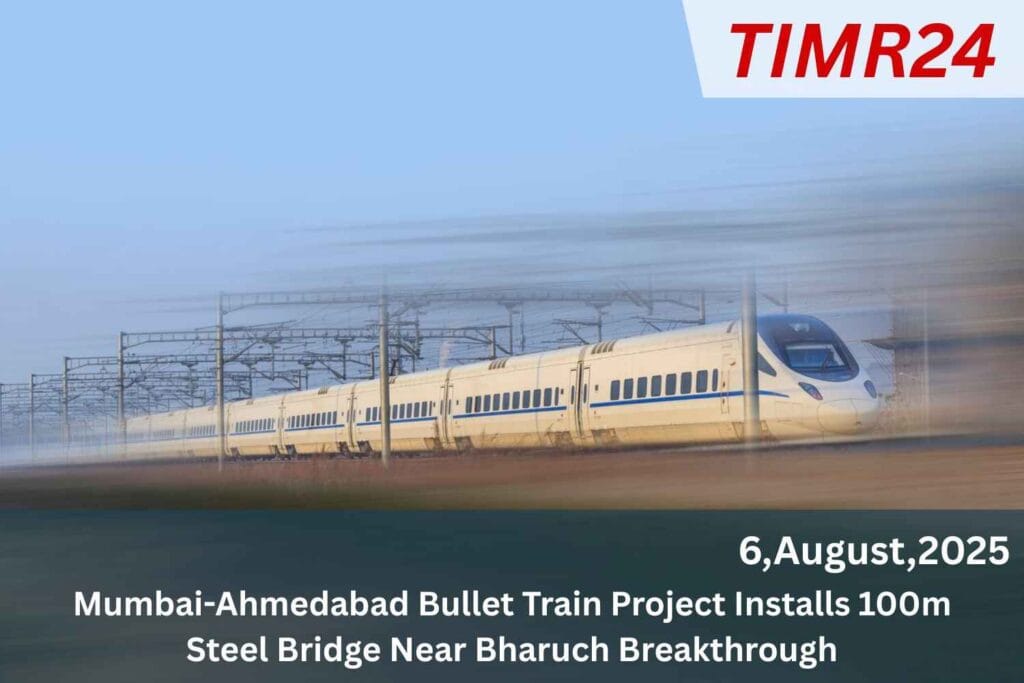
A 100 m long steel bridge was successfully launched over the DFC tracks near Bharuch, Gujarat, marking the eighth steel bridge completed for the Mumbai-Ahmedabad Bullet Train project. The bridge, weighing 1,400 metric tons, stands 14.6 meters tall and spans 14.3 meters wide. It was fabricated using 55,300 Nos. of Tor-Shear Type High Strength bolts and pulled using semi-automatic jacks. The launching was executed with traffic blocks to ensure safety and minimize disruption. The Mumbai-Ahmedabad High-Speed Rail (MAHSR) project achieved a major milestone with the successful installation of a 100-meter-long steel bridge near Bharuch, Gujarat.
Engineering Marvel Near Bharuch
The newly installed 100-meter-long steel bridge near Bharuch is one of the several critical structures along the 508-km MAHSR corridor. It was fabricated in a modular format and assembled on-site using precision engineering techniques. This kind of modular installation speeds up construction while maintaining high safety and quality standards. The bridge’s completion is especially significant as Bharuch is a flood-prone area and the installation demanded precise execution within a limited working window. This development marks a significant step forward in India’s first bullet train corridor, which is being executed by the National High-Speed Rail Corporation Limited (NHSRCL). The bridge, constructed over the Narmada river floodplain near Bharuch, demonstrates India’s advancing engineering capabilities in large-scale transport infrastructure.
Progress of the MAHSR Project
The Mumbai-Ahmedabad Bullet Train project is steadily progressing, with major civil and infrastructure works being carried out across Gujarat and Maharashtra. This includes the construction of (Bullet Train), bridges, stations, and maintenance depots. The project aims to connect Mumbai and Ahmedabad with a high-speed rail capable of running at 320 km/h, reducing the travel time between the two cities to approximately two hours. In addition to engineering complexity, the MAHSR corridor is also setting new benchmarks in project coordination. Multiple stakeholders, including Japanese consultants under the Shinkansen Technology Transfer initiative, Indian contractors, and state authorities, are working in close sync to meet construction timelines.
Importance of Steel Bridges in the Corridor
Steel bridges, like the one near Bharuch, are crucial for overcoming geographical obstacles such as rivers, valleys, and busy road crossings. These bridges are not only durable but also designed to withstand the dynamic loads of high-speed trains. Over 28 steel bridges are planned for the MAHSR route, with several already under various stages of completion, including installations. The bridge near Bharuch was installed with coordination between NHSRCL, local authorities, and expert contractors. Rigorous safety protocols were followed throughout the lifting and launching process. Heavy machinery, including specialized cranes and hydraulic jacks, was deployed to ensure minimal disruption to the surrounding environment and infrastructure. This seamless coordination ensures the implementation of best-in-class safety, quality, and environmental standards.
Boost to Regional Infrastructure
Once completed, the bullet train project is expected to significantly boost regional connectivity, economic activity, and employment. Cities like Bharuch, Surat, and Vadodara will benefit from enhanced accessibility, making them more attractive for industries and tourism. Moreover, the project is also expected to trigger a multiplier effect on ancillary sectors such as manufacturing, logistics, and construction. The installation of the 100-meter steel bridge near the (Project Progress) on Bharuch is a testament to the swift and structured progress of the Mumbai-Ahmedabad Bullet Train project. As more engineering milestones are achieved, the vision of high-speed rail travel in India moves closer to reality. For ongoing updates.
q1. What is the significance of the 100m steel bridge near Bharuch?
The bridge is a key structure enabling the bullet train to cross the Narmada River floodplain safely and efficiently.
q2. Who is executing the Mumbai-Ahmedabad Bullet Train project?
The project is being implemented by the National High-Speed Rail Corporation Limited (NHSRCL).
q3. How long is the Mumbai-Ahmedabad Bullet Train corridor?
The total length is 508 km, connecting Mumbai in Maharashtra to Ahmedabad in Gujarat.
q4. What speed will the bullet train achieve?
The train is designed to run at a maximum speed of 320 km/h.
q5. When is the expected completion date for the bullet train project?
The first phase is expected to be operational by 2026, subject to construction progress.