










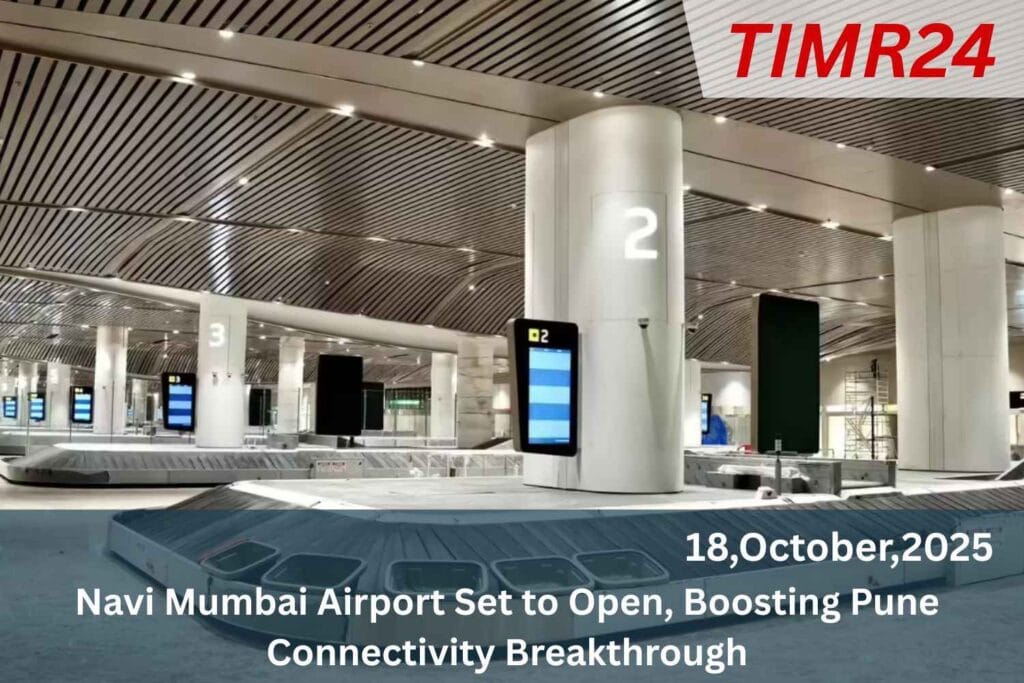
Navi Mumbai International Airport (NMIA) is set to open on September 30, offering residents of Pune and Pimpri Chinchwad a convenient alternative to Mumbai’s Chhatrapati Shivaji Maharaj International Airport. The airport, designed with a lotus-inspired layout and expansive terminals, is expected to reduce travel time and increase accessibility to long-haul flights to Europe. The first phase of NMIA is 94% complete, accommodating 60 flights per day and plans to expand to 300 daily within six months. The state government plans to integrate bus, metro, and rail services with NMIA. India’s aviation sector is on the brink of a major transformation with the upcoming launch.
The Navi Mumbai International Airport (NMIA) a long-awaited infrastructure marvel that promises to redefine regional connectivity and economic potential across Maharashtra. Developed as a modern alternative to the overburdened Chhatrapati Shivaji Maharaj International Airport (CSMIA) in Mumbai, (Coal) NMIA will serve as a second major gateway to western India, easing congestion while expanding access for travellers and industries alike. This state-of-the-art airport, being executed by Adani Airports Holdings Limited in collaboration with CIDCO (City and Industrial Development Corporation of Maharashtra), is expected to commence partial operations in 2025, with full-scale capacity by the end of the decade.
The Vision Behind Navi Mumbai International Airport
The foundation of NMIA is built on a vision to create a world-class aviation hub that complements Mumbai’s growing air traffic and strengthens India’s position as a global logistics center. With an estimated investment of ₹16,700 crore, the airport is designed to handle 60 million passengers annually once all phases are completed Situated near Panvel in Navi Mumbai, the airport covers nearly 1,160 hectares and will feature two parallel runways, multiple passenger terminals, and cutting-edge technology for operational efficiency. Designed by Zaha Hadid Architects, the structure will be a blend of futuristic design and Indian cultural aesthetics, making it one of Asia’s most architecturally advanced airports.
CIDCO’s blueprint emphasizes sustainability, smart management systems, and urban integration, ensuring that NMIA is not just an airport, but a city development catalyst that reshapes the surrounding region into a major economic corridor One of the most remarkable aspects of NMIA is its smart infrastructure approach. The airport incorporates AI-driven flight coordination systems, facial recognition technology, and automated passenger management to ensure seamless experiences. A key sustainability feature is its energy-efficient terminal, designed to utilize natural light and ventilation while reducing carbon emissions through solar power and rainwater harvesting.
Pune’s Enhanced Air and Economic Connectivity
The airport will have multimodal transport integration, connecting seamlessly with the Mumbai Trans Harbour Link (MTHL), Navi Mumbai Metro, Sion-Panvel Highway, and the Mumbai-Pune Expressway. Once the MTHL becomes fully operational, travel time from South Mumbai to NMIA will reduce to 25 minutes, and from Pune, to approximately two hours, offering an unprecedented level of convenience for both passengers and cargo operators. The biggest beneficiary of NMIA’s development will be Pune, Maharashtra’s thriving IT, education, and industrial hub. For decades, Pune has relied heavily on Mumbai’s airport for international flights and cargo logistics, causing.
Time delays and additional costs. With Navi Mumbai International Airport’s proximity and better road access, Pune’s global reach will expand exponentially Direct passenger and cargo flights via NMIA will help Pune’s industries, especially in automobile manufacturing (Chakan and Talegaon), pharmaceutical exports, and IT services, by reducing transit times and enhancing trade efficiency. The Hinjewadi IT Park, home to major global companies, will also benefit from the airport’s accessibility, attracting new investments and improving the business environment For travellers, NMIA will mean easier access to international destinations without needing to travel to central Mumbai.
Tourism and Real Estate Growth in Western Maharashtra
It will also help decongest Pune Airport, which has limited capacity and restricted civilian flight timings due to its shared operation with the Indian Air Force With the airport’s launch, tourism in Pune, Lonavala, Mahabaleshwar, and the Konkan coastal belt is expected to flourish. Direct flights from Navi Mumbai will attract domestic and foreign tourists seeking quick getaways from Mumbai or Pune. Moreover, NMIA’s location near Panvel and Ulwe has already triggered a real estate boom, with developers focusing on aerotropolis-style townships, business parks, and smart residential projects Infrastructure developers believe the Navi Mumbai Pune corridor could emerge.
As a new economic triangle, connecting industrial, educational, and tourism centers through road and rail integration. According to Maharashtra’s Urban Development Department, the project could attract investments worth ₹1 trillion in the next five years, transforming the (Zaha) region into a smart economic zone In alignment with India’s green growth mission, NMIA has been designed as one of the most eco-friendly airports in Asia. The use of solar panels, energy-efficient lighting systems, waste recycling plants, and low-emission ground vehicles ensures minimum environmental footprint. The airport aims for carbon neutrality by 2030, setting a benchmark for future infrastructure projects across the country.
Economic, Social, and Job Impact
Additionally, mangrove conservation and wetland restoration near the airport site have been prioritized under CIDCO’s supervision, ensuring environmental balance despite large-scale construction. This commitment echoes India’s broader goal of achieving net-zero emissions by 2070 and positions NMIA as a symbol of sustainable progress in urban infrastructure The construction and operation of NMIA are projected to generate over 200,000 jobs, both directly and indirectly. These range from engineering, aviation, and logistics to hospitality, retail, and tourism sectors. The airport will also serve as a training hub for aviation professionals and technicians.
Fostering skill development and creating employment opportunities for the local youth of Navi Mumbai, Raigad, and Pune districts Real estate, retail, and small businesses around Ulwe, Panvel, and Kharghar are witnessing an economic upswing as anticipation grows. The Maharashtra Industrial Development Corporation (MIDC) is planning satellite industrial clusters along the Pune-Mumbai corridor, ensuring balanced development across the state.
Challenges and Future Outlook
Despite its promise, NMIA’s development has faced several challenges, including land acquisition disputes, environmental clearances, and project delays due to the COVID-19 pandemic. However, with work progressing rapidly and multiple runways nearing completion, authorities have confirmed that Phase 1 will be ready by 2025. Once operational, NMIA is expected to handle 20 million passengers annually in the initial phase and gradually scale up. Experts believe that the airport will play a pivotal role in decentralizing air traffic from Mumbai, making western India’s infrastructure more efficient and resilient The Navi Mumbai International Airport stands.
As a symbol of India’s growing aviation capabilities and Maharashtra’s infrastructure-driven future. Beyond its architectural grandeur, it represents a bridge between opportunity and innovation connecting Pune’s dynamic industries, Mumbai’s financial strength, and India’s global ambitions By integrating sustainability, smart technology, and regional collaboration, NMIA will not only enhance Pune’s connectivity but also redefine how urban India moves, works, and grows. As Maharashtra prepares to open this monumental gateway, it’s clear that the sky is no longer the limit it’s the starting point for a new era of connected progress.
q1. When will Navi Mumbai International Airport open?
The airport is expected to become operational by mid-2025, according to CIDCO’s latest update.
q2. How will this airport benefit Pune?
It will drastically reduce travel time, improve cargo logistics, and enhance air connectivity between Pune and major global cities.
q3. Who is developing the airport?
The project is led by Adani Airports Holdings Ltd. in partnership with CIDCO.
q4. How far is Navi Mumbai Airport from Pune?
It’s approximately 125 km, with a travel time of about 2 to 2.5 hours via the Mumbai-Pune Expressway.
q5. What sustainable features does NMIA include?
It includes solar panels, AI-powered operations, and water recycling systems to ensure eco-friendly airport management.