












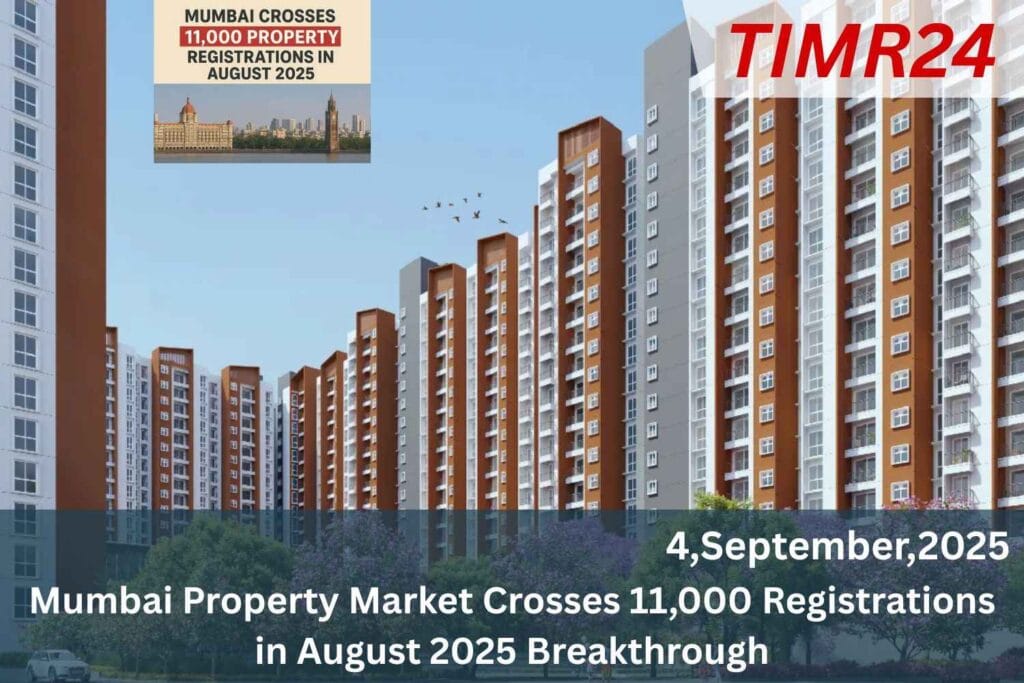
Mumbai’s property market saw 11,230 registrations in August 2025, with a 3% YoY and 11% MoM dip. Residential sales dominated, with compact units contributing 85%. Between January and August, the city recorded nearly 1 lakh registrations, generating ₹8,854 crore in stamp duty revenue. The Mumbai property market once again demonstrated its unmatched strength and resilience by recording more than 11,000 property registrations in August 2025, a milestone that reflects the city’s growing demand for residential and commercial spaces. This surge not only showcases Mumbai’s importance as the financial capital of India but also underlines.
How urban housing needs are evolving in line with infrastructure growth, lifestyle changes, and broader economic opportunities. The August figure is not just a number; it represents buyer confidence, developer activity, and the city’s ability to absorb new inventory while setting the stage for future investments One of the most important reasons for this impressive rise in registrations has been the ongoing infrastructure development projects across the Mumbai Metropolitan Region (MMR). With new metro lines becoming operational, the Mumbai Coastal Road project nearing completion, and expressway corridors linking Mumbai to Pune and Nashik, real estate hotspots have expanded beyond traditional zones.
Connectivity improvements have made areas like Thane, Navi Mumbai, and Mira-Bhayandar more attractive to first-time homebuyers as well as investors. Government support has also played a vital role. Policies around affordable housing, stamp duty benefits in the past years, and easy access to home loans have encouraged many families to move from rented accommodations to owned homes. Platforms such as ensure transparency and security in transactions, further boosting confidence.
Suburban Growth vs. South Mumbai’s Premium Pull
While South continues to attract high-net-worth buyers for luxury apartments in areas such as Worli, Tardeo, and Marine Drive, it is the suburban belts that are driving the numbers. Borivali, Kandivali, and Andheri recorded strong registration activity, supported by affordable ticket sizes and upcoming infrastructure like the Metro Line 7 and the Goregaon-Mulund Link Road (Property Market) The Eastern suburbs and Thane are also evolving into prime real estate corridors. Buyers who previously could not afford South Mumbai prices are finding value in Thane’s integrated townships, which offer modern amenities at a fraction of the cost. For a deeper dive into regional real estate, check our guide on.
Despite the growing fascination for luxury properties, it is mid-income housing that forms the backbone of Mumbai’s real estate registrations. Apartments priced between ₹50 lakh and ₹1.2 crore remain the most in-demand, particularly from salaried professionals working in the city’s IT, banking, and creative industries. The city’s working population, looking for stability and long-term value, continues to prioritize locations that balance affordability with connectivity. This trend is supported by developers like Lodha, Godrej Properties, and Oberoi Realty, who have been launching projects that cater specifically to the aspirations of middle-income families. For insights into developer strategies, visit CREDAI-MCHI (DoFollow), which regularly updates industry performance reports.
Luxury and Premium Housing Demand
At the same time, luxury real estate cannot be overlooked. With Mumbai being home to India’s wealthiest individuals, demand for exclusive apartments and penthouses continues to grow. Areas like Lower Parel, Worli, and Bandra have seen significant activity, with buyers looking for sea-facing apartments, large carpet areas, and world-class amenities. Interestingly, many Non-Resident Indians (NRIs) are also investing back into Mumbai’s luxury sector, encouraged by favourable exchange rates and India’s economic stability Compared to August 2024, property registrations in Mumbai grew by nearly 12%, a healthy figure that reflects the city’s ability to sustain demand even in fluctuating market conditions.
Experts suggest that the festive season ahead will further push the momentum, with Diwali expected to bring more offers, flexible payment plans, and new launches This upward trend also reflects how Mumbai’s housing market stands apart from other metros. While cities like Bengaluru and Pune show strong growth in IT-driven housing demand, Mumbai’s appeal is more diverse ranging from financial sector employees and entrepreneurs to global investors seeking a stable real estate market. For a comparative perspective, check our coverage on (Commercial Residential) where housing and infrastructure play a critical role.
Developer Strategies and New Launches
Developers have adapted to buyer needs by offering integrated projects with a focus on sustainability, green spaces, and community living. Many of the new launches in 2025 include mixed-use developments that combine retail, commercial, and residential components. This trend reflects the evolving preferences of urban buyers who seek convenience and lifestyle amenities in one place Larger developers such as Lodha and Hiranandani are also aligning with green building certifications, aiming to meet both environmental goals and consumer expectations. For further details, provides resources on sustainable real estate.
The long-term outlook for Mumbai’s real estate market remains positive. With infrastructure projects like the Navi Mumbai International Airport and Mumbai Trans-Harbour Link nearing completion, property values in adjoining areas are expected to rise significantly. For investors, this represents an opportunity to enter early and benefit from appreciation, while end-users continue to enjoy better connectivity and enhanced lifestyle options Moreover, as the Indian economy maintains its growth trajectory, Mumbai’s role as the commercial nerve center ensures steady employment opportunities, which directly feed into housing demand. For updates on national infrastructure projects.
Conclusion: A City That Keeps Growing
read our coverage and both of which highlight how India is boosting connectivity across regions. The milestone of crossing 11,000 property registrations in August 2025 demonstrates that Mumbai’s real estate market is not only recovering but thriving. The combination of government support, developer innovation, infrastructure upgrades, and evolving buyer aspirations ensures that the city will remain a prime investment hub for years to come. Whether it is the allure of South Mumbai’s luxury towers or the practical affordability of Thane and Navi Mumbai, the diversity of choices continues to strengthen the city’s position as the real estate capital of India.
For those considering property purchases, the time could not be more favourable. With festive offers around the corner, continued infrastructure enhancements, and long-term appreciation potential, Mumbai remains a city where real estate is more than just an asset it is a future.
Q1. What drove Mumbai’s property market to cross 11,000 registrations in August 2025?
Increased demand for residential units, affordable housing schemes, and positive economic growth fuelled this milestone.
Q2. Which areas in Mumbai saw the highest registrations?
Western suburbs like Andheri, Borivali, and Thane recorded maximum demand, followed by Navi Mumbai and South Mumbai.
Q3. How does August 2025 compare with the same period last year?
Registrations grew by nearly 12% year-on-year, reflecting improved buyer confidence.
Q4. Are luxury homes driving the surge in registrations?
Yes, luxury and premium housing saw notable traction, but mid-income housing remains the largest contributor.
Q5. What does this mean for future property investments in Mumbai?
Experts suggest a stable growth trend, making it an attractive time for both homebuyers and investors.