








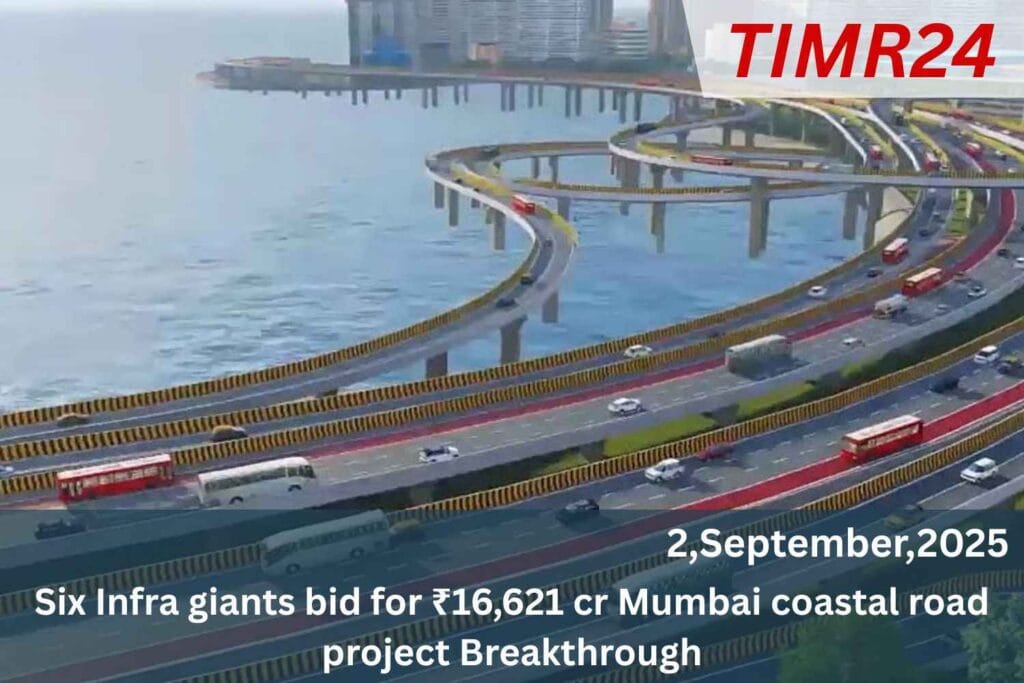
Six major infrastructure firms, including L&T, J Kumar Infraprojects, NCC Limited, Megha Engineering, APCO Infraprojects, and Afcons Infrastructure, are competing for the ₹16,621-crore Coastal Road project in Mumbai. The project is divided into six packages, with tendering for each package conducted separately. The Mumbai Coastal Road Project has quickly become one of India’s most ambitious urban infrastructure initiatives, attracting widespread attention from government authorities, investors, and citizens alike. With six major infrastructure companies submitting bids totaling ₹16,621 crore, the project demonstrates the immense scale and strategic importance of this undertaking for Mumbai’s urban mobility and economic development.
The road, envisioned to stretch along Mumbai’s western coastline from Marine Lines in South Mumbai to Kandivali in the north, is designed to significantly reduce travel times for commuters, decongest the city’s existing road network, and integrate seamlessly with the broader urban transport ecosystem The bidding process for this project was fiercely competitive, drawing participation from India’s top construction firms. Companies such as Larsen & Toubro, Tata Projects, and Shapoorji Pallonji Group are reportedly among the frontrunners, highlighting the project’s appeal as a landmark contract in the Indian infrastructure sector. These companies are known for their expertise in executing large-scale civil engineering projects, ranging from highways and bridges to metro rail networks.
Their involvement underscores the level of technical and financial commitment required for a project of this magnitude. The Mumbai Metropolitan Region Development Authority (MMRDA), which is overseeing the Coastal Road Project, has emphasized strict adherence to quality, safety, and environmental standards to ensure that construction aligns with global best practices. Detailed project specifications can be explored on the (MMRDA) From a city planning perspective, the Coastal Road is a transformative infrastructure project. Mumbai has long struggled with traffic congestion, particularly along its western arterial roads such as the Western Express Highway and Marine Drive. By creating a dedicated coastal corridor, the project aims to redistribute traffic.
Flows, reduce bottlenecks, and enhance the efficiency of commuting for both private and public transport users. Urban planners also envision the integration of the Coastal Road with other transport projects, including metro lines and upcoming expressways, to create a cohesive network that improves accessibility across the city. This vision aligns with Mumbai’s broader smart city initiatives, which aim to leverage technology and infrastructure planning to create more livable, efficient, and sustainable urban spaces. More information on smart city projects can be accessed The design and sustainability aspects of the Coastal Road Project are equally noteworthy. Beyond easing vehicular traffic.
The project plans include landscaped green belts, pedestrian pathways, and cycling tracks, demonstrating a commitment to environmentally friendly urban development. Measures to protect coastal ecosystems, such as mangrove restoration and pollution control systems, are also being incorporated. This focus on sustainability not only ensures compliance with environmental regulations but also contributes to improving the quality of life for residents and visitors. For insights on sustainable urban infrastructure, refer to (India Infrastructure) Economically, the ₹16,621 crore investment represents a significant stimulus for Mumbai and the surrounding region. Large-scale infrastructure projects such as this generate substantial employment opportunities during.
The construction phase, ranging from skilled engineers and project managers to laborers and logistics personnel. The demand for raw materials such as steel, cement, and machinery further benefits ancillary industries, creating a multiplier effect on the economy. Once operational, the Coastal Road is expected to improve connectivity between business districts, residential areas, and industrial hubs, thereby facilitating trade, boosting real estate development, and enhancing overall economic activity. For detailed insights on investment opportunities in Indian infrastructure, the India Infrastructure provides comprehensive resources Technological innovation is a core element of the project Advanced traffic management systems, automated surveillance, disaster-resilient.
construction techniques, and real-time monitoring are being incorporated to ensure commuter safety and operational efficiency. The use of intelligent transport systems (ITS) will enable dynamic traffic flow management, reducing congestion and minimizing the risk of accidents. Additionally, the project integrates lessons learned from other global coastal infrastructure developments, ensuring that Mumbai benefits from proven engineering practices while adapting to local environmental and urban conditions.
The Coastal Road also carries social and urban mobility benefits. By shortening travel times and creating more reliable transport routes, it enhances access to education, healthcare, and employment opportunities for residents across the city. Improved road connectivity between South and North Mumbai is expected to facilitate smoother commutes, reducing stress and allowing people to reclaim hours previously lost in traffic jams. Additionally, the project is expected to bolster tourism, as the scenic coastal corridor provides enhanced accessibility to beaches, promenades, and cultural landmarks along the western coastline.
A critical consideration for the project has been environmental management. Mumbai’s coastline is home to sensitive ecosystems, including mangroves, estuaries, and marine habitats. The Coastal Road Project has adopted a series of measures to mitigate environmental impact, including the construction of artificial mangroves, eco-friendly drainage systems, and controlled construction techniques to minimize pollution. Collaboration with environmental consultants ensures that the project adheres to both national and international sustainability standards. These initiatives demonstrate that modern urban infrastructure can be designed with both developmental and ecological considerations in mind.
The long-term strategic significance of the Coastal Road Project cannot be overstated. By establishing a high-capacity corridor along Mumbai’s western coastline, the city is not only addressing immediate traffic concerns but also preparing for future urban growth. As Mumbai continues to expand, the demand for efficient transportation infrastructure will increase, and projects like the Coastal Road ensure that the city remains resilient and navigable. Moreover, the project serves as a benchmark for other Indian cities, providing a template for integrating transportation, sustainability, and smart city planning into cohesive urban development strategies.
In conclusion, the Mumbai Coastal Road Project, backed by bids from six leading infrastructure companies totaling ₹16,621 crore, is set to redefine urban mobility and infrastructure in Mumbai. The combination of advanced engineering, environmental stewardship, and strategic urban planning ensures that the Coastal Road will deliver economic, social, and environmental benefits. With government oversight by MMRDA and alignment with smart city objectives, the project demonstrates how visionary infrastructure can transform a city, streamline transportation, and improve quality of life for residents and visitors alike. As Mumbai moves closer to realizing this ambitious project.
Q1. What is the Mumbai Coastal Road Project?
A major urban road initiative spanning 29 km to connect South Mumbai to Kandivali.
Q2. How much is the project valued at?
The total bids from six infra giants amount to ₹16,621 crore.
Q3. Who is overseeing the project?
The Mumbai Metropolitan Region Development Authority (MMRDA) is responsible for monitoring quality and execution.
Q4. What are the benefits of the project?
Reduced travel time, improved connectivity, urban development, and sustainable infrastructure.
Q5. Which companies are bidding for the project?
Leading infrastructure companies like Larsen & Toubro, Tata Projects, and Shapoorji Pallonji are among the frontrunners.