











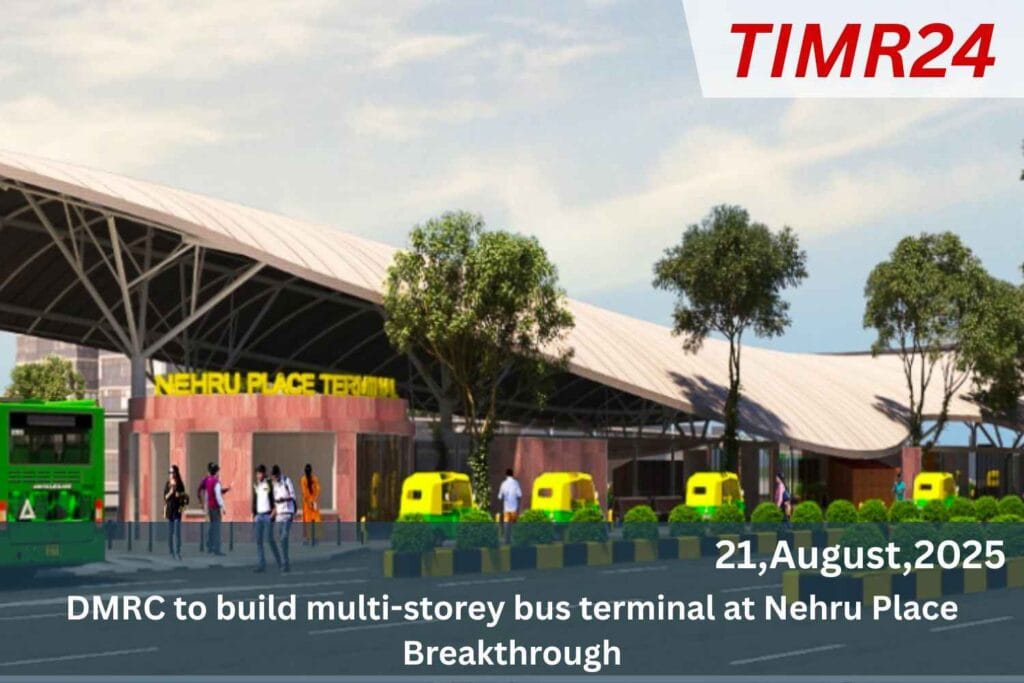
The Delhi government plans to build a multi-storey bus terminal in Nehru Place, South Delhi, with a total area of 15,749 square metres. The terminal will have a commercial development area, parking space for 472 cars, and capacity to accommodate over 120 buses. The project is part of a public-private partnership with the Delhi Metro Rail Corporation. The Delhi Metro Rail Corporation (DMRC) has announced a landmark project that will redefine urban connectivity in the national capital – the development of a state-of-the-art multi-storey bus terminal at Nehru Place.
This initiative is not just about creating a new transport hub; it represents a broader vision of integrating various modes of mobility under one roof to ensure a seamless travel experience for commuters. Nehru Place, already a bustling hub for IT businesses, shopping complexes, and metro connectivity, will now be positioned as one of the most advanced intermodal transport centres in Delhi. The capital city has long struggled with rising traffic congestion and inadequate last-mile connectivity. The Nehru Place bus terminal project is expected to address both these challenges by providing direct access to buses, auto-rickshaws, and metro lines within a single integrated space.
By reducing the dependency on scattered bus stops and improving the scheduling efficiency of public transport, DMRC is laying the foundation for smoother passenger movement across Delhi. This project aligns with other recent infrastructure upgrades like the (Delhi Metro) and the introduction of electric buses in different parts of the city. The proposed multi-storey bus terminal will be equipped with modern infrastructure, including advanced parking bays, digital information displays, and passenger-friendly amenities such as waiting lounges, food kiosks, restrooms, and automated ticket counters The multi-level design is aimed at ensuring that different categories of buses long-route, intra-city, and feeder services can operate without bottlenecks.
Economic and Social Impact
A critical aspect of the design is its integration with the Nehru Place metro station, allowing passengers to switch modes of transport conveniently. DMRC is also emphasizing sustainable construction practices, including energy-efficient lighting, water recycling systems, and designated spaces for electric vehicle charging. The creation of a multi-storey terminal at Nehru Place is not only a transportation breakthrough but also an economic catalyst. Thousands of commuters who rely on Nehru Place for work, shopping, and business will experience significant time savings and reduced travel stress. Local businesses are expected to benefit from increased footfall, while improved.
Connectivity will encourage more companies to set up offices in the vicinity. Additionally, the terminal will create direct and indirect employment opportunities, ranging from construction jobs to long-term positions in operations and maintenance. Similar to projects like the which boosted local real estate and commerce, this terminal is expected to uplift the surrounding economy of South Delhi has been at the forefront of discussions about sustainable urban mobility, and the Nehru Place bus terminal is being positioned as a green model. By encouraging public transport use and discouraging private car dependency, the terminal is expected to lower overall carbon emissions in the area.
The integration of electric buses into the terminal’s design is a crucial step toward achieving Delhi’s environmental targets. Initiatives such are complementary to this effort, and together they signal a nationwide shift toward greener transport infrastructure. One of the most significant aspects of the Nehru Place terminal is its emphasis on the passenger experience. Unlike traditional bus depots that often lack facilities, this hub will prioritize commuter comfort and efficiency. Advanced information systems will display real-time bus arrival and departure schedules, while digital integration with the Delhi Metro app will allow passengers to plan their routes with ease.
Future Vision and Connectivity
The terminal will also provide special access features for differently-abled passengers, ensuring inclusivity in transport planning. In many ways, this reflects a broader trend in India where public infrastructure is evolving to match global standards of service and convenience. DMRC’s vision for this project extends beyond Nehru Place. The multi-storey bus terminal is expected to serve as a model for future hubs across the capital. Similar projects are already being considered at major transport nodes like Kashmiri Gate, Dwarka, and Anand Vihar. By creating interconnected, multi-modal facilities, Delhi is moving toward a transport ecosystem
Where passengers can switch seamlessly between metro, bus, rail, and even air travel corridors. The Nehru Place project will also complement upcoming road and rail initiatives such as (DMRC) highlighting India’s focus on holistic mobility solutions. The announcement of a multi-storey bus terminal at Nehru Place by DMRC is more than just a construction update it is a vision for the future of Delhi’s transport landscape. With its integrated design, passenger-centric features, and focus on sustainability, the terminal represents a breakthrough in how urban mobility is planned
Q1. What is DMRC building at Nehru Place?
A modern multi-storey bus terminal to improve transport facilities.
Q2. How will the new terminal benefit commuters?
It will provide better connectivity, comfort, and reduce traffic congestion.
Q3. When is the Nehru Place bus terminal project expected to be completed?
The timeline will be announced by DMRC after final approvals.
Q4. Will the terminal have modern facilities?
Yes, it will feature passenger amenities, parking, and seamless metro-bus integration.
Q5. How will this project impact South Delhi traffic?
It is expected to ease congestion and streamline bus operations in the area.