


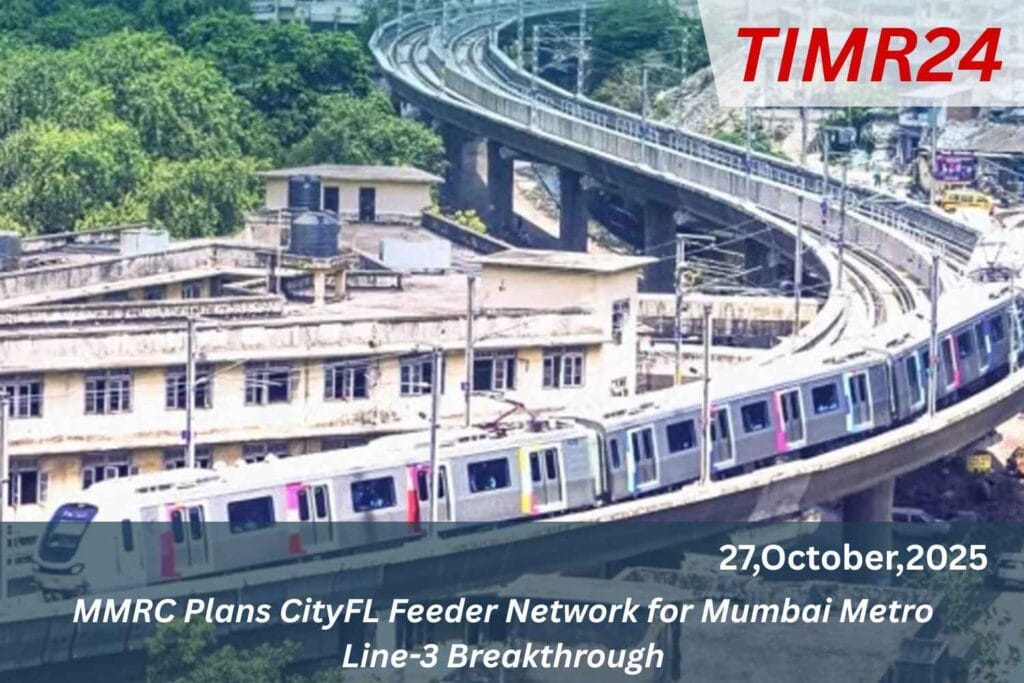
Mumbai Metro Rail Corporation plans to introduce a CityFL feeder network for Metro Line-3, aiming to provide seamless last-mile connectivity from stations to surrounding neighbourhoods and commercial hubs. The system will include electric buses, e-autos, and shared mobility options Here’s a detailed look at how the Mumbai Metro Rail Corporation (MMRC) has partnered with Cityflo to set up a feeder-bus network for Mumbai Metro Line 3 (the “Aqua Line”) and what it means in terms of integration, connectivity, commuter convenience and the wider mobility ecosystem of Mumbai The Aqua Line has been positioned by MMRC as a transformational.
Corridor in Mumbai’s urban transit landscape. But even the best metro line is only as effective as the ease with which people can get to and leave from its stations. Recognising this, MMRC has teamed with Cityflo to launch dedicated feeder-bus services that link several key stations (MMRC) along Metro Line 3 with the surrounding business hubs, residential precincts and major trip-generators. According to multiple reports, the feeder service will initially operate from three major stations: Bandra‑Kurla Complex (BKC), Worli and Chhatrapati Shivaji Maharaj Terminus (CSMT) From the BKC station, the feeder buses will connect to major landmarks such as.
The National Stock Exchange (NSE), Jorden, One BKC, the Family Court, which are significant employment and commercial zones. From Worli, the service will link the Century Mills complex, One India bulls Centre, Kamala Mills and Peninsula Corporate Park. From CSMT, the route will serve the Old Custom House, Lions Gate, S.P. Mukherjee Chowk, K.C. College and the nearby Churchgate Metro station What this means is that the metro station isn’t simply a stop in isolation, but becomes the hub of a wider network, feeding into nearby destinations that previously might have required a separate bus or private vehicle The operational model is designed to reduce.
Waiting times and make the feeder service truly viable for daily commuters. For example, buses are scheduled to run every ten minutes during peak hours. That level of frequency sends a strong message: this is not a token service but an integral part of the mobility chain On fares, the single-ride fare has been set at ₹ 29 and there is (at least initially) a monthly pass priced at ₹ 499 to attract regular users On the digital front, ticketing has been integrated via both the Cityflo app and the Metro-specific “MetroConnect3” app (or similar) so that commuters can plan and pay more seamlessly From a strategic viewpoint, this linkage addresses one of the long-standing.
Bottlenecks in metro systems in India: the “first-mile/last-mile” gap. Many commuters may find getting to a metro station difficult if there’s no good feeder service, and similarly leaving the station to their final destination can be cumbersome. By introducing dedicated feeder buses that synchronise with the metro, MMRC and Cityflo are aiming to close that gap and thereby boost the attractiveness of Metro Line 3 as a full-journey solution not just a trunk corridor. Indeed, MMRC’s director R. Ramana is quoted saying that “Metro Line 3 marks a new era in Mumbai’s public transport. To ensure seamless travel, it’s essential that commuters have reliable first and last.
Mumbai’s Metro Network
Mile options On the Cityflo side, the CEO Jerin Venda emphasises that the move is aimed at building “an integrated mobility ecosystem” for Mumbai, and encouraging citizens to switch from private vehicles to shared, tech-enabled transit In terms of urban mobility impact, this feeder system is more than just additional buses. It is part of a push towards sustainable transport modes (Karnataka) Metro provides high-capacity, congested-road-relief service along major corridors; the feeder buses ensure that people can reach the metro easily; together they unlock modal shift from cars/taxis to public transit, thereby easing traffic, lowering emissions and improving.
Overall network efficiency. Reports underline that Mumbai’s metro network has expanded rapidly, and commuter adoption will be higher when interchange, connectivity and access are strengthened Of course, there are challenges and things to watch. For one, even though the service is launched, full station coverage and user adoption take time. The feeder buses are currently operational at BKC and Worli, with the CSMT feeder service still slated to begin “by end of month” as of the reports Also, while the fare structure is affordable, the long-term viability of the service will depend on ridership levels, route efficiency, integration of timings, and growth.
The catchment areas. Another point is the broader ticketing integration across all metro services in the city: while this feeder-metro link is digitised, commuters still desire even wider integration (with other lines, trains, bus services) so as to minimise transfers and friction. Indeed, users have pointed out that metro lines in Mumbai still suffer from fragmentation of apps, ticketing and transfers In the bigger picture, this initiative sets a precedent. By showing how metro network plus feeder buses can be made into a well-integrated system, MMRC is demonstrating a template for future corridors. Metro Line 3 is delivering high-capacity underground rail service.
Across critical nodes in Mumbai; the feeder buses ensure that the benefits of that corridor are extended to nearby employment zones and residential pockets. That means higher utilisations of the metro, better service for commuters, and greater return on infrastructure investment over time From the commuter’s perspective, what does this change mean? Imagine commuting from office at One BKC: earlier you might have taken a road-vehicle or shared-taxi to your local metro station, then metro, then another transport mode. With the feeder bus, you can walk or hail a bus from the metro station entrance to your office hub, paying a single fare for the feeder portion.
(₹ 29 or the monthly pass) and then board the metro for the main leg of your journey. This reduces time lost in transfers, waiting, road-traffic delays, and uncertainty. It also makes the choice of using public transport more compelling compared to taking a car or bike A critical aspect will be ensuring the feeder routes match the metro schedule, operate reliably during peak hours, and cover the most logical destinations job hubs, commercial centres, residential pockets, major transit nodes. If the feeder bus comes every ten minutes during peak hours and serves the corridors around stations efficiently, commuters will find it convenient.
MMRC-Cityflo
The fact that the buses run every 10 minutes is a strong start. But for sustained success, the service may need even higher frequency, extra capacity during peak surges, and continuous monitoring of user patterns Another area of evolution will be ticketing and payment convenience. While integration via two apps is a good beginning, the future ideal is a single mobility-card or multimodal wallet that covers metro, feeder bus, other bus services, suburban trains, and even last-mile shared mobility options. In that respect, the MMRC-Cityflo link is a step in the right direction, but farther integration will enhance usability further Finally, there is the urban planning and catchment area dimension.
For a feeder network to truly succeed, the land-use around the stations needs to support high footfall: offices, residential, retail, mixed-use developments, good pedestrian access and safe last-mile paths. The choice of BKC, Worli and CSMT indicates that the feeder system is targeting high-density zones with strong trip generation. Over time, expansion of feeder services to more stations and more neighbourhoods will extend the reach of Metro Line 3 deeper into the urban fabric of Mumbai the MMRC-Cityflo feeder bus network for Metro Line 3 is a significant milestone in Mumbai’s public transport evolution. It addresses the crucial first-mile/last-mile challenge, makes.
Use of technology for ticketing and integration, ties the metro line into employment and commercial zones, and promotes a shift away from private transport. The success of the service will depend on execution, frequency, route coverage, and ongoing integration with the broader transit ecosystem. But as things stand, it is a well-conceived initiative that raises the standard for how metro systems in India can be complemented by zonal feeder services.
Q1. What is the new feeder bus service launched by MMRC and Cityflo for Metro Line 3?
The service is a dedicated bus network operated in partnership between MMRC and Cityflo that connects key Metro Line 3 stations (such as BKC, Worli, CSMT) to surrounding business and residential areas, improving first- and last-mile connectivity.
Q2. Which stations will the feeder buses initially cover?
Initially the service will cover stations at Bandra‑Kurla Complex (BKC), Worli and Chhatrapati Shivaji Maharaj Terminus (CSMT).
Q3. How much will it cost and how do passengers buy tickets?
Answer: The single-ride fare starts at ₹29, with a monthly pass option at ₹499. Ticketing is available via the Cityflo app and the MetroConnect3 app, with plans for deeper integration.
Q3. What is the frequency of the feeder buses and what are the service features?
Answer: Buses will operate at about every 10 minutes during peak hours. The routes link metro stations with nearby employment/business hubs and residential zones to make the metro more accessible.
Q4. What are the expected benefits of introducing this feeder network?
The feeder network aims to reduce the walking/commute gap to and from Metro Line 3 stations, boost metro ridership, reduce reliance on private vehicles, ease congestion, and create a more integrated, tech-enabled mobility ecosystem in Mumbai.