











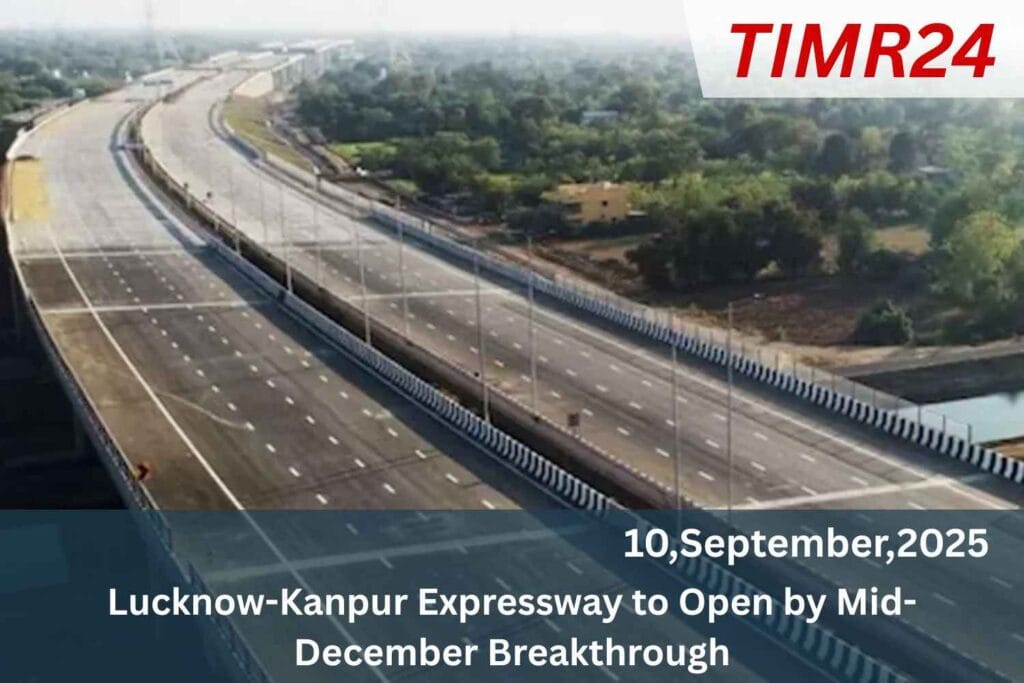
The Lucknow-Kanpur Expressway, a 63-kilometre road built along NH-27 at an estimated cost of Rs 47 billion, is set to be fully completed by 15 December. The project aims to enhance connectivity between Lucknow and Kanpur, two major industrial and administrative hubs in Uttar Pradesh. The NHAI confirmed that only minor work remains, with final tasks expected to be completed between the first and second week of December. The expressway will reduce travel time between Lucknow and Kanpur to just one hour. A trial run will be conducted before the official opening.
The state of Uttar Pradesh is preparing to witness another landmark development in its infrastructure landscape with the inauguration of the Lucknow Kanpur Expressway, expected to open by mid-December 2025. This 63-km long expressway has been a highly anticipated project for years, primarily because it connects two of the most significant cities in the region Lucknow, the capital city known for its cultural richness and administrative importance, and Kanpur, the industrial and commercial powerhouse of Uttar Pradesh. Together, these two cities form a dynamic growth corridor, and the new expressway is poised to not only reduce travel time but also transform the way people, goods, and businesses move between them.
The journey from Lucknow to Kanpur has traditionally been a time-consuming affair, often stretching to two and a half hours or more due to congested routes and mixed traffic conditions. With the expressway designed for high-speed mobility, this travel time will be reduced dramatically to around one hour, offering unprecedented convenience for both daily commuters and long-distance travellers. The project is being spearheaded by the Uttar Pradesh Expressways Industrial Development Authority (UPEIDA), the same body responsible for some of the state’s most ambitious road projects such as The new corridor not only promises to improve intercity connectivity but also adds.
A vital link to the state’s expanding network of high-speed road infrastructure The expressway is not just a travel convenience it is expected to serve as an economic lifeline. Lucknow, with its administrative clout and growing IT sector, and Kanpur, known for textiles, leather, and heavy industries, have always been interdependent in terms of trade and workforce exchange. By providing a seamless road link, the expressway will cut down logistics costs and streamline the transport of goods, particularly for industries relying on fast supply chains. According to data from (NHAI) better highway networks not only save time but also reduce fuel consumption and vehicle operating costs.
Which in turn enhances business competitiveness. With freight corridors becoming more reliable, Kanpur’s industrial base will gain an edge in reaching national markets, while Lucknow will further consolidate its position as a commercial and administrative hub Beyond trade and commerce, the expressway also holds immense significance for tourism and cultural exchange. Lucknow has always attracted visitors for its iconic sites such as Bara Imambara, Rumi Darwaza, and its unique Awadhi cuisine, while Kanpur is home to attractions like Allen Forest Zoo, JK Temple, and various colonial-era landmarks. With travel time reduced, tourists will be able to plan same-day.
Or weekend trips between the two cities more conveniently. In a state like Uttar Pradesh, which boasts not only historical monuments but also religious sites of national importance, infrastructure like the Lucknow Kanpur Expressway plays a pivotal role in unlocking the true potential of tourism revenue. Similar to how the (IRB Infrastructure) spurred tourism in Agra, this project is expected to create a ripple effect across central Uttar Pradesh.
Safety and sustainability have also been kept in mind during the design phase of the expressway. Automated toll collection, CCTV-based monitoring, and emergency response services are expected to be integrated to ensure a secure and efficient commuting experience. In addition, UPEIDA has emphasized the creation of green belts and environmental buffers along the alignment to reduce noise and air pollution. These eco-friendly measures align with India’s larger commitment to sustainable infrastructure, where highways are not just about speed but also about minimizing environmental impact. With road safety being a growing concern in India, such integrated features will help make expressway travel not only faster but also more reliable and secure.
The expressway also ties into the broader vision of Uttar Pradesh becoming a logistics and connectivity powerhouse. Over the past decade, the state government has aggressively expanded its expressway network, with projects like the Bundelkhand Expressway, Ganga Expressway, and Purvanchal Expressway creating a dense grid of high-speed corridors. Once the Lucknow–Kanpur Expressway becomes operational, it will further strengthen links to the National Capital Region (NCR) and other major trade routes. This interconnectivity has been crucial in attracting investments to the state, particularly from manufacturing and warehousing sectors. With the central government also emphasizing industrial corridors and freight efficiency, projects like this one help Uttar Pradesh align with national development goals.
From a regional development perspective, the expressway is expected to generate employment and real estate growth along its route. New townships, industrial parks, and logistics hubs are likely to emerge, mirroring the development witnessed along the Agra–Lucknow and Yamuna Expressways. For smaller towns and villages located near the alignment, the expressway opens up opportunities for improved access to markets, healthcare, and education. Infrastructure, when done right, creates multiplier effects, and this project has the potential to transform the socio-economic fabric of central Uttar Pradesh It is also important to see this project in the context of India’s.
Larger highway modernization journey. Expressways like Delhi–Meerut, Yamuna, and Mumbai Nagpur Samruddhi Mahamari have already demonstrated how high-speed roadways can reshape urban-rural dynamics, ease pressure on older highways, and promote balanced development. By mid-December 2025, when the Lucknow Kanpur Expressway opens to the public, Uttar Pradesh will take another big step in cementing its reputation as the “Expressway State of India.” The progress is not just about physical roads but about building confidence among investors, travellers, and local communities that growth and connectivity can go hand in hand.
On the digital side, the expressway is likely to integrate smart mobility features in the future, including electronic toll collection through FASTag, GPS-enabled traffic management, and real-time updates for commuters. As India transitions into an era of smart cities and intelligent transport systems, expressways like this will become crucial platforms for testing and implementing such innovations. While the initial focus is on physical connectivity, the long-term vision clearly points towards a future where technology and mobility converge seamlessly.
As the countdown to its opening begins, the Lucknow–Kanpur Expressway represents much more than a stretch of road—it embodies the aspirations of a state that is determined to modernize, expand its economic frontiers, and offer its people the benefits of world-class infrastructure. For the lakhs of commuters who travel between Lucknow and Kanpur every month, the project will redefine their daily lives. For industries, it will mean faster access to markets. For tourists, it will open new doors of exploration. And for Uttar Pradesh as a whole, it will be a symbol of progress, vision, and connectivity.
By mid-December 2025, when vehicles finally roll down this expressway, it will not just shorten distances—it will also pave the way for a new era of growth for Uttar Pradesh. The journey from Lucknow to Kanpur will no longer be about traffic jams and long waits, but about speed, safety, and opportunity. With every kilometre, the expressway will tell a story of how infrastructure can truly transform lives.
Q1. When will the Lucknow–Kanpur Expressway open?
The expressway is expected to open by mid-December 2025.
Q2. How much travel time will it save?
It will reduce Lucknow–Kanpur travel time from 2.5 hours to around 1 hour.
Q3. What is the length of the expressway?
The expressway spans approximately 63 km.
Q4. Who is constructing the Lucknow–Kanpur Expressway?
The project is being executed under the Uttar Pradesh Expressways Industrial Development Authority (UPEIDA).
Q5. Will the expressway connect to other highways?
Yes, it will link with the Agra–Lucknow Expressway and Purvanchal Expressway, improving overall regional connectivity.