











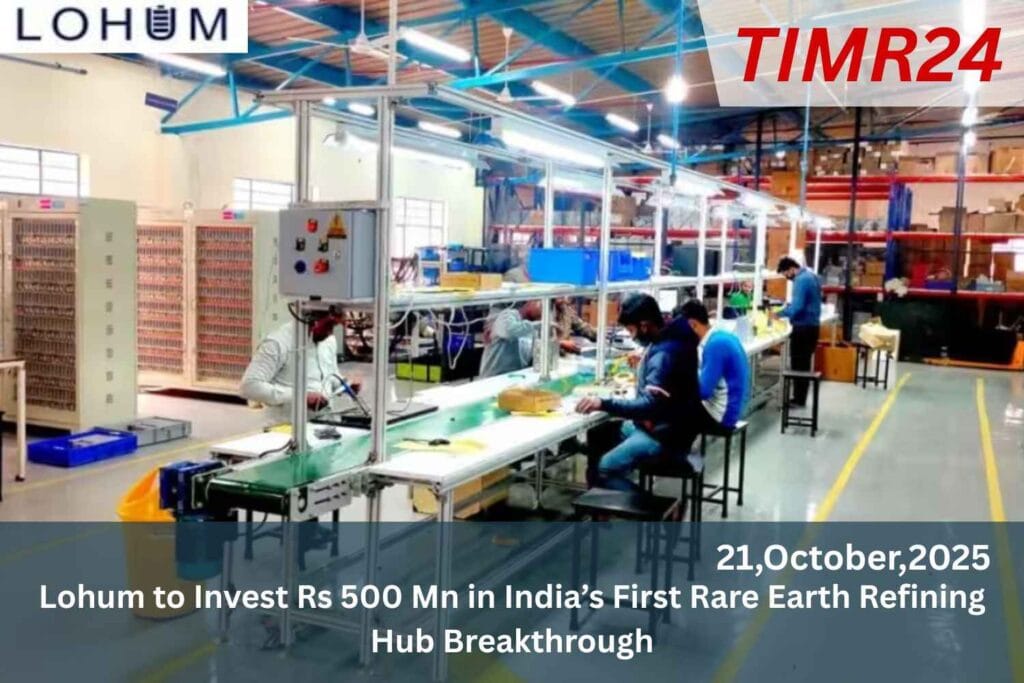
Lohum plans to invest Rs 500 million to establish India’s first rare earth refining hub, aiming to strengthen the nation’s critical minerals supply chain and advance the government’s Critical M. The facility will refine rare earth elements essential for electric mobility, advanced batteries, and green technologies. Lohum plans to expand its recycling capacity four to five times by 2029 and establish two Centres of Excellence for sustainable materials recovery and circular technologies. Lohum, a pioneer in sustainable energy transition and battery recycling solutions, has announced a groundbreaking investment of Rs 500 million to establish India’s first rare earth refining hub.
This significant move is set to revolutionize the country’s domestic capabilities in processing and recycling critical minerals, particularly rare earth elements (REEs), which are essential components for electric vehicle (EV) motors, high-capacity batteries, and advanced electronics. By creating a local infrastructure for rare earth refining, Lohum is not only contributing to India’s technological self-reliance but also aligning with global trends toward sustainable resource management and the circular economy. According to (KEC) the facility is designed to support India’s growing need for domestically sourced critical minerals, which have traditionally been imported in large volumes.
Rspecially from China. This project represents a strategic step toward reducing India’s dependency on global supply chains while simultaneously fostering innovation in the clean energy sector India’s dependence on imported rare earth elements has been a longstanding challenge. With over 90% of its critical minerals coming from foreign sources, India faces supply vulnerabilities that can impact the growth of the EV sector, renewable energy infrastructure, and high-tech manufacturing. Rare earth elements, including neodymium, praseodymium, and dysprosium, are essential for manufacturing strong magnets used in EV motors and wind turbines, as well as for.
The production of lithium-ion batteries. By establishing a domestic refining hub, Lohum aims to create a robust ecosystem where used batteries and industrial waste can be processed to recover these high-value minerals. This initiative aligns with the Atmanirbhar Bharat Mission, emphasizing self-reliance in strategic sectors, and complements India’s National Resource Efficiency Policy (NREP), which encourages sustainable recycling and resource optimization The strategic significance of Lohum’s investment extends beyond raw material recovery. As India accelerates its transition toward electric mobility, the availability of domestically refined rare earths becomes.
A crucial factor in ensuring the scalability and affordability of EVs. Current EV manufacturers such as and reply heavily on imported components, which exposes them to fluctuations in global supply and price. With Lohum’s hub in operation, India can establish a closed-loop supply chain for critical minerals, allowing batteries and motors to be manufactured, recycled, and refined locally. This not only reduces costs and dependence on imports but also significantly mitigates the environmental footprint of mining and transporting rare earth elements from overseas. In addition to its industrial and economic impact, Lohum’s project is expected to bring considerable environmental.
Benefits The facility is planned to incorporate zero-liquid discharge (ZLD) systems and environmentally sustainable processing techniques, minimizing waste and reducing water consumption. By recovering high-value elements from discarded batteries and electronic waste, the hub will also prevent the accumulation of toxic metals in landfills, a common environmental concern associated with battery disposal. According to India EV News, such initiatives are critical for achieving India’s long-term sustainability targets and for supporting the nation’s commitments under global climate agreements. The combination of technological innovation and environmental responsibility positions Lohum as a leader in responsible industrial practices.
The economic implications of this investment are substantial. The establishment of the rare earth refining hub is projected to generate over 400 direct and indirect jobs in its initial phase, spanning roles in operations, logistics, research, and quality control. Beyond immediate employment, the hub will stimulate growth in allied sectors such as EV manufacturing, renewable energy projects, and battery recycling. By creating a domestic base for refining rare earths, Lohum is also expected to reduce India’s import bill for these critical minerals by 10–12% annually, contributing to both trade balance improvements and industrial competitiveness. The project, therefore, represents a multi-dimensional boost to India’s economy.
Merging environmental responsibility with industrial growth Lohum’s rare earth refining hub is also part of a broader vision to establish critical mineral clusters across India. The company is actively exploring partnerships with international firms, particularly from Europe and Japan, to integrate advanced refining technologies and operational best practices. This global collaboration is crucial, as rare earth refining involves sophisticated chemical and metallurgical processes that require high precision and environmental safeguards. By leveraging international expertise, Lohum can ensure that India’s hub meets global standards for efficiency, safety, and sustainability.
Moreover, this initiative complements India’s increasing participation in international strategic partnerships on critical minerals, such as collaborations with Australia and the United States, aimed at securing supply chains and fostering technological exchange. For more on global mineral policies, see The technological infrastructure of the hub is designed to maximize efficiency and sustainability. Lohum plans to implement cutting-edge processes that allow simultaneous extraction of multiple rare earth elements from spent batteries, reducing energy consumption and waste. By using advanced automation and precision analytics, the facility can optimize material recovery rates.
Ensuring that nearly all valuable components are reclaimed. This not only enhances the economic viability of the hub but also reduces the environmental footprint of refining operations. The integration of research and development within the hub will further support continuous innovation, enabling Lohum to adopt new techniques as technologies evolve. Internal collaboration with entities involved in battery recycling and clean energy initiatives, (Solar’s) reinforces the vision of a comprehensive domestic energy ecosystem Government support and policy alignment play a vital role in enabling such projects. Lohum’s investment benefits from policy frameworks promoting domestic.
Critical mineral processing, incentives for clean energy initiatives, and export facilitation for high-value recycled materials. The government’s focus on enhancing EV adoption, renewable energy generation, and green manufacturing provides an enabling environment for companies like Lohum to innovate and scale rapidly. By integrating these efforts with domestic industrial clusters, the project demonstrates how strategic investments can create a self-sustaining ecosystem that benefits industry, environment, and society simultaneously Looking ahead, Lohum’s rare earth hub is poised to become a cornerstone of India’s clean energy transition.
The combination of advanced technology, environmental responsibility, and strategic economic planning positions the facility as a model for sustainable industrial development. Beyond rare earth refining, the hub will enable India to develop robust battery recycling networks, support EV growth, and establish itself as a leader in global critical mineral innovation. Internal collaboration with other clean energy initiatives, government-backed projects, and international partnerships ensures that the hub’s impact will resonate across the country and beyond. By transforming waste into high-value resources, Lohum exemplifies how innovation can drive both economic growth.
q1. What is Lohum’s Rs 500 Mn investment for?
Lohum is investing Rs 500 million to set up India’s first rare earth refining hub, aimed at strengthening domestic critical mineral processing and recycling capabilities.
q2. Why are rare earth elements important for India?
Rare earths are crucial for EV motors, wind turbines, and high-tech electronics. Local refining ensures energy independence and lower import dependency.
q3. Where will Lohum’s new rare earth hub be located?
While the exact site is not yet disclosed, it is expected to be in North India (likely NCR region), close to Lohum’s existing battery recycling facilities.
q4. How will this project impact India’s EV industry?
It will create a circular economy by recovering valuable minerals from used batteries, supporting the growth of EV manufacturers and battery startups.
q5. What are the environmental benefits of the project?
The facility will follow zero-waste and carbon-neutral operations, significantly reducing India’s carbon footprint and promoting sustainable industrial growth.