




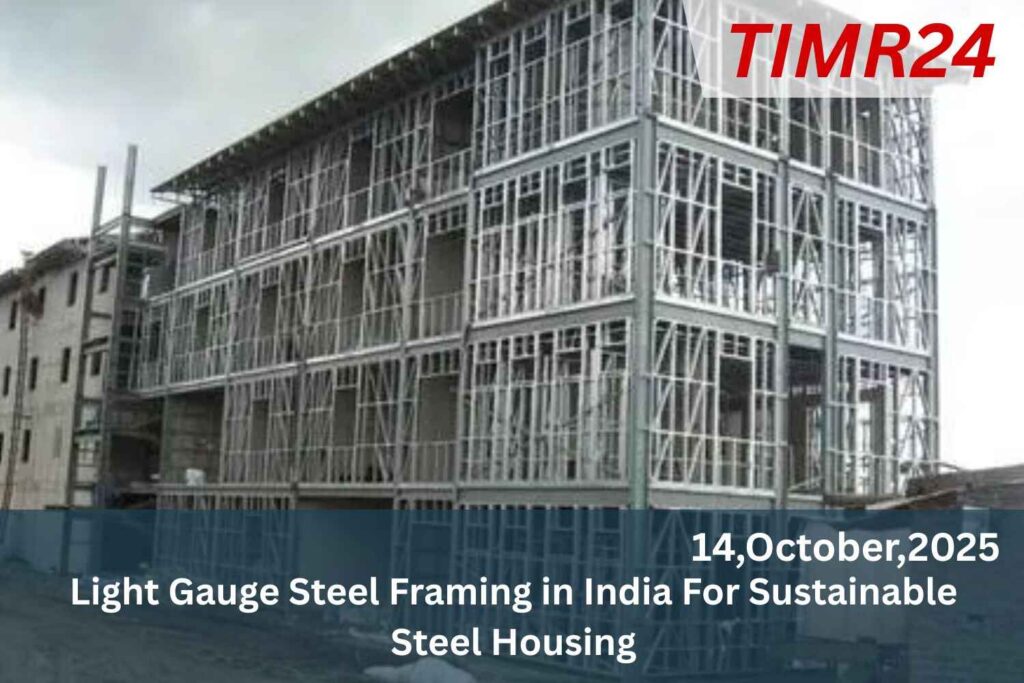
Light Gauge Steel Framing (LGSF) is a popular alternative to traditional building materials in India due to its faster construction time, higher durability, and environmental sustainability. It is used in heavy industrial structures, railways, bridges, metros, and high- and medium-rise commercial buildings. LGSF consists of Cold Formed Steel (CFS) sections assembled as panels or full truss systems at the site, forming a structural steel framework. There are three basic forms of LGSF for buildings: individual members assembled onsite, prefabricated wall, roof, and floor panels or sub-frames, and volumetric systems. Cold-formed steel sections are made from thin sheets of steel bent or rolled.
Into desired shapes at room temperatures, increasing their hardness, resistance against tension breaking, and resistance against deformation Cold Formed Sections (CFS) are an advanced technology in steel-framed housing, resulting in strain-hardening and increased yield strength. They can be used to produce cross-sectional shapes, forges metal sheets at room temperatures, and can be used to produce almost any desired shape to any desired length. Cold forming can be pre-galvanized or pre-coated, offering high resistance to corrosion and an attractive surface finish. Conventional jointing methods, such as bolting, welding, and adhesives, can be employed, but bolt and screws are mostly used in the LGSF system.
Light Gauge Steel Framing in India addresses buckling issues in CFS, such as local and distortional buckling due to their thin thickness and low torsional rigidity. Sheathings in CFS wall panels provide stability against buckling, resist lateral forces, and increase fire performance in elevated temperatures. C section studs with depths of 90 and 200 mm and thicknesses between 2.7 mm and 2.0 mm are provided for efficient use of cladding material Light Gauge Steel Framing can be used for roof systems, wall systems, floor systems, roof panels, decks, and entire buildings, including low to mid-rise house construction, multi-unit buildings, hotels, resorts, hospitals, warehouses, storage.
Sheds, garages, solar panel mounting, and commercial buildings. Fire protection in CFS and LGSF is generally lower compared to other forms of construction, and beams section with CFS can be concealed behind a suspended false ceiling for protection against fire. Light Gauge Steel Framing (LGSF) is rapidly transforming the construction landscape in India, offering a sustainable, cost-effective, and efficient alternative to traditional building methods. This innovative technique employs cold-formed steel sections to create structural frameworks, enabling faster construction, reduced material waste, and enhanced durability.
LGSF utilizes thin-walled, cold-formed steel sections to construct building frameworks. These sections are lightweight yet strong, allowing for quick assembly and flexibility in design. The process involves prefabricating components in controlled environments, ensuring high Link out to external resources Add pointing to external resources Add internal links in your content. quality and precision before on-site assembly. This approach significantly reduces construction time and labor costs while minimizing material waste.
- Energy Efficiency: LGSF structures offer excellent insulation properties, reducing the need for artificial heating and cooling, leading to lower energy consumption and reduced carbon footprints. With proper maintenance, LGSF houses can last 50+ years, maintaining structural integrity.
- Material Efficiency: The use of cold-formed steel minimizes material (STEEL) waste, and the components are often recyclable, contributing to a circular economy in construction
- Seismic Resilience: The lightweight nature of LGSF buildings reduces the load on foundations, enhancing seismic performance, which is crucial in earthquake-prone regions of India.
Market Growth and Adoption
The Indian LGSF market was valued at approximately USD 1.89 billion in 2022 and is projected to grow at a CAGR of 6.3% from 2023 to 2030. This growth is driven by urbanization, increasing housing demands, and government initiatives like the Pradhan Mantri Awas Yojana, which aim to provide affordable housing.
- SEAS Homes: Based in Pune, SEAS Homes is a prominent player in the LGSF sector, known for delivering projects with reduced construction time and cost savings. Their portfolio includes residential, commercial, and institutional buildings.
- EPACK Prefab: Operating across India, EPACK Prefab specializes in modular and prefab construction using LGSF technology, offering solutions for various sectors including housing and industrial buildings.
- S2S Designs: Located in Greater Noida, S2S Designs leverages LGSF for rapid construction of residential and commercial projects, completing structures in significantly shorter timelines compared to traditional methods.
Applications of LGSF
LGSF is versatile and can be applied in various construction scenarios :-
- Residential Housing: Ideal for low to mid-rise homes, offering quick and cost-effective solutions.
- Commercial Buildings: Suitable for offices, retail spaces, and hospitality sectors.
- Industrial Structures: Used in warehouses, storage units, (STEEL) and factories.
- Disaster Relief Housing: Provides rapid deployment of temporary shelters in disaster-stricken areas.
Standards and Codes
In India, the design and construction of LGSF structures are governed by standards such as IS:801 and IS:811, which provide guidelines for the use of cold-formed steel in building construction LGSF represents a significant advancement in sustainable construction practices in India. Its benefits in terms of speed, cost, and environmental impact make it a compelling choice for modern building projects. As the demand for affordable and resilient housing continues to rise, LGSF is poised to play a pivotal role in shaping the future of construction in the country.
Q1. What is Light Gauge Steel Framing (LGSF)?
LGSF is a construction system using thin, cold-formed steel sections for walls, roofs, and floors, offering strength and durability.
Q2. Why is LGSF considered sustainable?
It is eco-friendly because it reduces construction waste, is 100% recyclable, and lowers carbon footprint compared to traditional methods.
Q3. Where is LGSF used in India?
LGSF is used for residential housing, commercial buildings, schools, and disaster-resilient structures across urban and semi-urban areas.
Q4. What are the advantages of LGSF housing?
Lightweight, earthquake-resistant, fast to construct, low maintenance, termite-free, and energy-efficient.
Q5. How long does an LGSF house last?
With proper maintenance, LGSF houses can last 50+ years, maintaining structural integrity and durability.