


















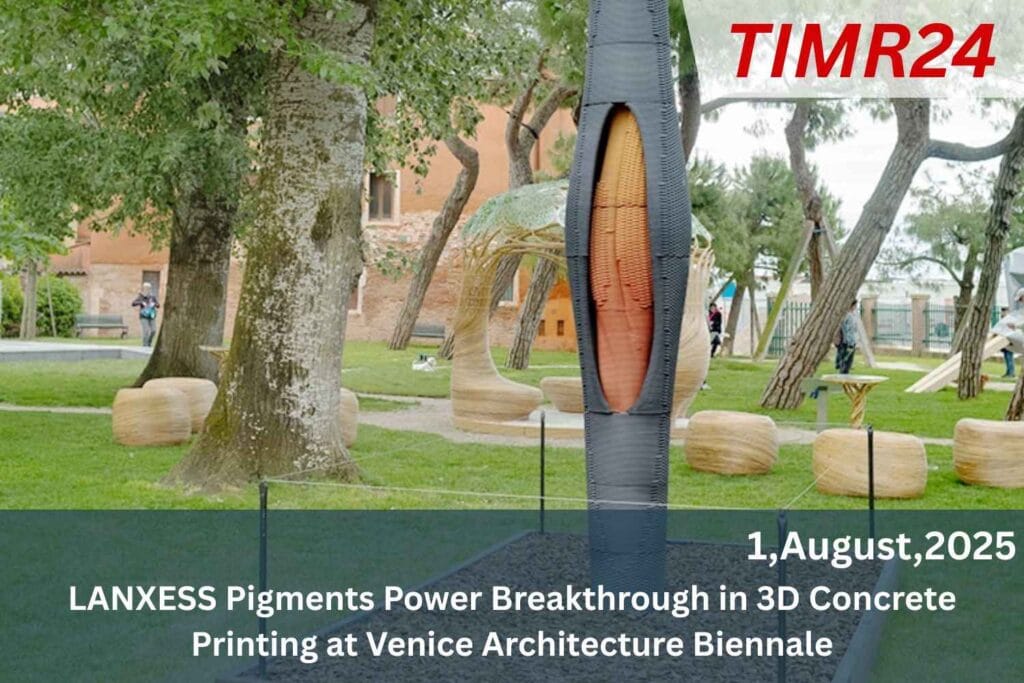
LANXESS’s inorganic pigments are transforming 3D concrete printing, as demonstrated by the “Duality of Skin and Core” sculpture at the Venice Architecture Biennale. The modular concrete column, created using red and black iron oxide pigments, showcases how colour and design innovation can merge with advanced construction technologies. The project, developed in partnership with LANXESS and Dutch 3D printing expert Vertigo, demonstrates a new frontier in architectural design and digital manufacturing.
At the globally renowned (Venice Architecture Biennale 2025) the fusion of art, science, and construction was vividly brought to life through an innovative exhibit utilizing LANXESS iron oxide pigments in 3D concrete printing. Known for their colour brilliance and durability, these pigments added a new dimension to digitally fabricated architectural forms showcased at the event.
The modular design and manufacturing strategy, inspired by ancient Greek and Roman columns, facilitates transport, flexible assembly, disassembly, and reuse, contributing to sustainable construction and circular design principles. LANXESS is also conducting research into the properties of its pigments under additive manufacturing conditions to secure the potential of coloured concrete in 3D printing.
At the prestigious (Liebherr) innovation met artistry as LANXESS, a leading global supplier of synthetic iron oxide pigments, demonstrated how colour can elevate technology-driven architecture. Their pigments were integral to a ground-breaking 3D concrete printing exhibit that fused aesthetics, sustainability, and advanced materials science.
The Role of Pigments in Architectural 3D Printing
Concrete is a favoured material in construction due to its versatility and durability. However, 3D concrete printing requires precise formulation to ensure both structural integrity and visual quality. LANXESS’s Afrox® and Colcothar® pigments brought vivid, long-lasting colour to printed structures without compromising the printability of the material. Their high tinting strength and excellent dispersion properties made them ideal for layer-by-layer printing applications. Learn more about these pigments on.
Innovative Collaboration at the Biennale
The 2025 Biennale featured a collaborative installation between architects, artists, and material scientists, showcasing freeform concrete elements printed using state-of-the-art robotic arms. The coloured structures not only demonstrated architectural freedom but also addressed themes of urban sustainability and circular design. LANXESS’s pigments played a key role in maintaining uniform colour under varying environmental and curing conditions—something that’s critical in outdoor, large-scale 3D printing. For context on architectural trends.
Sustainability and Environmental Compatibility
One of the defining features of LANXESS pigments is their eco-friendly production. Manufactured in accordance with strict environmental guidelines, these pigments are free from heavy metals and support LEED and BREEAM certification goals. The Venice installation emphasized this by using cementitious materials compatible with low-carbon construction practices. For insights into green construction certification.
Aesthetic Versatility Meets Structural Integrity
In 3D-printed architecture, colour is more than cosmetic—it contributes to form, space perception, and material expression. LANXESS’s iron oxide pigments were chosen not just for hue, but for their UV stability, weather resistance, and performance in high-alkaline concrete environments. As 3D construction evolves from prototypes to permanent structures, such pigment reliability becomes indispensable. For technical guidance on pigment use in construction.
Conclusion
The Venice Architecture Biennale served as a global stage to illustrate how LANXESS pigments can reshape the future of architectural 3D printing. Beyond enhancing visual appeal, they address the growing demand for sustainable, durable, and creative building methods. With urban designers increasingly embracing digital fabrication, LANXESS’s colour technologies are positioned at the forefront of this transformation.
Q1. What role did LANXESS pigments play at the Venice Architecture Biennale?
LANXESS pigments were used to add vibrant, durable color to 3D-printed concrete structures featured in an architectural exhibit.
Q2. Which pigments were used in the 3D concrete printing?
Bayferrox® and Colcothar® iron oxide pigments from LANXESS were used for their high performance and colour stability.
Q3. Why are these pigments suitable for 3D concrete printing?
They offer excellent UV resistance, tinting strength, and compatibility with high-alkaline concrete environments.
Q4. Are LANXESS pigments environmentally friendly?
Yes, they are produced sustainably, free from heavy metals, and support green building certifications like LEED.
Q6. How do LANXESS pigments contribute to design flexibility in construction?
They allow for a wide range of colour customization in concrete, enabling architects to enhance both form and function.