
















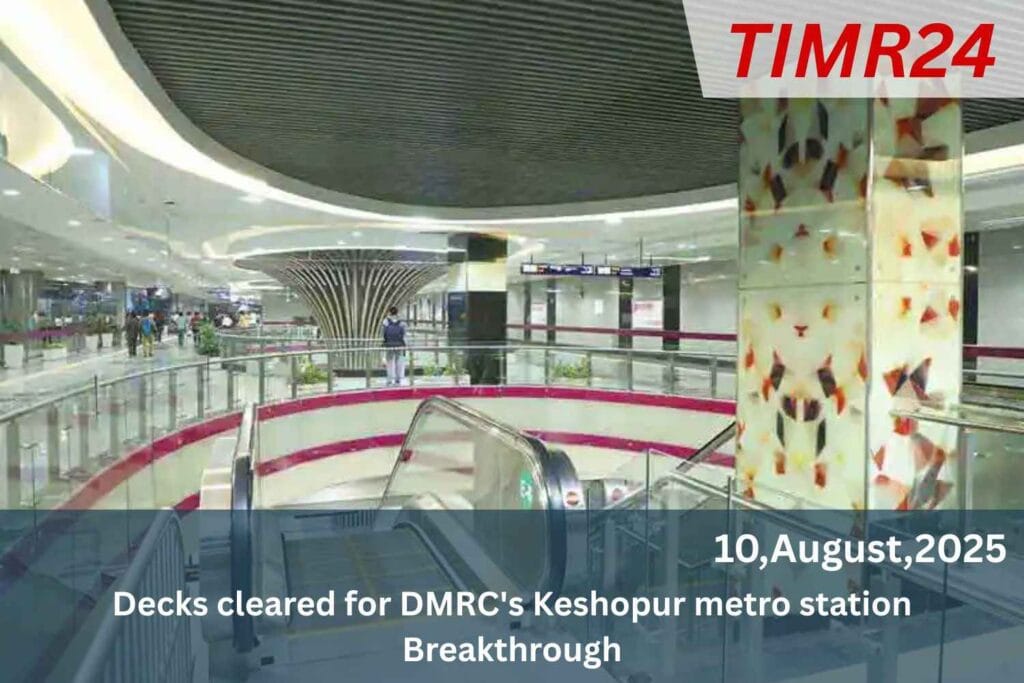
The Lieutenant Governor of Delhi has approved the transfer of 2,790 square meters of land to the Delhi Metro Rail Corporation (DMRC) for the construction of the Keshopur Metro Station. The land, previously under irrigation and flood control control, will be used for the station building, columns, entry and exit gates, and a temporary working area. The land transfer will require a payment of approximately Rs 2.62 crore for the permanent land and Rs 26.5 lakh for the temporary land. This development marks a significant milestone in the Keshopur Metro Station project. The Delhi Metro Rail Corporation (DMRC) has achieved a significant breakthrough with the clearing of decks at the Keshopur metro station site.
Importance of Keshopur Metro Station in Delhi’s Transport Network
This development marks a crucial step forward in the completion of the new corridor, which aims to improve connectivity in West Delhi and enhance commuter convenience. The progress on the Keshopur station reflects DMRC’s commitment to expanding the metro network and easing the daily commute for millions of Delhi residents. Keshopur metro station is a key node on the ongoing metro corridor expansion project, strategically positioned to serve the populous West Delhi region. The station will provide improved access to residential and commercial areas, reducing road traffic congestion and promoting sustainable urban mobility. By linking to existing metro lines, the station is expected to facilitate smooth interchanges, making travel faster and efficient across (Delhi Metro).
Technical Overview: Deck Clearance and Construction Progress
The clearance of decks at the Keshopur station site indicates the completion of foundational structural work necessary for subsequent construction phases. Decks, which are critical platform structures that support station facilities and tracks, must be carefully installed and cleared before further development. This milestone means DMRC is now prepared to advance with superstructure construction, including passenger concourses, platforms, and utility areas. The construction employs modern engineering techniques ensuring safety and efficiency, vital for minimizing disruptions in this busy urban zone. Once operational, Keshopur metro station will significantly ease access to nearby neighbourhoods like Nangloi, Rajouri Garden, and Paschim Vihar.
Connectivity Benefits and Commuter Convenience
Enhanced metro connectivity not only cuts travel time but also reduces vehicular emissions, supporting Delhi’s ongoing efforts to improve air quality. The station’s integration with bus services and other last-mile connectivity options will further enhance commuter convenience. Expansion projects like Keshopur station contribute positively to Delhi’s sustainable urban development goals. By encouraging mass transit usage, the project aims to decrease dependency on private vehicles, leading to lower pollution levels and traffic congestion. Additionally, the construction phase adheres to environmental guidelines, including noise control and waste management, to minimize impact on surrounding communities. (International Association of Public Transport).
Timeline and Next Steps
With decks cleared, DMRC is on track to expedite the construction and commissioning of the Keshopur station. The next steps involve erecting station superstructures, installing tracks, and setting up electrical and signaling systems. DMRC plans to complete these stages within the stipulated timeline, aiming for operational readiness that aligns with the overall corridor launch. The progress at Keshopur is part of a larger expansion strategy designed to address Delhi’s growing urban mobility challenges. The addition of new stations and corridors ensures the metro remains.
Q1. What does the deck clearance at Keshopur station signify?
Deck clearance means the foundational platform structures are complete, allowing further construction of the station to proceed.
Q2. How will Keshopur station benefit commuters?
It will improve connectivity in West Delhi, reduce travel time, and provide easier access to key neighbourhoods and other metro lines.
Q3. When is the Keshopur station expected to be operational?
The station is under active construction and expected to open as part of the new metro corridor in the upcoming phases, with updates available from DMRC.
Q4. What impact will the new station have on traffic and pollution?
By promoting public transit, the station will help reduce road congestion and vehicular emissions, supporting Delhi’s environmental goals.
Q5. How is Keshopur station integrated with other transport systems?
It will connect with existing metro lines and nearby bus services, ensuring smooth last-mile connectivity for passengers.