


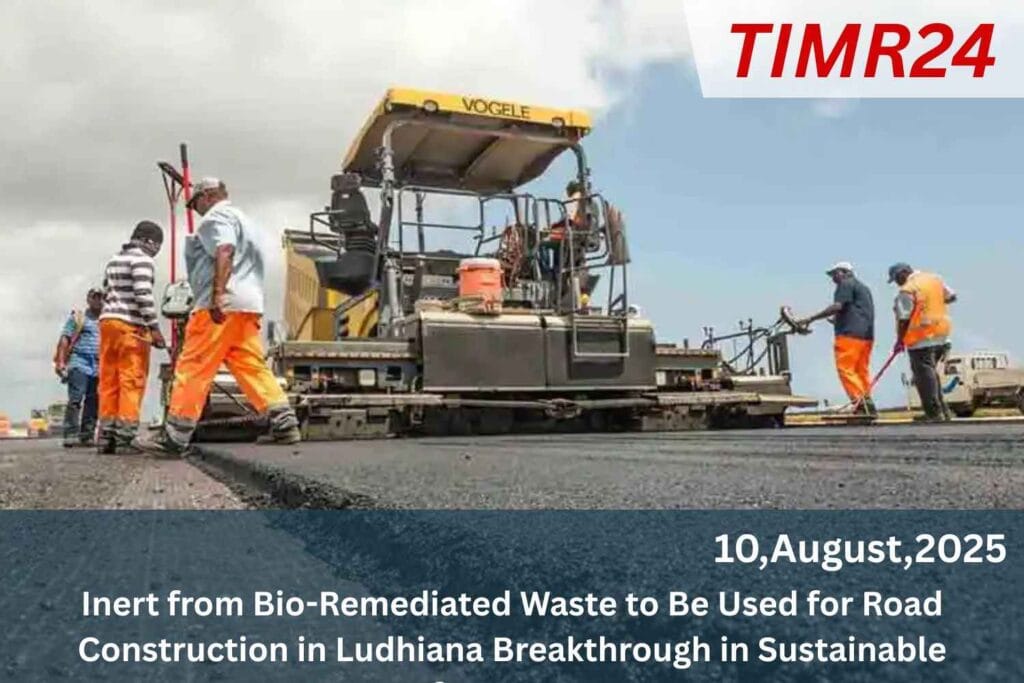
The Municipal Corporation of Ludhiana has adopted an eco-friendly approach to road construction, using inert generated from bio-remediation of legacy waste. The National Highways Authority of India (NHAI) contractor, Sagar Motors, has signed a Memorandum of Understanding to dispose of accumulated waste, showcasing Ludhiana’s commitment to sustainable waste management and environment-friendly Infrastructure Development. The city of Ludhiana has embarked on a pioneering initiative to utilize inert materials derived from bio-remediated waste for road construction, promoting sustainable infrastructure development. This approach not only addresses the mounting problem of waste disposal but also offers an eco-friendly alternative to conventional construction materials.
Bio-Remediation Process and Waste Management
Bio-remediation involves the use of microorganisms and natural processes to decompose and detoxify hazardous organic waste. In Ludhiana, this technique is being employed to treat municipal solid waste and industrial sludge, significantly reducing the volume of harmful residues. The treated waste undergoes a transformation, resulting in inert materials—substances that are chemically stable, non-toxic, and safe for reuse. This process effectively converts waste into a valuable resource, aiding in the city’s waste management efforts. The inert material recovered from bio-remediation has favourable properties suitable for road construction. These materials demonstrate excellent compaction, load-bearing. (Road Construction)
Characteristics of Inert Materials for Construction
Capacity, and durability. Because they are free from organic contaminants and chemically stable, their use in road base layers does not pose environmental risks. Utilizing such materials reduces reliance on natural aggregates, helping conserve natural resources like gravel and sand. Ludhiana’s municipal authorities have initiated pilot projects incorporating inert materials into the sub-base and base layers of roads. These projects focus on improving road strength while maintaining cost-effectiveness. Early results indicate enhanced resistance to waterlogging and reduced surface deformation, common challenges faced by roads in the region. The successful application serves as a model for sustainable urban infrastructure, promoting circular economy principles by repurposing waste products.
Environmental and Economic Benefits
By diverting bio-remediated waste from landfills, Ludhiana is minimizing environmental pollution, including soil contamination and greenhouse gas emissions. The reuse of inert materials also curtails the carbon footprint associated with extracting and transporting conventional construction aggregates. Economically, this initiative lowers construction costs and fosters local employment opportunities within waste treatment and construction sectors. The Ludhiana administration plans to expand this eco-friendly approach, integrating it into larger road development schemes across the city. Supportive policies and guidelines are being developed to ensure quality standards and environmental compliance. Collaboration with research institutes is ongoing to optimize the bio-remediation process and material properties, enhancing their suitability for diverse construction applications.
This innovative strategy of using inert materials from bio-remediated waste marks a significant step towards sustainable urban development in Ludhiana, offering a scalable and environmentally responsible solution to the challenges of waste disposal and infrastructure modernization. Bio-remediation is an environmentally friendly process that utilizes naturally occurring microorganisms, fungi, or plants to break down hazardous organic pollutants present in solid waste. In Ludhiana, this method has been applied extensively to treat municipal solid waste, industrial by-products, and sludge. Through biological activity, harmful contaminants are neutralized, resulting in stabilized inert material that can safely be repurposed. (Infrastructure Development)
Q1. What is inert material from bio-remediated waste?
Inert material is the chemically stable, non-toxic residue obtained after treating waste through bio-remediation, making it safe for reuse in construction.
Q2. How is bio-remediated inert material used in road construction?
It is primarily used in the base and sub-base layers of roads to improve strength, durability, and reduce environmental impact.
Q3. What are the benefits of using inert from bio-remediated waste in roads?
It helps reduce landfill waste, conserves natural resources, lowers construction costs, and enhances road longevity.
Q4. Is using bio-remediated inert material environmentally safe?
Yes, the material is chemically stable and non-toxic, preventing soil and groundwater contamination.
Q5. Are there ongoing projects using this material in Ludhiana?
Yes, Ludhiana has initiated pilot projects integrating bio-remediated inert materials into road infrastructure with promising results.