














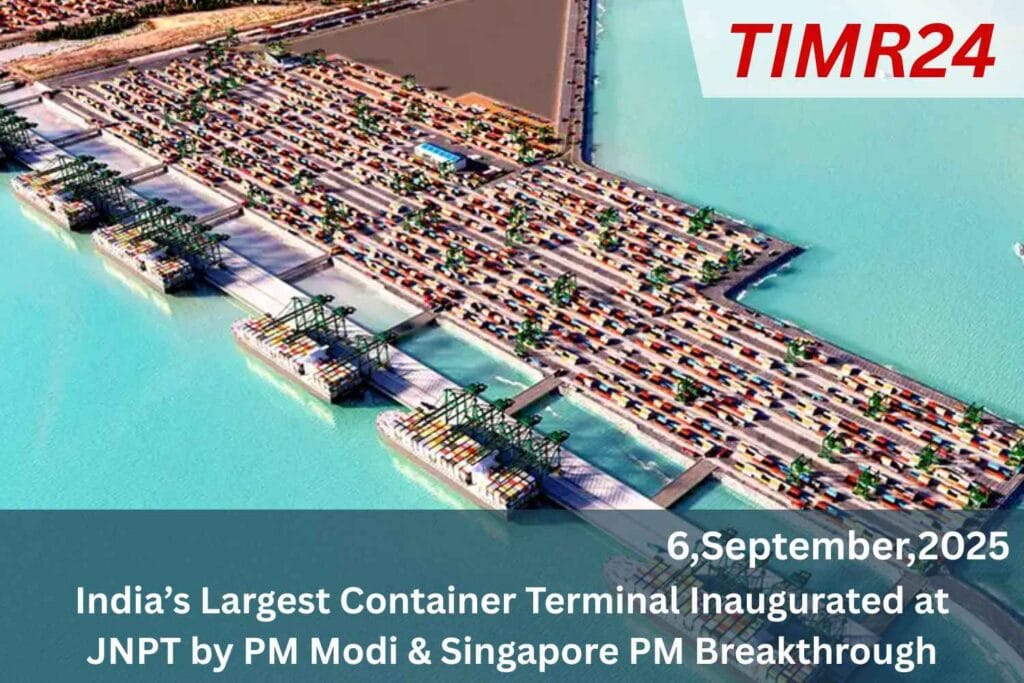
Prime Minister Narendra Modi and Singapore Prime Minister Lawrence Wong inaugurated Phase II of the Bharat Mumbai Container Terminal (BMCT), doubling its capacity to 4.8 million TEUs. The expansion, funded by SGD 1.7 billion ($1.3 billion) under a public-private partnership, is the largest foreign direct investment from Singapore into India. The terminal spans 200 hectares and is connected to the Dedicated Freight Corridor, enhancing multimodal logistics efficiency. Man Infra Construction Ltd developed the 110-hectare land parcel. The inauguration of India’s largest container terminal at (Port) by Prime Minister Narendra Modi and the Prime Minister of Singapore has set.
A new benchmark for the country’s maritime sector. Strategically located near Mumbai, JNPT has long been India’s premier gateway for containerized trade, handling over half of the nation’s container traffic. With the launch of this world-class facility, India has stepped into a new era of port infrastructure that promises to transform its role in international shipping and strengthen its logistics ecosystem The event was not only a domestic milestone but also a reflection of international collaboration. The presence of Singapore’s leader underscores the deepening partnership between India and Singapore in areas of trade, maritime technology, and infrastructure development. Singapore.
The Strategic Importance of JNPT
Home to the globally acclaimed brings with it a legacy of advanced port management practices. By integrating these global standards with India’s massive trade potential, the inauguration positions JNPT as a vital hub in Asia’s logistics map. Situated on the western coast of India, JNPT enjoys proximity to major shipping routes that connect South Asia with Europe, Africa, and the Middle East. This location makes it a natural choice for trade corridors and transshipment activities. Before the expansion, India relied heavily on foreign ports like Colombo or Singapore for transshipment services, which increased both time and cost for exporters The launch of this container terminal.
Significantly reduces that dependence and strengthens India’s ability to act as a direct gateway for global trade The scale of the project is unprecedented. With the new facility, JNPT can now handle millions of Twenty-foot Equivalent Units (TEUs) annually, pushing it into the ranks of the world’s largest ports. This positions India alongside countries that dominate maritime trade, ensuring competitiveness in the evolving global supply chain landscape Infrastructure projects of this magnitude always bring ripple effects across the economy. The JNPT terminal is expected to generate thousands of jobs in port operations, warehousing, logistics, and allied sectors. More importantly, it creates.
Technology-Driven Efficiency
Opportunities for small and medium enterprises by lowering logistics costs and ensuring faster delivery timelines. Exporters dealing with textiles, pharmaceuticals, automotive parts, and electronics will particularly benefit from the efficiency improvements The terminal aligns seamlessly with the government’s Make in India and Atmanirbhar Bharat initiatives. By enabling smoother export operations, the port strengthens India’s position as a global manufacturing hub. Lower turnaround times mean goods reach international buyers faster, thereby boosting the competitiveness of Indian products. One of the most notable aspects of the new terminal is its focus on cutting-edge technology.
Automated cranes, artificial intelligence systems, and blockchain-based cargo tracking have been integrated to streamline operations. These innovations not only minimize human error but also improve transparency and security in cargo handling Digitalization of port processes is another highlight. Exporters and importers can now complete documentation online, track their shipments in real time, and coordinate seamlessly with customs authorities. Such integration is expected to significantly cut down on paperwork delays that previously hampered trade.
Sustainability and Green Initiatives
In line with global efforts to reduce carbon footprints, JNPT’s new terminal incorporates eco-friendly practices. Electric and hybrid vehicles are being deployed for cargo movement within the port premises, while renewable energy sources are powering several operations. Initiatives like water recycling, energy-efficient lighting, and reduced emission handling equipment demonstrate India’s commitment to sustainable development This approach resonates with other national projects that aim to combine modernization with environmental responsibility. For instance, also designed around sustainable urban development, highlighting a consistent focus on green growth.
The joint inauguration by leaders of India and Singapore sends a strong message about the importance of international cooperation in infrastructure development. Singapore has been a key partner in India’s growth story, particularly in the maritime and investment sectors. The expertise from Singapore is expected to bring in global best practices for efficiency, making the JNPT terminal a model for other ports across India The collaboration also strengthens India’s standing in regional trade frameworks such as ASEAN, where maritime connectivity plays a pivotal role. With enhanced port infrastructure, India is now better positioned to negotiate trade deals and expand its exports to Southeast Asia and beyond.
The JNPT terminal does not stand in isolation it forms part of India’s larger strategy to integrate transport infrastructure across the nation. Projects like the (Bullet Train) and the complementary efforts designed to create seamless corridors for trade and travel. Improved rail and metro connectivity ensures that goods moving through JNPT can quickly reach industrial clusters across India This integrated approach highlights the government’s vision of building multi-modal transport systems, where ports, railways, highways, and airports function as a unified network. Such connectivity reduces overall logistics costs, which have traditionally been a challenge for Indian exporters compared to global competitors.
Long-Term Outlook and Global Relevance
In the coming years, the JNPT container terminal is expected to catalyze further investments in related industries. Logistics parks, cold storage facilities, and warehousing hubs are likely to emerge in the vicinity, creating a complete ecosystem around the port. With global companies seeking alternatives to China for supply chain diversification, India’s upgraded port facilities offer a timely solution By leveraging this opportunity, India can attract more foreign direct investment into manufacturing and logistics. The expansion also supports India’s ambition of moving up in the World Bank’s Logistics Performance Index, where efficiency of ports and customs is a key metric.
The ripple effect of the JNPT terminal will not just be felt in trade statistics but also in everyday life. From cheaper consumer goods due to reduced logistics costs to new employment avenues in urban centers, the impact of this port extends far beyond maritime boundaries. The inauguration of India’s largest container terminal at JNPT is more than just an infrastructural achievement it is a symbol of India’s aspirations to emerge as a global trade powerhouse. With its combination of technology, sustainability, and international cooperation, the terminal is a blueprint for future development in the logistics sector. Supported by complementary initiatives like.
Q1. Where is India’s largest container terminal located?
It is located at Jawaharlal Nehru Port Trust (JNPT) near Mumbai.
Q2. Who inaugurated the terminal?
The terminal was inaugurated jointly by Prime Minister Narendra Modi and Singapore’s Prime Minister.
Q3. Why is this terminal important?
It strengthens India’s maritime trade capacity, global shipping connectivity, and logistics efficiency.
Q4. What is the capacity of this new terminal?
The facility is designed to handle millions of TEUs annually, positioning JNPT among top global ports.
Q5. How will it impact India’s economy?
The terminal will increase exports, attract investments, and create jobs in the logistics sector.