










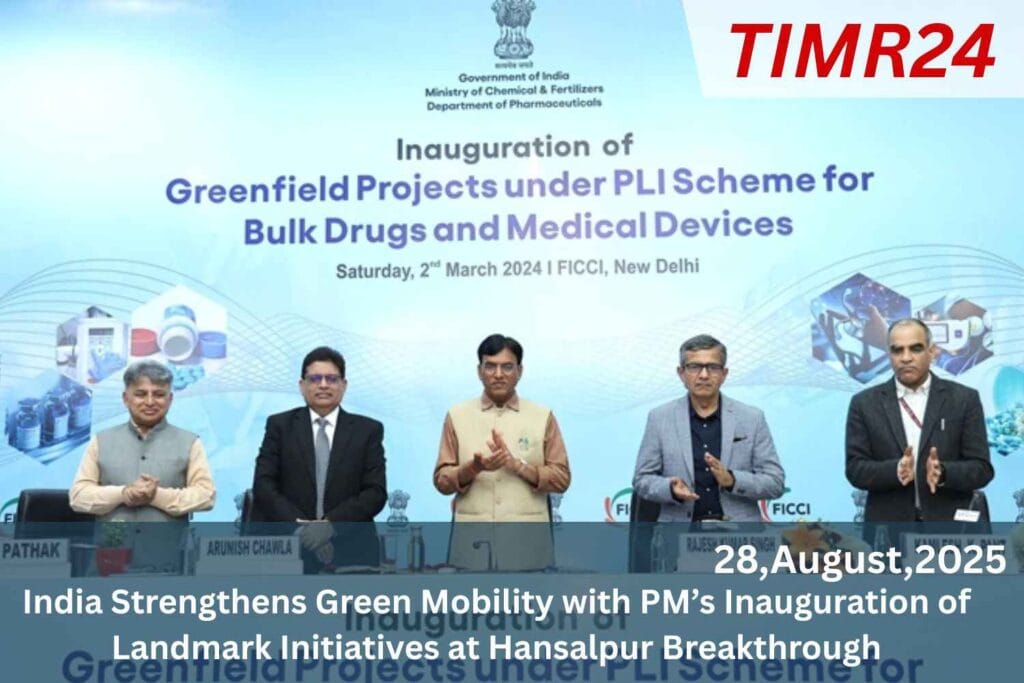
India PM Narendra Modi inaugurated two initiatives at Suzuki Motor’s Hansalpur plant, marking a significant step towards sustainable mobility. He launched Suzuki’s first global strategic Battery Electric Vehicle (BEV), “e VITARA,” and inaugurated the local production of hybrid battery electrodes at the TDS Lithium-Ion Battery Plant, strengthening India’s battery ecosystem and advancing the vision of Aatmanirbhar Bharat. India has once again demonstrated its commitment to sustainable development and environmental responsibility with the Prime Minister’s inauguration of landmark green mobility initiatives at Hansalpur.
The move is being seen as a breakthrough moment in the country’s ongoing efforts to accelerate the adoption of electric vehicles, clean transport solutions, and renewable-powered infrastructure. Green mobility is no longer a futuristic aspiration but a national mission that aligns with India’s global pledge to achieve net-zero emissions by 2070, while also strengthening the domestic economy and creating thousands of new opportunities in the clean energy sector. The event at Hansalpur highlighted India’s ambition to transition from a fossil-fuel dependent transport system to a sustainable, technology-driven, and locally manufactured ecosystem that serves both urban and rural populations.
The Hansalpur region has emerged as a crucial hub for automobile and electric vehicle manufacturing, with the new projects marking a significant leap toward making India a self-reliant leader in eco-friendly transport solutions. With investments in advanced EV assembly lines, lithium-ion battery production facilities, and solar-powered charging infrastructure, Hansalpur is set to play a defining role in reshaping India’s mobility future. This initiative is closely tied to the government’s (Steel Building) vision, where domestic manufacturing is prioritized to reduce import dependency and strengthen supply chains in the clean technology sector. By nurturing local talent and encouraging collaborations with global EV leaders,
Hansalpur is positioned to become a centre of innovation that supports India’s larger industrial and climate action goals One of the most significant aspects of the inauguration was the government’s emphasis on strengthening the wider EV ecosystem. The projects are designed not only to manufacture vehicles but also to support innovations in battery technologies, charging solutions, and digital platforms for smart mobility. The introduction of battery swapping stations, expansion of solar-integrated charging points, and plans for nationwide charging corridors demonstrate the government’s commitment to making EV adoption practical and convenient for citizens.
These developments are in harmony with policy frameworks introduced by which highlight the importance of integrated EV infrastructure and affordable financing solutions to ensure that both individuals and businesses benefit from the transition. The link between Hansalpur’s projects and India’s environmental commitments is undeniable. Transportation has been one of the largest contributors to rising carbon emissions, with conventional fuel-based vehicles accounting for almost a tenth of the country’s total greenhouse gases. The initiatives inaugurated at Hansalpur represent a direct effort to tackle this issue, making mobility cleaner and healthier for India’s cities. By reducing reliance on petrol and diesel vehicles.
The government aims to not only cut emissions but also curb urban air pollution, thereby addressing critical health challenges faced by millions in metropolitan regions. This aligns seamlessly with India’s pledge to by 2070, where the transport sector remains a pivotal pillar in the decarbonization roadmap.
Beyond environmental impact, the socio-economic advantages of these initiatives are equally transformative. The projects are expected to create thousands of jobs in sectors ranging from manufacturing and supply chain management to research, development, and after-sales service for EVs. With India’s youth forming the backbone of its labor force, this transition ensures the generation of sustainable employment opportunities that also enhance technical skills. Moreover, as EVs become more affordable and infrastructure more accessible, ordinary citizens will enjoy benefits such as reduced fuel costs, lower maintenance expenses, and smoother commuting experiences. For rural India, the push towards electric transport offers an opportunity to integrate clean mobility solutions into agriculture, logistics, and local businesses,
Ensuring inclusive growth that touches every sector of society The inauguration also underscores India’s ambition to become a global leader in green mobility. With a vast domestic market, favourable policy frameworks, and significant renewable energy potential, India is poised to attract international investors and strategic partnerships in the EV sector. Already, the global shift towards clean transport has positioned India as a promising hub for technology exchange and sustainable supply chains. The notes that countries that prioritize large-scale EV adoption will have a competitive advantage in global trade and innovation. By taking bold steps at Hansalpur, India signals its readiness to seize this opportunity and strengthen its role in shaping the future of global mobility.
Ultimately, the Prime Minister’s inauguration of green mobility projects at Hansalpur is not just a ceremonial event but a visionary step that integrates economic progress, environmental sustainability, and social inclusivity. It highlights the government’s recognition that green mobility is (NITI Aayog) central to India’s development story, one that must balance rapid industrial growth with responsible climate action. With projects like those at Hansalpur, India is not only preparing to meet domestic demands but also setting the foundation to emerge as a key exporter of electric vehicles, batteries, and clean transport solutions. The momentum generated here will inspire similar hubs across the country, creating a nationwide network of sustainable innovation. As India continues to advance on this path.
Q1. What initiatives were inaugurated by the PM at Hansalpur?
The PM inaugurated electric mobility projects, EV manufacturing facilities, and green transport infrastructure to promote eco-friendly travel in India.
Q2. How will these initiatives impact India’s EV industry?
They will boost domestic EV production, reduce reliance on imports, and create jobs in the clean energy sector.
Q3. What role does Hansalpur play in green mobility?
Hansalpur is emerging as a key EV and automotive hub, supporting India’s transition toward sustainable mobility solutions.
Q4. How do these initiatives align with India’s net-zero goals?
They encourage EV adoption, reduce carbon emissions, and support India’s commitment to achieving net-zero emissions by 2070.
Q5. What benefits will citizens experience?
Affordable EVs, cleaner air, reduced fuel costs, and better green transport infrastructure across India.