













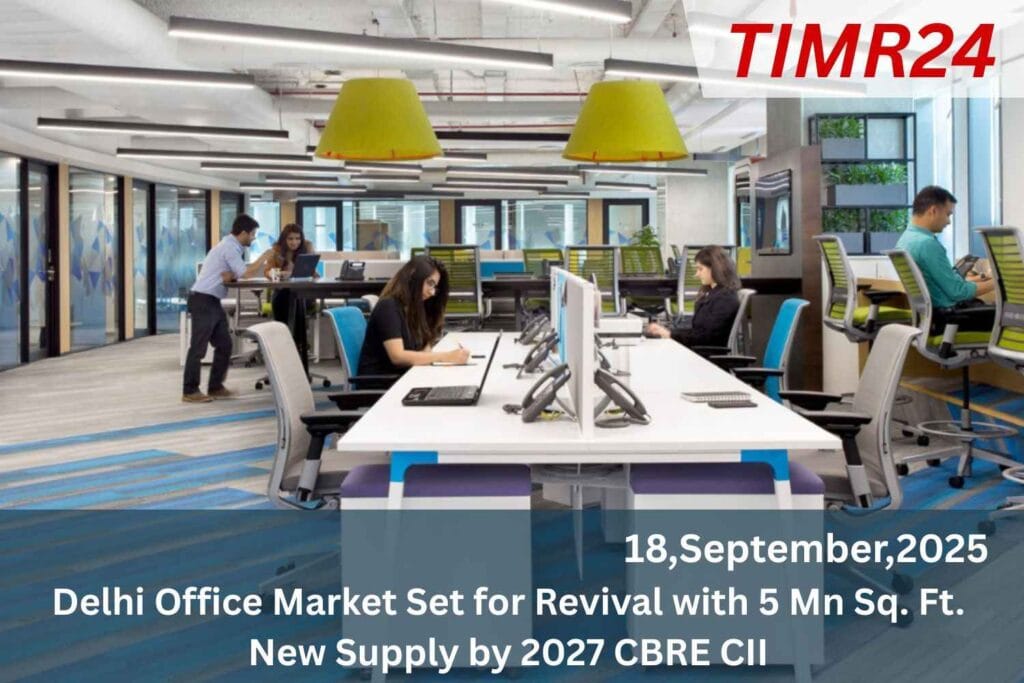
Delhi’s office real estate market is expected to see a sharp revival after nearly a decade of limited supply, with around 5 million sq. ft. of new office space projected to be added between 2025 and 2027. The city’s strong economic potential has helped its property market bounce back and start on a path of steady high-quality growth. The Delhi Master Plan 2041, the government’s comprehensive blueprint for urban expansion, integrates rural areas and prioritises affordable housing. From January to June 2025, Delhi recorded an office space absorption of approximately 400,000 sq. ft., driven by strong business confidence in core business districts. Retail space.
Absorption of about 230,000 sq. ft. was also recorded, with fashion and apparel retailers demonstrating the highest demand. Delhi-NCR’s residential market has demonstrated robust growth in H1 2025, dominated by luxury units. Capital values, particularly in South-East and South-West Delhi, have also witnessed significant appreciation. The commercial real estate sector of Delhi-NCR is entering a new era of growth, with CBRE and CII jointly projecting nearly 5 million square feet of fresh office supply by 2027. This announcement marks a significant milestone for India’s capital region, which has always been at the forefront of corporate activity but saw fluctuations in demand.
During the pandemic years. Now, as India’s economy strengthens and global investors continue to see the country as a growth destination, Delhi’s office market is well-positioned to absorb the next wave of occupier activity, investor interest, and sustainable development Delhi’s central business district, along with Gurugram and Noida, has long been a magnet for multinational corporations, startups, and government-linked enterprises. The CBRE–CII findings reveal that the upcoming office supply will be concentrated in Grade A projects, with a strong focus on sustainability, technology adoption, and hybrid work readiness. This development is particularly relevant because it reflects.
The broader transformation of India’s urban business hubs, where tenants are increasingly seeking smart, green-certified workspaces that can adapt to evolving workforce models. To understand how this ties into the larger property landscape, readers may refer to our recent coverage on (Real Estate) which highlights the capital flows shaping this segment The primary driver of office demand in Delhi-NCR remains the IT and IT-enabled services industry, but it is no longer the sole contributor. According to the report, BFSI firms, e-commerce companies, and global capability centers (GCCs) are expanding their footprint, contributing to rising leasing activity.
What makes the current cycle particularly interesting is the growing share of flexible workspaces and managed office operators, who are catering to occupiers looking for agility. This means that instead of long lock-in leases, companies are preferring spaces that allow them to scale up or down based on business needs, aligning with hybrid and remote-first approaches. For a deeper perspective on this evolving model, our feature on provides valuable insights From a geographic lens, Gurugram continues to dominate demand, especially around Cyber City, Golf Course Extension Road, and Udyog Vihar, owing to world-class infrastructure and connectivity. At the same time.
Noida is emerging as a competitive alternative, particularly along the Noida Expressway, where a large share of IT and e-commerce occupiers are setting up operations. Central Delhi’s Connaught Place and Aerocity remain attractive for financial services and consulting firms, given their brand value and proximity to government institutions. This diversified demand ensures that the NCR office market will not be dependent on a single sub-market, but will benefit from a multi-nodal growth structure. Internal reports such as highlight these location-specific shifts in greater detail One of the most important aspects of the CBRE–CII study is the emphasis on sustainability.
The report highlights that over 60% of the upcoming supply will be green-certified buildings, either LEED or IGBC certified, underscoring how environment-friendly construction is now central to developer and investor strategy. Occupiers too are prioritizing sustainability, not just for compliance, but as part of their corporate ESG mandates. This is in line with India’s broader push towards a net-zero carbon economy, supported by initiatives like the Developers are therefore incorporating energy-efficient designs, smart building technologies, and wellness-focused layouts that enhance employee productivity while reducing operational costs Another significant factor reshaping.
Delhi’s office market is the hybrid work revolution. While early predictions suggested remote work could shrink demand for offices, the reality has been more nuanced. Instead of eliminating office needs, hybrid work has created demand for smaller, flexible, and collaborative office formats, where teams can come together for brainstorming, training, and client interactions. As per the CBRE–CII analysis, co-working operators could account for up to 25% of fresh leasing activity in the next three years, making Delhi-NCR one of the largest co-working hubs in Asia. Our dedicated analysis on (Future of Hybrid Work) sheds light on how companies are striking this balance.
From an investment perspective, Delhi’s office market revival presents significant opportunities for institutional investors, REITs, and private equity funds. With SEBI recognizing office REITs as equity assets for index inclusion, investor appetite is expected to grow further, ensuring liquidity and transparency in the sector. Global funds are already showing keen interest in acquiring premium office assets in Gurugram and Noida, betting on rental growth and long-term demand stability. For readers keen to explore this financial dimension provide an excellent overview of the regulatory environment driving investment Infrastructure development plays a crucial role in shaping.
Office market dynamics. Delhi-NCR is witnessing massive improvements in connectivity, including the expansion of metro networks, the development of the Delhi–Mumbai Expressway, and enhancements in airport connectivity through Aerocity and Jewar Airport projects. These infrastructure upgrades are not just improving commute times but are also expanding the geographic spread of viable office hubs. Initiatives like the continue to act as policy backbones, supporting real estate development in an integrated manner Looking ahead, the CBRE–CII report suggests that by 2027, Delhi-NCR will not only add 5 million square feet of premium office space but also position.
Itself as a benchmark market for sustainable, tech-driven, and occupier-focused development This revival is expected to create a balanced ecosystem where corporates can operate in future-ready workspaces, employees benefit from well-designed environments, and investors enjoy steady returns. For professionals and decision-makers tracking these shifts, our insights on provide complementary perspectives the Delhi office market’s revival is a story of resilience, innovation, and opportunity. From sectoral diversification and sustainable development to flexible work adoption and policy support, every element is aligning to make Delhi-NCR a leader in India’s.
Commercial real estate landscape. The upcoming supply will not only meet the growing appetite of occupiers but also reshape the way offices are designed, leased, and managed. For corporates, this means access to world-class facilities at competitive costs; for developers, it signals a chance to innovate; and for investors, it opens doors to one of the most dynamic and stable office markets in Asia. The next two years will therefore be pivotal in defining the contours of Delhi’s position on the global real estate map, and all indicators point towards a robust and sustainable revival.
Q1. What is the projected office space supply in Delhi by 2027?
CBRE–CII projects 5 million sq. ft. of fresh office space supply in Delhi-NCR by 2027.
Q2. Which sectors are driving office demand in Delhi?
IT, BFSI, startups, e-commerce, and co-working operators are leading demand growth.
Q3. Which micro-markets will benefit the most from new supply?
Gurugram, Noida, and Central Delhi are expected to see the highest absorption.
Q4. How will hybrid work impact office demand in Delhi?
Hybrid work is pushing demand for flexible, green-certified, and co-working spaces.
Q5. What opportunities does this revival bring for investors?
Investors can benefit from higher occupancy, rental appreciation, and sustainable asset portfolios.