











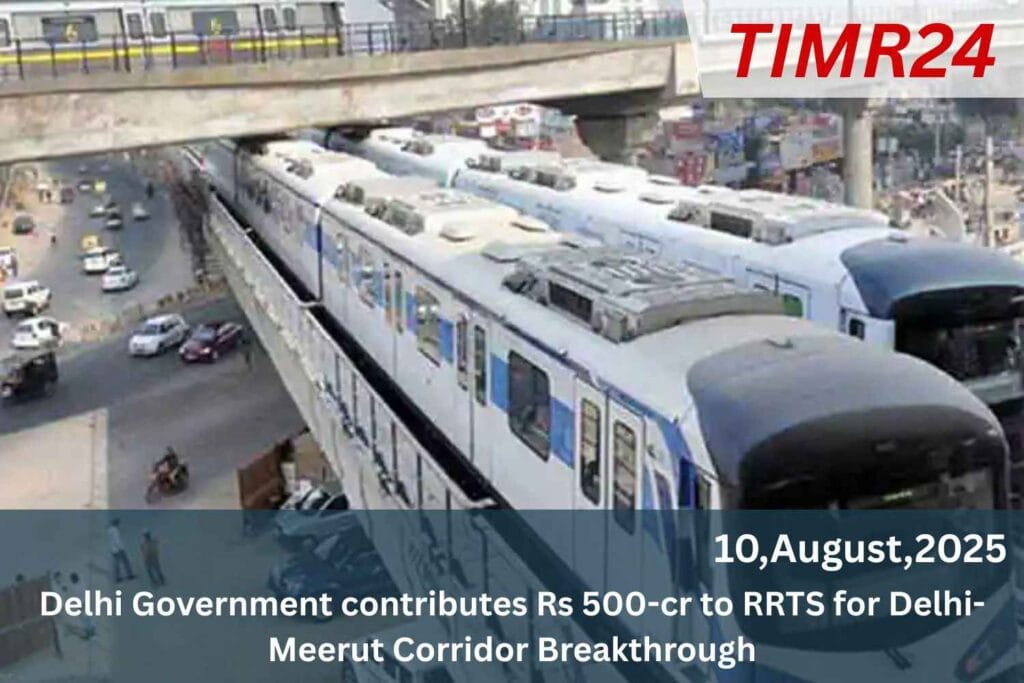
The Delhi government has contributed Rs 500 crore to the construction of the RAPIDX rapid rail transit system along the Meerut corridor, sourced from the environment compensation fee. This funding aims to improve connectivity, reduce travel time, and alleviate congestion in the region, with plans for two more corridors. The Government has taken a significant step forward in enhancing regional connectivity by contributing Rs 500 crore towards the Rapid Regional Transit System (RRTS) project for the Delhi-Meerut Corridor. This financial commitment underlines the state’s dedication to developing world-class infrastructure that will not only improve commuter convenience but also bolster economic growth in the National Capital Region (NCR).
Background and Need for the Delhi-Meerut RRTS Corridor
The Delhi-Meerut RRTS corridor is envisioned as a high-speed, efficient transit link that will revolutionize daily travel between these two important urban centres. The Delhi-Meerut corridor is a vital link connecting the capital city of India with the fast-growing city of Meerut in Uttar Pradesh. Currently, the region faces heavy traffic congestion on roads and slow transit options, causing long commute times for thousands of daily passengers. The RRTS aims to address these challenges by providing a fast, reliable, and comfortable transit alternative that can cover the approximately 82 km distance in under an hour. This corridor is part of the larger RRTS network planned to connect Delhi with surrounding cities including Panipat and Alwar. (Indian Railways)
The Delhi Government’s contribution of Rs 500 crore towards the Delhi-Meerut RRTS project is a major breakthrough in securing funding for the initiative. This amount will be utilized for various aspects of the project, including land acquisition, construction, and technological installations. The collaboration between the Delhi Government, central agencies, and the neighbouring state of Uttar Pradesh highlights a multi-stakeholder approach necessary for the success of large infrastructure projects. This funding support accelerates project timelines and reflects the state’s commitment to improving urban mobility. For information on funding mechanisms for infrastructure projects
Features of the Delhi-Meerut RRTS Corridor
The Meerut RRTS corridor is designed to be a semi-high-speed rail system featuring state-of-the-art trains capable of speeds up to 160 km/h. The corridor will have multiple stations equipped with modern amenities, providing seamless connectivity to metro lines, buses, and other transport modes. The project also incorporates advanced safety and signaling technologies to ensure efficient and secure operations. Passengers can expect reduced travel times, enhanced comfort, and improved accessibility, transforming the daily commute experience significantly. To understand the technological framework.
The RRTS corridor is expected to have a transformative effect on the NCR’s economy by facilitating easier movement of people and goods. It will encourage the development of residential and commercial hubs along the route, generating employment and boosting regional economic integration. The corridor also supports the government’s vision of sustainable urbanization by reducing reliance on private vehicles, thereby lowering traffic congestion and pollution. Socially, the project will enhance access to education, healthcare, and employment opportunities for people residing in both Delhi and Meerut. The development aligns with the goals of inclusive growth and balanced regional development (Delhi Metro).
Environmental Considerations
Sustainability is a core focus of the RRTS project. The corridor is designed to use energy-efficient trains and infrastructure, incorporating green building practices in station design. By encouraging mass transit usage, the project contributes to reducing carbon emissions and improving air quality in the NCR, a region that frequently faces pollution challenges. With the Delhi Government’s financial contribution now in place, the NCR’s-Meerut RRTS corridor project is advancing steadily. Land acquisition and civil works are underway, with multiple packages being tendered and construction progressing in phases. The project aims for partial operationalization within the next few years, ultimately providing full connectivity that will redefine regional travel.
The RRTS corridor is designed to integrate seamlessly with existing transport infrastructure in NCR’s and Meerut. Key stations will offer interchange facilities with NCR’s Metro lines and local bus services, ensuring smooth last-mile connectivity. This multi-modal integration is essential to enhance overall commuter convenience and promote public transport usage. The success of the Delhi-Meerut RRTS corridor is expected to serve as a model for other regional transit projects in India. Its implementation will strengthen the concept of metropolitan regional planning and foster greater economic synergy among NCR cities. Looking ahead, the RRTS network will expand to cover more cities, supporting the government’s vision for smart, sustainable urban mobility.
q1. What is the NCR’s Government’s contribution to the RRTS Delhi-Meerut Corridor?
Delhi Government has contributed Rs 500 crore towards the Rapid Rail Transit System (RRTS) project between Delhi and Meerut.
q2. What is the significance of this Rs 500 crore contribution?
This funding helps accelerate the development of the RRTS corridor, improving connectivity and reducing travel time between Delhi and Meerut.
q3. What benefits will the Delhi-Meerut RRTS corridor provide?
The corridor will offer high-speed, comfortable, and efficient travel, boosting regional economic growth and easing traffic congestion.
q4. Who is responsible for implementing the Delhi-Meerut RRTS project?
The National Capital Region Transport Corporation (NCRTC) is the nodal agency managing the RRTS project implementation.
q5. When is the Delhi-Meerut RRTS corridor expected to be operational?
The project is targeted for phased completion with initial operations expected within the next few years, enhancing commuter convenience.