


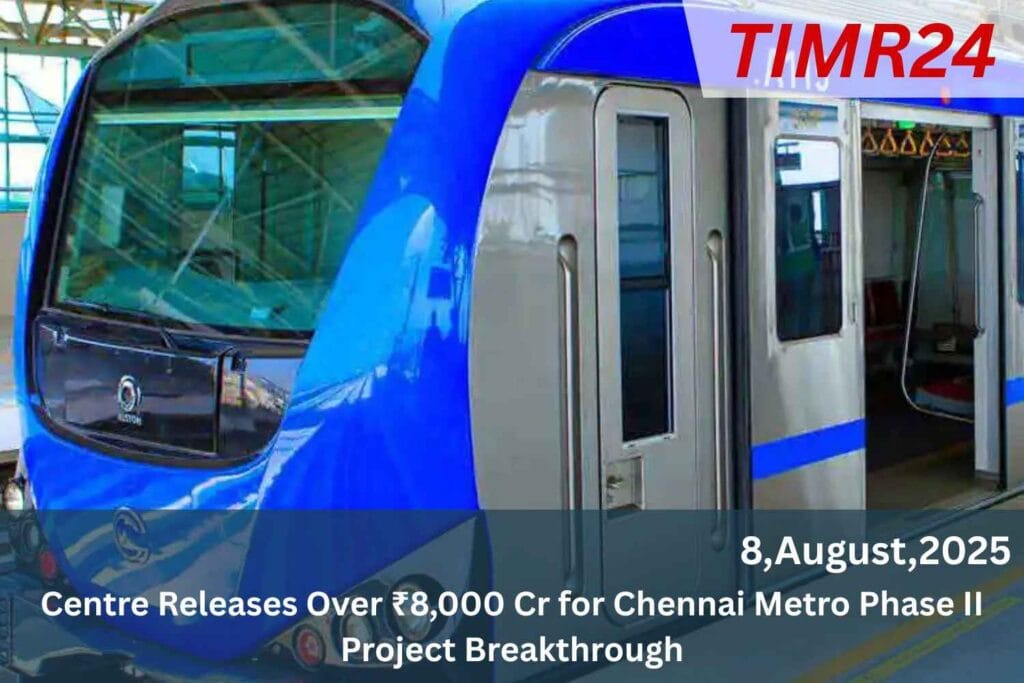
The Central Government has contributed over ₹8,000 crore to the Chennai Metro Rail Phase II project, a joint funding of ₹63,246 crore, with ₹5,219.57 crore released in FY 2024-25 and ₹8,445.8 crore allocated for FY 2025-26.The Government of India has released over ₹8,000 crore for the Chennai Metro Phase II Project, marking a significant financial boost for one of Tamil Nadu’s most ambitious urban transport developments. This funding is financial injection will be utilised for expected to accelerate construction work, improve connectivity, and enhance the overall commuting experience for residents of Chennai (Metro Rail).
Overview of Chennai Metro Phase II
Phase II of Metro spans approximately 118.9 km and is designed to connect key residential, commercial, and industrial hubs across the city. The project includes three major corridors — Corridor 3 (Madhavaram to SIPCOT), Corridor 4 (Light House to Poonamallee), and Corridor 5 (Madhavaram to Sholinganallur). Once completed, Phase II is expected to significantly reduce travel times and road congestion The ₹8,000 crore funding from the Centre is part of the total project cost, which is estimated to exceed ₹61,000 crore. This financial injection will be utilised for civil works, station development, and system integration. The Centre’s timely support underscores the importance.
Infrastructure and Technological Advancements
Phase II will introduce advanced signalling systems, energy-efficient rolling stock, and modern station designs. Features such as platform screen doors, upgraded ticketing systems, and enhanced passenger information of the displays are planned to improve commuter convenience and safety. The project also integrates with other transport modes, including suburban rail and bus networks, to ensure seamless travel The expansion is expected to reduce Chennai’s dependence on private vehicles, leading to a drop in carbon emissions and improved air quality. The Chennai Metro Rail Limited (CMRL) has committed to incorporating sustainable practices such as solar energy use at stations, water recycling, and rainwater harvesting. These initiatives align with India’s environmental goals and urban resilience strategies.
Boost to Economy and Employment
Large-scale infrastructure projects like Chennai Metro Phase II have a direct impact on local economies. Apart from improving connectivity, the project will generate substantial employment during construction and create opportunities for ancillary businesses such as retail outlets, real estate, and transport services. With substantial funding now in Metro Phase II is poised for rapid progress. The completion of this project will transform the city’s transport landscape, making daily commutes faster, safer, and more reliable. It will also strengthen Chennai’s position as a modern metropolitan city with a world-class public transport system.
Chennai Metro in improving public transport infrastructure and aligns with the national agenda for sustainable urban mobility The (Urban Transport).Phase II spans 118.9 km and will link key residential, commercial, and industrial hubs. It consists of three corridors — Corridor 3 (Madhavaram to SIPCOT), Corridor 4 (Light House to Poonamallee), and Corridor 5 (Madhavaram to Sholinganallur). The ₹8,000 crore released is part of the total estimated project cost of ₹61,843 crore. This allocation will be used for civil construction, station development, and system integration timely funding ensures the project meets its phased completion deadlines.
Q1. How much funding has the Centre released for Chennai Metro Phase II?
Over ₹8,000 crore has been released (Light House to Poonamallee)
Q2. What is the total length of Chennai Metro Phase II?
Around 118.9 km across three corridors.
Q3. Which areas will Chennai Metro Phase II connect?
Madhavaram, SIPCOT, Light House, Poonamallee, and Sholinganallur.
Q4. How will the project benefit commuters?
It will reduce travel time, road congestion, and improve connectivity.
Q5. Will Chennai Metro Phase II adopt eco-friendly practices?
Yes, it will use solar energy, water recycling, and rainwater harvesting.