

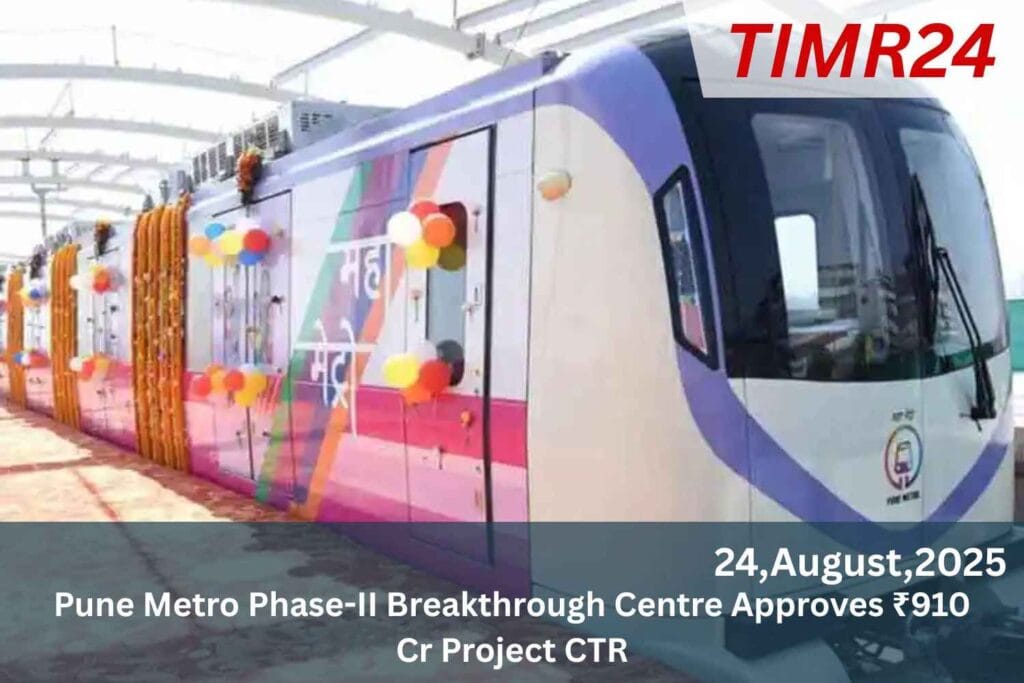
The Centre Ministry of Housing and Urban Affairs has approved the next phase of the Pune Metro, involving an investment of Rs 910.18 crore. The second phase aims to extend the metro rail by 4.413 km from Pimpri-Chinchwad Municipal Corporation station to Nigdi, with three elevated stations. Tenders for civil, electrical, and signal works are being floated, with the project expected to be completed in three years The Pune Metro Phase-II project has received a major boost with the Government approving ₹910 crore for its development. This expansion reflects India’s growing focus on sustainable public transportation and urban development.
Pune, being one of the fastest-growing cities, faces significant traffic congestion, and the metro project is seen as a long-term solution to mobility challenges The Maharashtra (Smart Cities) Metro Rail Corporation Limited (Maha-Metro) will oversee the execution of this phase, just as it has been managing Phase-I of Pune Metro. According to officials, Phase-II aims to extend the metro corridors to suburban and industrial areas, improving connectivity between residential colonies, IT hubs, and business districts. This step is expected to help daily commuters save time, reduce dependency on private vehicles, and cut down fuel costs. For details about the current operational routes,
Ministry of Housing and Urban
You can check our From an infrastructure standpoint, the Phase-II extension is designed with modern facilities, energy-efficient trains, and better integration with other urban transit systems such as bus rapid transit (BRTS) and suburban railways. By doing so, it complements India’s vision of enhancing urban mobility through multi-modal transport systems. For a broader perspective, you can also explore how similar initiatives are progressing in cities The project will also contribute to environmental sustainability. With Pune facing rising levels of vehicular pollution, metro connectivity is expected to reduce carbon emissions significantly.
According to the Ministry of Housing and Urban Affairs (MoHUA), metro rail projects across India collectively aim to shift millions of commuters from cars and two-wheelers to mass rapid transit systems. You can read more about these efforts on the From an economic perspective, improved metro infrastructure boosts real estate growth, increases commercial activity around metro corridors, and creates direct and indirect employment opportunities. This has already been observed in Phase-I, where metro connectivity improved land value and accessibility in certain neighbourhoods. The financial approval also demonstrates its commitment to empowering Tier-II cities like.
Pune to match global infrastructure standards. Pune Metro Phase-II is not just a transport project but a critical step towards India’s Smart City Mission. Citizens will experience improved urban living, thanks to faster travel times, modernized stations, and world-class facilities. To learn more about India’s Smart City projects, you may visit the the ₹910-crore funding approval for Pune Metro Phase-II is a landmark decision that will change the way people commute in Pune. It will not only provide a sustainable solution to traffic congestion but also integrate seamlessly with ongoing smart city and infrastructure development project (MoHUA) With timely execution, this project has the potential to set new benchmarks in public transportation in India.
Q1 What is the total cost approved for Pune Metro Phase-II?
The Centre has approved ₹910 crore for Phase-II development.
Q2 How will Pune Metro Phase-II benefit commuters?
It will reduce travel time, traffic congestion, and pollution while offering modern facilities.
Q3 When will Phase-II of Pune Metro be completed?
Construction timelines will be finalized soon, with work expected to speed up from 2025.
Q4 Which areas will be covered under Pune Metro Phase-II?
The extension will cover additional routes connecting key residential and business hubs.
Q5 How does this project contribute to Smart City goals?
By enhancing sustainable transport, reducing emissions, and improving urban connectivity.