














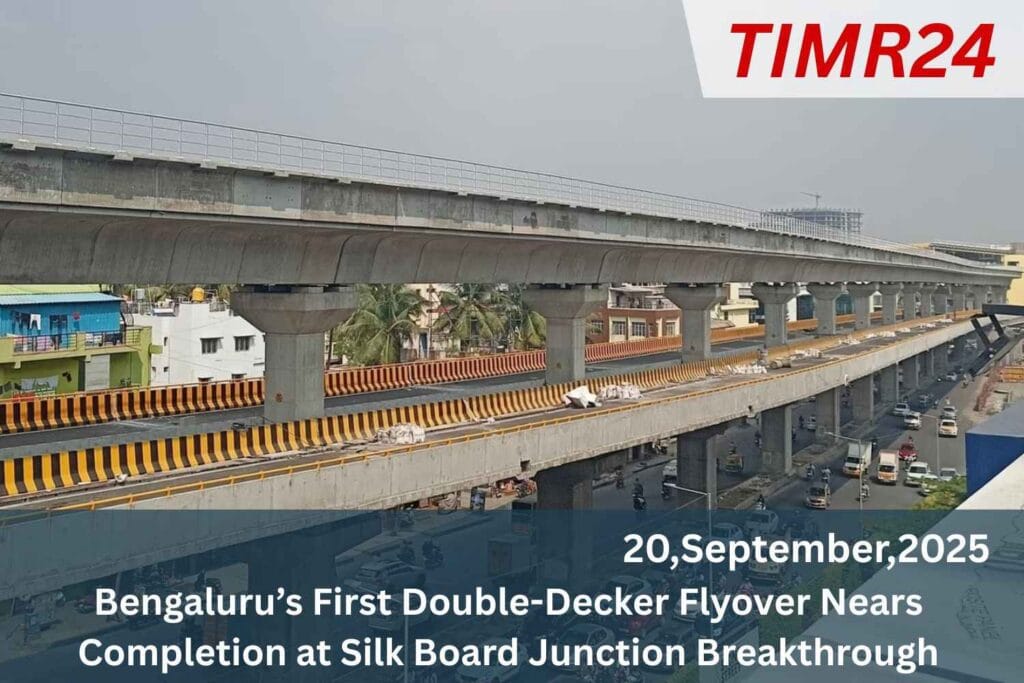
Bengaluru’s first double-decker flyover is set to be operational by December or early next year. The Bangalore Metro Rail Corporation Limited is launching steel girders to connect the HSR Layout side of the Outer Ring Road with BTM Layout. Bengaluru, a city often hailed as the Silicon Valley of India, has been synonymous with innovation, growth, and opportunity. Yet, one issue that has shadowed its rapid development is traffic congestion. Among the busiest intersections in the city, the Silk Board Junction stands out, notorious for daily traffic snarls and long hours of commute for lakhs of residents and IT professionals. To address this bottleneck, the government and infrastructure.
Planners introduced a ground-breaking project Bengaluru’s first double-decker flyover. With construction in its final stages, this ambitious development promises not only relief from traffic but also a complete transformation in how the city experiences mobility For decades, commuters traveling through Silk Board Junction have struggled with gridlocks that stretch for kilometres. This junction connects crucial roads, including Hosur Road, Outer Ring Road, and Electronic City the hub of IT and electronics companies. Recognizing the critical need for a long-term solution, authorities conceptualized a structure that integrates road and metro infrastructure in one design.
The double-decker flyover, spread over nearly three kilometres, has two levels: the top deck dedicated to road traffic and the lower deck to house the Namma Metro Yellow Line. Such integration ensures that private and public transport can coexist, offering commuters multiple options to reach their destinations faster One of the biggest promises of this project is the decongestion of Silk Board Junction, which has become a symbol of Bengaluru’s traffic woes. By channeling vehicles onto the elevated deck, the load on ground-level roads will decrease considerably. In parallel, the metro line running below offers commuters an efficient, reliable, and sustainable option to avoid traffic.
Altogether. Residents traveling between Central Silk Board and hubs like Electronics City, HSR Layout, and Outer Ring Road will benefit immensely from reduced travel time. This change is expected to create a ripple effect, improving the flow of traffic in neighbouring junctions (Smart City) The integration of the Yellow Line of Namma Metro is perhaps the most significant element of the project. This metro line stretches from RV Road to Bommasandra, covering some of Bengaluru’s busiest IT corridors. With the metro running along the flyover, commuters will not only save time but also contribute to reducing vehicular emissions and environmental stress. As metro ridership.
Engineering Marvel and Design Challenges
Increases, the reliance on private vehicles is expected to decline, aligning with the city’s vision of shifting towards sustainable mobility solutions. For urban planners, this double-decker approach demonstrates how road and metro systems can be harmonized for maximum impact. Constructing a double-decker flyover in a bustling city center is no easy feat. Engineers had to carefully design a structure capable of supporting the heavy load of road vehicles while ensuring the stability of metro tracks beneath. Innovative construction techniques, advanced machinery, and phased execution were deployed to minimize disruption to ongoing traffic during the project’s duration.
The structure not only adds capacity but is also designed with durability and safety in mind, ensuring it will serve Bengaluru for decades. The project also sets a precedent for other Indian cities grappling with traffic issues, showcasing how engineering ingenuity can offer holistic solutions Major infrastructure projects often reshape the urban landscape around them, and Silk Board’s double-decker flyover is no exception. Improved connectivity is expected to boost property values in nearby areas such as BTM Layout, HSR Layout, and Electronic City. Reduced commute times will make these locations more attractive for both homebuyers and investors.
Impact on Daily Life of Commuters
Commercial activity is also projected to rise, as better access encourages businesses, retail outlets, and co-working hubs to expand operations. The flyover’s impact extends beyond traffic management it is a catalyst for economic growth in Bengaluru. For the average commuter, the completion of this flyover means much more than shorter travel times. It translates into improved productivity, reduced stress, and better work-life balance. For IT professionals who spend hours stuck in traffic, this development could reclaim precious time. Furthermore, the integration of metro services allows families and students to rely less on private vehicles, encouraging a cultural shift towards public transport.
The double-decker flyover at Silk Board is not an isolated initiative. It is part of a larger network of infrastructure projects shaping Bengaluru’s future. Developments such as the Peripheral Ring Road, Suburban Rail Project, and Metro Phase 2 expansions complement this flyover, collectively contributing to the city’s transformation into a smart and connected urban hub. Together, these projects are expected to create seamless travel corridors, linking the city’s residential, commercial, and industrial clusters Another major outcome of the project is the environmental relief it brings. Bengaluru has long struggled with rising pollution levels, partly due to vehicular emissions By offering.
Symbol of Modern Urban Development
Smoother traffic flow and strengthening metro connectivity, the project is poised to cut down fuel wastage and carbon emissions. Encouraging commuters to shift towards public transport further enhances its role in building a sustainable future for the city. When completed, the Silk Board double-decker flyover will symbolize the city’s progress toward modern, integrated urban planning. It reflects Bengaluru’s capacity to adopt global practices and adapt them to local challenges. For residents, it will stand as a reminder that the city is not just growing outward with IT parks and high-rises but also upward in its approach to smarter mobility solutions.
As construction nears completion, the anticipation among citizens grows stronger. For a city where daily commutes often define lifestyles, this project promises meaningful change. The combination of engineering brilliance, strategic urban planning, and sustainable vision makes it one of Bengaluru’s most important infrastructure achievements. Once operational, the double-decker flyover at Silk Board Junction will not only ease traffic congestion but also pave the way for similar integrated solutions in other Indian metros Bengaluru’s story has always been about innovation and adaptation, and the Silk Board double-decker flyover is the latest chapter in that journey.
By blending metro and road infrastructure into a single, elegant design, it demonstrates how urban challenges can be turned into opportunities. For commuters, businesses, and the city at large (FAME) this flyover is more than concrete and steel is the promise of a faster, smarter, and more sustainable Bengaluru.
Q1. What is the purpose of Bengaluru’s first double-decker flyover at Silk Board Junction?
It aims to ease chronic traffic congestion by separating traffic levels for smoother vehicle movement and metro connectivity.
Q2. When is the double-decker flyover expected to be completed?
The project is nearing completion in late 2025, with final touches being given before opening to the public.
Q3. Which metro line is integrated into the Silk Board double-decker flyover?
The Yellow Line of Namma Metro runs along the structure, improving multimodal connectivity.
Q4. How will the double-decker flyover impact Bengaluru’s real estate and local economy?
It will boost real estate values, reduce commute times, and enhance commercial growth in the surrounding areas.
Q5. How long is the Silk Board double-decker flyover?
It spans over 3 km, integrating flyover and metro infrastructure to decongest one of Bengaluru’s busiest junctions.