













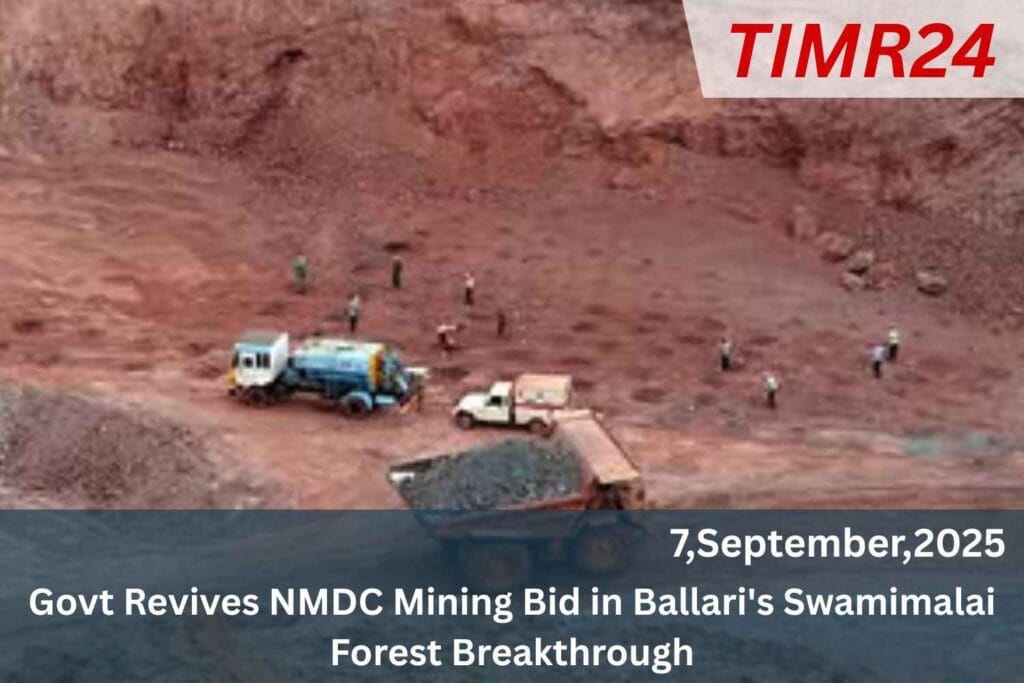
The Karnataka government Ballari’s has revived a mining proposal in Swamimalai forests near the historic Kumaraswamy-Parvati temple, five years after it was rejected. The National Mineral Development Corporation (NMDC) had initially sought 392.92 acres of forest land, home to over 26,000 trees and species. The company has revised its application in 2024, reducing the land request to 250.86 acres and reserving rights over the remaining area. The Deputy Conservator of Forests (DCF) in Ballari has asked NMDC to update its proposal and include details for compensatory afforestation. The case is currently under suo motu review by the National Green Tribunal.
The revival of the NMDC mining bid in Ballari’s Swamimalai forest has triggered a wave of discussions that extend far beyond the mining sector, touching upon themes of economic development, environmental sustainability, tribal rights, and India’s energy security goals. The government’s decision to revisit the proposal is part of its broader attempt to balance industrial growth with ecological concerns, but it has also raised critical questions about the future of protected landscapes and the communities that rely on them. Swamimalai, located in the mineral-rich Ballari district of Karnataka, holds significant iron ore reserves, making it an attractive site for mining activity.
However, its designation as a forest area brings it under strict environmental scrutiny, especially since it forms part of a sensitive ecological corridor that supports wildlife and traditional livelihoods. Readers interested in related policy updates can explore our (India Mining) section for ongoing developments in this sector The National Mineral Development Corporation (NMDC), India’s largest iron ore producer, has long eyed the Ballari region for its rich mineral potential. Ballari itself has been central to India’s iron ore industry, supplying raw materials to steel plants across the country. The Swamimalai block, in particular, has been in the spotlight for its estimated high-grade iron ore.
Environmental and Ecological Concerns
Deposits. According to reports from India’s steel sector is projected to grow steadily, and secure access to domestic ore supplies is crucial to reducing dependence on imports. The revival of NMDC’s bid comes at a time when the government is seeking to accelerate mining production to meet rising demand. More detailed analysis of mining industry trends is also available in our category. Swamimalai is not just a mineral-rich zone; it is also a forest ecosystem that supports unique biodiversity. The revival of mining plans here has reignited debates between conservationists and industry advocates. Environmental experts argue that mining could disrupt fragile ecosystems.
Threaten wildlife corridors, and impact water sources that sustain agriculture and local villages. India’s Supreme Court has in the past imposed restrictions on mining in Ballari due to environmental violations, making the current revival highly sensitive has emphasized that any new mining bid will have to undergo rigorous environmental assessments, including public consultations. To explore further, our page highlights how India is handling the conflict between development and conservation. Another dimension of the mining bid lies in its impact on local communities and tribal groups. Swamimalai forest is not just an ecological zone but also a cultural and economic lifeline for indigenous people who depend on forest.
Local Communities and Tribal Rights
produce and land for survival. Any mining project has to comply with the Forest Rights Act and obtain consent from gram sabhas, ensuring that community voices are not side-lined. Previous experiences in Ballari have shown that unchecked mining can displace communities, create livelihood disruptions, and lead to long-term social unrest. The government has promised that the revived bid will take into account these rights and provide compensation or rehabilitation measures if required. For insights on how industries interact with local communities, our section carries reports on grassroots-level challenges in development projects.
From the government’s perspective, reviving the NMDC bid represents an opportunity to boost economic output and enhance India’s self-reliance in critical raw materials. With India targeting a $5 trillion economy and expanding its steel production capacity, domestic mining plays a pivotal role in ensuring raw material security. Ballari’s ore reserves, if tapped responsibly, could generate revenues, create employment opportunities, and strengthen downstream industries such as construction and infrastructure. The NMDC, being a public sector enterprise, also ensures that profits feed back into the government’s development agenda. For readers keen on broader economic.
Sustainability and Policy Balance
Linkages, our section explores how raw materials like iron ore fuel India’s industrial base. One of the most challenging aspects of this revival is policy balance. The government has been pushing for sustainability through the National Mineral Policy and commitments under global climate agreements, but it also recognizes the need for industrial growth. Reconciling these two goals in Swamimalai will be a test case for India’s approach to sustainable mining. NMDC has pledged to adopt eco-friendly practices, from minimizing land disturbance to rehabilitating mined areas, but environmental groups remain sceptical about whether such measures can truly offset the damage.
More examples of green mining initiatives are covered in our category, which examines how industries worldwide are moving toward reduced-impact practices The revival of this bid also falls under India’s legal and regulatory framework for mining. The Mines and Minerals (Development and Regulation) Act, along with Supreme Court judgments on Ballari mining, set strict guidelines for operational transparency and environmental compliance. NMDC will be required to follow a transparent auction process, secure forest and environmental clearances, and adhere to stringent monitoring by regulatory bodies. Past mining scandals in Ballari have made it a symbol of the need for.
Wider Implications for India’s Mining Sector
Accountability, and the government’s insistence on transparency this time reflects lessons learned from history. Readers can learn more about governance frameworks. The implications of Swamimalai extend beyond Karnataka. If the NMDC bid successfully balances economic and environmental considerations, it could serve as a blueprint for responsible mining in other ecologically sensitive areas. India’s mining sector is poised for expansion, and striking the right balance between growth and sustainability will be crucial for future projects. The decision will also influence foreign investor confidence, as global markets increasingly demand that resource extraction follows ESG.
Future Outlook
Looking ahead, the revived NMDC mining bid in Swamimalai remains both a challenge and an opportunity. The government’s ability to ensure strict compliance, respect community rights, and enforce ecological safeguards will determine whether the project can move forward without repeating the mistakes of the past. For NMDC, the bid represents a chance to consolidate its role as India’s premier iron ore producer and showcase its commitment to responsible mining practices. For local communities and environmental advocates, the decision is a reminder that development cannot come at the cost of long-term sustainability continue to provide updates on how this story unfolds and what it means for India’s broader mining sector.
The revival of NMDC’s mining bid in Ballari’s Swamimalai forest is not just an industrial story it is a complex narrative that weaves together ecology, economy, law, and society. On one hand, it promises significant contributions to India’s energy and steel security, while on the other, it poses risks to (OIL India) fragile ecosystems and vulnerable communities. As India navigates its growth trajectory, projects like Swamimalai will test the nation’s ability to balance ambition with accountability, growth with conservation, and progress with justice. The final outcome of this bid will be closely watched, not only by industry stakeholders but also by citizens, environmentalists, and global observers who see in it a reflection.
Q1. What is the NMDC mining bid in Ballari’s Swamimalai Forest?
The NMDC mining bid refers to the government’s decision to revive a proposal allowing the National Mineral Development Corporation (NMDC) to conduct mining operations in the Swamimalai forest region of Ballari, Karnataka, an area rich in iron ore reserves.
Q2. Why is the mining bid in Swamimalai Forest controversial?
The forest is ecologically sensitive and home to diverse flora, fauna, and tribal communities. While mining may boost industrial growth and create jobs, it raises serious concerns about deforestation, biodiversity loss, and displacement.
Q3. How will the revival of this mining bid impact the local economy?
If approved, the project could strengthen Karnataka’s iron ore supply, benefit steel industries, and generate local employment. However, balancing economic benefits with environmental safeguards will be a major challenge.
Q4. What environmental measures are being discussed for the project?
Authorities are considering strict environmental clearances, afforestation commitments, and regulated mining practices to minimize ecological damage, though activists argue these steps may not fully offset the impact.
Q5. What is the current status of the NMDC mining project in Ballari?
The project is in its revival stage, with government clearances under review. Environmental impact assessments and public consultations will likely play a role before final approvals are granted.