


















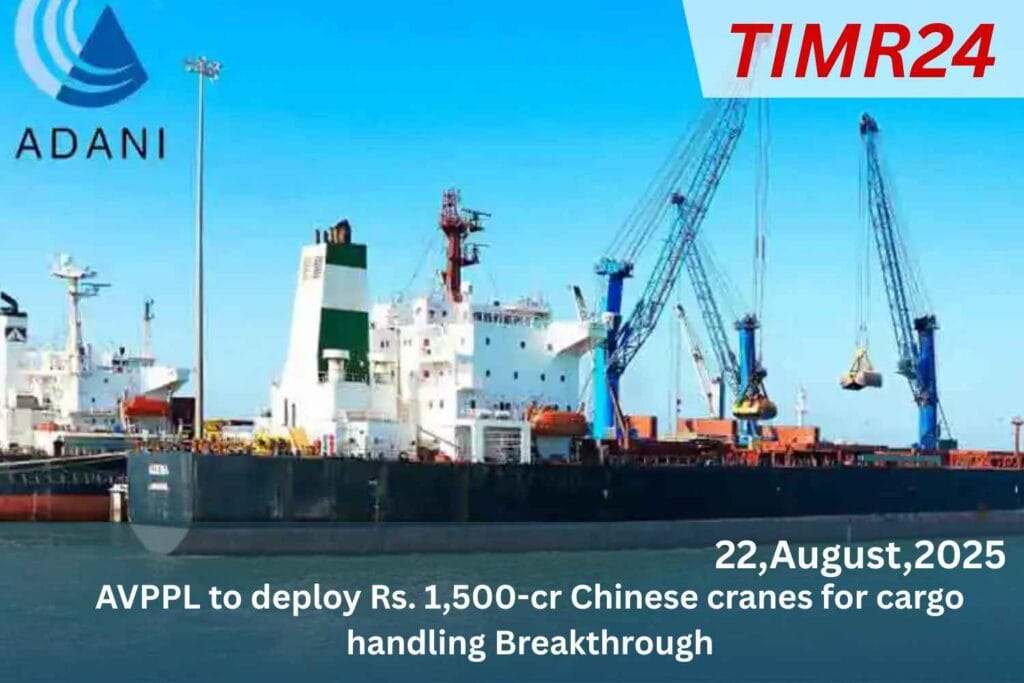
Adani Vizhinjam Port Private Ltd (AVPPL) is set to deploy Chinese-Manufactured cranes for cargo handling at the Vizhinjam multi-purpose and container transhipment port in Kerala. The move comes amid the Union government’s decision to block the use of China-made equipment in India’s infrastructure projects. The first batch of equipment, estimated to cost over Rs. 1,500 crore, is scheduled for delivery within the next month. The state government has granted permission to import large cranes and other necessary equipment from China. Adani Vizhinjam Port Private Limited (AVPPL) is set to transform India’s maritime cargo handling sector with the deployment of Chinese cranes.
Worth Rs. 1,500 crore, a move that marks a major leap in port infrastructure development. Ports across India have been witnessing exponential growth in trade volumes, and the need for advanced equipment to handle cargo more efficiently has never been more pressing. By introducing (Shanghai Port) state-of-the-art cranes, AVPPL is positioning itself at the forefront of modernization and aligning with global standards, ensuring that India’s ports remain competitive in international trade routes This initiative is not only about upgrading machinery but also about boosting.
The operational capabilities of one of India’s most strategic port projects, the Vizhinjam International Seaport, which has already been recognized as a potential game-changer in India’s maritime economy. The deployment of cranes is expected to significantly enhance cargo handling efficiency, thereby reducing turnaround times for vessels. In the global logistics chain, quick handling of goods is a critical factor that influences both cost and competitiveness. With the integration of advanced crane technology, AVPPL aims to cut down delays, streamline port operations, and provide shipping companies with a faster and more reliable service. The move mirrors global practices where major.
Ports, such as have invested heavily in automation and high-capacity cranes to maintain their status as international shipping hubs. India, through projects like this, is signaling its intent to move in the same direction and reduce dependence on older, less efficient cargo handling systems The investment of Rs. 1,500 crore underlines the economic significance of this project. For a developing economy like India, every infrastructural improvement has a ripple effect across industries. Better cargo handling means smoother export-import operations, reduced logistics costs, and improved competitiveness for Indian goods in global markets.
The role of ports in supporting India’s “Make in India” and “Atmanirbhar Bharat” initiatives cannot be understated, as efficient logistics is central to attracting foreign investments and supporting domestic manufacturers. The cranes, sourced from China, represent an immediate solution to India’s growing needs, even as the country continues to strengthen its own industrial base in heavy machinery and port equipment manufacturing. Another aspect of this development is its impact on regional trade dynamics. Vizhinjam Port, where AVPPL is investing, is strategically located near key international shipping lanes, which makes it highly attractive for transshipment cargo.
Currently, much of India’s transshipment cargo is routed through ports like Colombo in Sri Lanka or Dubai’s Jebel Ali Port. With world-class cranes now being installed, Vizhinjam will have the capacity to directly handle larger vessels and higher cargo volumes, reducing dependency on foreign ports and saving millions in annual logistics costs. This will also make India more self-reliant in managing its maritime trade, while simultaneously boosting Kerala’s economic prospects In terms of technological integration, the Chinese cranes being deployed are expected to feature automated systems, remote monitoring, and safety enhancements that not only speed up operations but also.
Ensure minimal human error. While automation often raises questions about employment, in the case of ports, it generally leads to the creation of new high-skilled jobs in machine operation, digital monitoring, and system maintenance. Furthermore, India’s workforce will gain exposure to advanced technologies, enhancing their skill sets and making them more competitive globally. Ports like (JNPT) have already begun adopting similar technologies, and the move by AVPPL will reinforce this modernization trend across the country. The environmental impact of this project also deserves attention. Modern cranes are designed with energy efficiency in mind, and their use can reduce.
Fuel consumption and emissions compared to older cargo handling equipment. This aligns with India’s broader sustainability goals, where infrastructure projects are being designed to balance economic growth with environmental responsibility. With growing concerns about carbon footprints in shipping and logistics, deploying modern cranes is not just a business decision but also a step toward greener port operations Finally, the broader strategic implications of AVPPL’s investment cannot be ignored. Ports are critical nodes in national security and economic growth, and equipping them with advanced cargo handling systems strengthens India’s maritime capabilities.
In a region where geopolitical competition is intense, particularly across the Indian Ocean, efficient and modern ports give India a stronger hand in securing trade routes and supporting naval logistics. The Rs. 1,500 crore investment, therefore, is not just about handling containers; it is about securing India’s future in global trade, ensuring that its ports are world-class, and laying down the foundation for long-term economic resilience. AVPPL’s decision to deploy Chinese cranes worth Rs. 1,500 crore for cargo handling marks a watershed moment for India’s port infrastructure. It represents a fusion of global technology with local ambition, promising faster trade, stronger economic growth.
Q1. What is AVPPL investing in?
AVPPL is deploying ₹1,500 crore worth of Chinese cranes for cargo handling.
Q2. Why are Chinese cranes being used?
They offer advanced technology, efficiency, and cost-effectiveness.
Q3. How will this investment benefit ports?
It will increase cargo handling speed, capacity, and overall efficiency.
Q4. What is the project’s estimated cost?
The project involves an investment of ₹1,500 crore.
Q5. When will the cranes be operational?
Deployment is planned in upcoming phases to strengthen port operations.