


















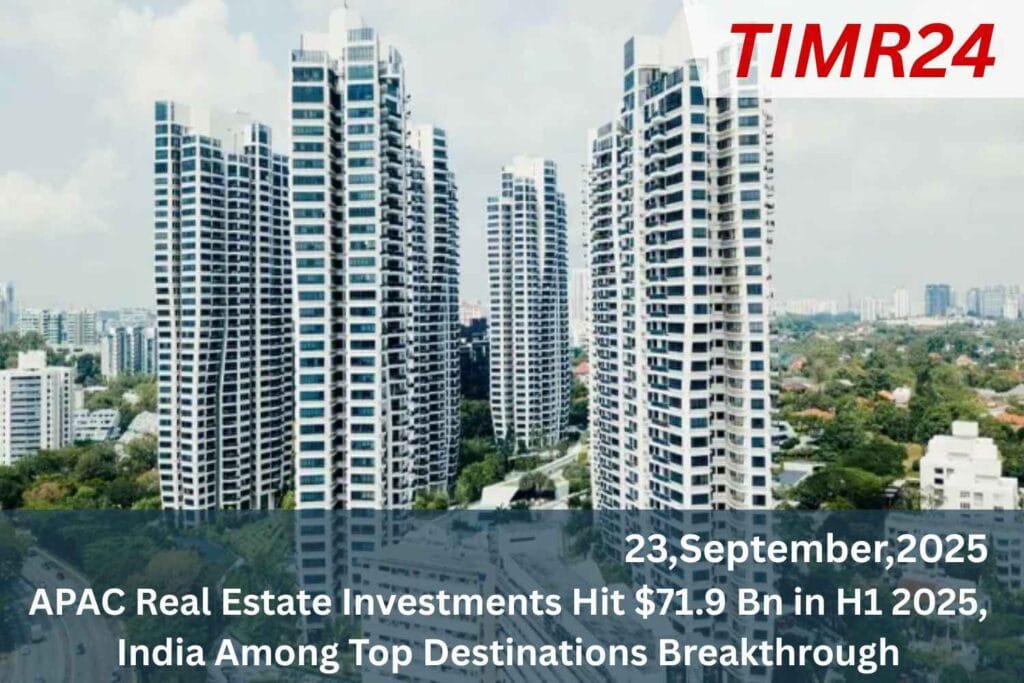
Real estate investments in nine Asia-Pacific (APAC) markets reached USD 71.9 billion in H1 2025, reflecting a modest 6% YoY decline due to trade volatilities and global headwinds, according to Colliers’ Investment Insights H1 2025 report. The report expects stronger performance in the second half of 2025, supported by stabilizing interest rates, robust domestic investments, and diversified capital allocation across APAC. Singapore, Japan, and Hong Kong ranked among the top 10 global sources of capital in H1 2025, while Japan and Australia emerged as top destinations for standing assets. India ranked fourth globally for land and development site investments.
Underscoring sustained investor confidence in the region. Office assets remained the most sought-after, accounting for 36% of total investment volumes in H1 2025. Retail investments saw a notable upswing, with investment rising 13% year-on-year, driven by investments in Australia, South Korea, and Mainland China. India’s prominence in the Asia Pacific region continues to grow, driven by strong demand traction across real estate asset classes. The second half of 2025 is poised to perform equally well, with rising investments in both core segments like office and residential, along with traction in alternative assets such as data centers, senior living, and life sciences.
The Asia-Pacific Region has witnessed one of the strongest surges in real estate activity in recent years, with total investments in the first half of 2025 reaching $71.9 billion. This remarkable growth signals not just a recovery from global economic uncertainties but also a shift in how capital is flowing across geographies. India, in particular, has emerged as one of the most sought-after destinations, standing alongside powerhouses like China, Singapore, Japan, and Australia. The trend reflects investor appetite for both stability and high growth potential, while also underlining the transformative role of government policies, infrastructure projects, and sustainability goals.
The Changing Landscape of APAC Real Estate
The Asia-Pacific property market has become increasingly attractive for global investors who are seeking a balance between diversification and long-term returns. The surge to $71.9 billion has been fuelled by large-scale investments in urban centers, technology-driven smart city projects, and cross-border acquisitions. Major hubs such as Singapore and Sydney remain key to institutional investors, but the narrative is gradually shifting toward emerging markets like India, which offers both scale and resilience. The investment momentum is also being supported by structural reforms, digital adoption, and demand in sectors ranging from logistics to residential housing. For readers interested.
In India’s infrastructure momentum, our recent coverage on (India) highlights how connectivity projects are fueling real estate expansion in new regions India’s rise as a preferred destination in the APAC investment landscape is no coincidence. Over the last decade, the country has introduced reforms such as RERA and GST, while simultaneously attracting foreign direct investment with more transparent and investor-friendly regulations. Additionally, the Indian government’s focus on affordable housing, infrastructure corridors, and smart cities has boosted confidence among institutional players. Large private equity funds and sovereign wealth funds are now actively deploying capital across.
Commercial, residential, and warehousing segments. Similar infrastructure-driven momentum was seen in Maharashtra with where transport upgrades directly enhance property values Commercial office spaces remain one of the strongest pillars of investment across India. Bengaluru, Gurugram, Hyderabad, and Mumbai continue to attract global firms, particularly in IT, fintech, and e-commerce sectors. These businesses require Grade-A office spaces that meet international standards, which has in turn created demand for premium commercial projects. This institutional interest in India mirrors broader APAC patterns, where financial hubs such as Hong Kong and Tokyo still dominate.
But India’s rise lies in its ability to combine strong economic growth with cost-effective expansion. The office market is also directly benefiting from India’s digital economy, where startups and global capability centers are creating long-term rental commitments The logistics and warehousing segment has become another focal point for investors. With India’s booming e-commerce sector and the rapid expansion of supply chain infrastructure, Grade-A warehouses are now one of the fastest-growing investment themes. Investors are actively targeting hubs near Delhi NCR, Pune, and Chennai, where demand for organized storage and last-mile delivery infrastructure is skyrocketing. Retail spaces.
Residential Real Estate and Affordable Housing
Too, are witnessing a revival. High-street retail and organized malls are benefiting from the rise of India’s middle class, which is increasingly looking toward premium consumption experiences. This transformation in retail and logistics is not unique to India but part of a broader APAC trend, as can be seen in large-scale urban waterfront developments such as where integrated real estate projects include retail and mixed-use elements Residential real estate, long seen as a slow-moving sector, is now witnessing significant growth. In India, government schemes like Pradhan Mantri Awas Yojana (PMAY) have accelerated affordable housing, while luxury and mid-segment housing.
Continue to grow in Tier-1 cities. Investors see resilience in this sector due to urban migration, favourable demographics, and increasing purchasing power. The trend is equally visible in APAC, where rising urbanization in markets like Vietnam, Indonesia, and the Philippines is attracting foreign capital into residential projects. India’s housing boom is further strengthened by financing support and digital property platforms that ensure smoother buyer-seller interactions One of the defining characteristics of real estate in 2025 is the focus on sustainability. Investors are increasingly aligning their portfolios with ESG (Environmental, Social, and Governance) principles.
In India, this means green-certified office spaces, energy-efficient housing projects, and mixed-use developments that prioritize environmental sustainability. Global investors are demanding projects that not only provide financial returns but also comply with climate-conscious goals. This ESG-driven shift has been reinforced by international institutions, and in India, it is shaping future developments just as much as capital inflows. Our analysis of shows how financial Frameworks are being designed to support long-term and sustainable infrastructure, which directly influences the real estate sector APAC’s real estate story is incomplete without examining cross-border capital flows.
Sovereign wealth funds, pension funds, and global REITs are entering India not just as passive investors but as long-term strategic partners. Joint ventures with domestic developers are increasingly common, giving global players access to high-growth markets while ensuring compliance with local regulations. This model has already been tested in Singapore and Australia, and its success in India marks the country’s integration into global capital cycles The trend also reinforces India’s role as a stable, high-yield market compared to more saturated property markets in the West As the first half of 2025 sets new benchmarks, the outlook for the rest of the year remains promising.
India is projected to continue attracting major real estate investments, supported by its strong economic fundamentals, digital economy, and infrastructure-led growth (Real Estate) APAC as a whole is expected to strengthen its role as the leading global destination for real estate investors, with sustainability, technology integration, and demographic-driven housing growth as the primary drivers. The future of property investment in India and APAC will not just be about.
Q1. What was the total value of APAC real estate investments in H1 2025?
The total value stood at $71.9 billion.
Q2. Why is India emerging as a top real estate investment destination?
Strong economic growth, urbanization, and government-friendly policies attract global investors.
Q3. Which APAC countries lead in real estate investment inflows?
India, China, Singapore, Japan, and Australia are among the leaders.
Q4. What sectors in India’s real estate are driving investment?
Office spaces, residential housing, warehousing, and retail.
Q5. How do sustainability trends impact APAC real estate growth?
Green buildings and ESG-focused developments are shaping long-term investment strategies.