

















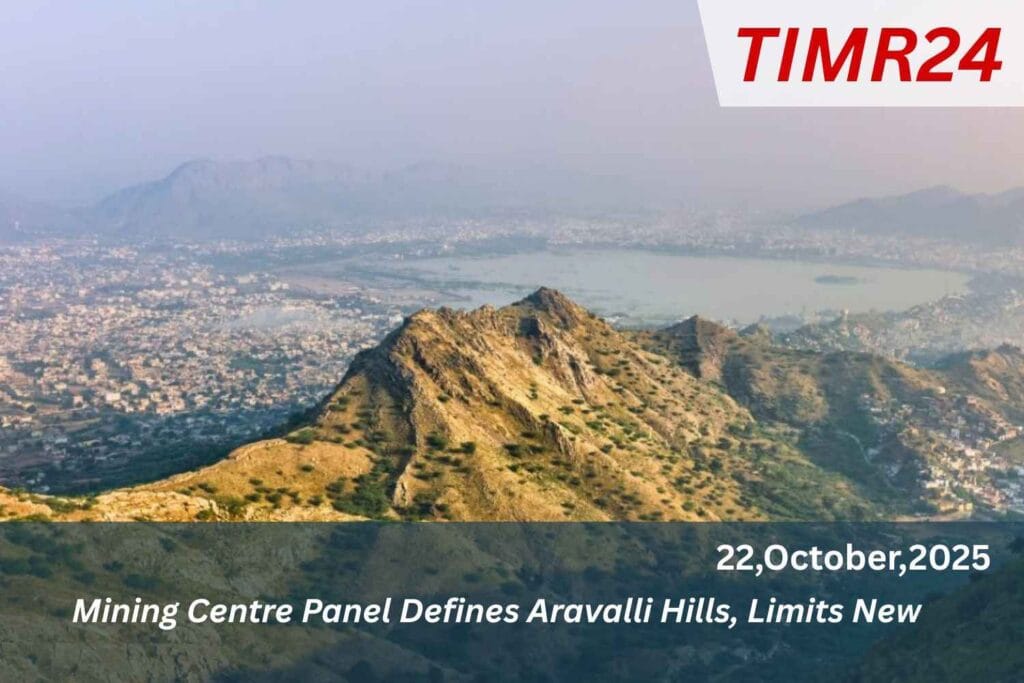
A high-level committee led by the Union Environment Secretary has submitted a report proposing that any slope rising over 100 meters from the base should qualify as part of the Aravalli Hills. The report, the first to establish a uniform definition for the Aravallis, also recommends banning new mining leases within the identified hills and ranges, except for projects involving critical, strategic, or atomic minerals. The committee, comprising forest department secretaries from Delhi, Haryana, Rajasthan, and Gujarat, and representatives from the Geological Survey of India (GSI), Forest Survey of India (FSI), and the Central Empowered Committee (CEC), will consider.
The report on 11 November and hear objections raised by various states. The report highlights the ecological significance of the Aravallis as one of the world’s oldest fold mountain systems, dating back more than 2.5 billion years, and advises states to adopt stricter environmental safeguards for existing mines. (National Mineral). In a significant move to safeguard the ecological integrity of the Aravalli mountain range, a high-level committee led by the Union Environment Secretary has submitted a comprehensive report to the Supreme Court, proposing a uniform definition of the Aravalli Hills and recommending stringent curbs on new mining activities within this region.
This initiative aims to address the longstanding challenges of illegal mining and environmental degradation that have plagued the Aravallis, one of the world’s oldest mountain ranges The committee’s report introduces a standardized definition of the Aravalli Range, stipulating that an Aravalli Hill must possess a minimum slope of 100 meters in height. Additionally, it specifies that two or more Aravalli Hills located within a proximity of 500 meters from each other, measured from the outermost point on the boundary of the lowest contour line on the two hills, should be considered part of the Aravalli Range. This definition aims to eliminate ambiguities and ensure consistent.
Application across the states of Delhi, Haryana, Rajasthan, and Gujarat, where the Aravallis extend To promote sustainable mining practices, the committee has recommended a ban on granting new mining leases within the designated Aravalli Hills and Ranges, except for projects involving critical, strategic, or atomic minerals. This measure seeks to curb the expansion of mining activities that have led to extensive deforestation, habitat destruction, and pollution in the region. Furthermore, the report advocates for the identification of core or inviolate areas within these ranges where mining should be entirely prohibited.
Environmental Significance of the Aravallis
The Aravalli mountain range plays a crucial role in maintaining the environmental stability of northwestern India. As one of the oldest fold mountain ranges in the world, originating more than 2.5 billion years ago during the Precambrian era, the Aravallis are geologically stable and deeply eroded. They serve as a vital ecological barrier, preventing desertification and protecting biodiversity. However, unsustainable mining practices have weakened this natural barrier, accelerating desert spread and contributing to the loss of public revenue due to the sale of minerals below market The committee’s recommendations have elicited varied responses from the concerned states.
Rajasthan and Delhi have expressed support for the new definition of the Aravalli Ranges, recognizing the need for uniformity in conservation efforts. In contrast, Haryana has raised objections, arguing that the new definition could lead to increased mining activities within its jurisdiction. The state contends that factors such as the geological age of rocks should be considered alongside height criteria to define the Aravallis, a stance that may potentially exclude significant forested areas, particularly in Gurgaon and Faridabad The Supreme Court has been actively involved in overseeing mining activities in the Aravalli region. In May 2024, the Court directed the states of Delhi, Haryana.
Restoration and Rehabilitation Efforts
Rajasthan, and Gujarat to refrain from granting final permissions for new mining activities in the Aravalli hills and their ranges until further orders. This decision underscores the judiciary’s commitment to balancing developmental needs with environmental conservation. The Court has also emphasized the importance of a uniform definition of the Aravalli hills to address issues related to illegal mining and inconsistent state policies Beyond regulatory measures, the committee’s report highlights the necessity of restoring areas that have been adversely affected by mining activities. The Supreme Court has instructed the Central Empowered Committee (CEC) to collaborate with.
The Haryana government to formulate plans for the restoration of regions in the Aravalli zone of Nuh district that have been ravaged by illegal mining. This initiative aims to rehabilitate the ecological balance and prevent further degradation of the environment The submission of the committee’s report marks a pivotal step towards the conservation of the Aravalli mountain range. By establishing a uniform definition and imposing restrictions on new mining leases, the initiative seeks to preserve the ecological integrity of this ancient mountain system. However, the divergent responses from state governments and the complexities of balancing development with conservation.
Present ongoing challenges. As the Supreme Court prepares to consider the report and hear objections from various states, the future of the Aravallis hinges on (NHAI) collaborative efforts that prioritize environmental sustainability alongside economic development.
Q1. What areas of the Aravalli Hills are affected by the new mining restrictions?
The restrictions cover regions across Haryana, Rajasthan, and Delhi, as defined by the mining panel.
Q2. Why did the Centre impose limits on new mining?
To prevent environmental degradation, illegal mining, and protect the biodiversity of the Aravalli Hills.
Q3. Who will monitor compliance with these mining restrictions?
Local authorities, environmental agencies, and the mining panel will oversee adherence.
Q4. Are existing mining operations affected by the new guidelines?
Existing operations must comply with sustainability and environmental regulations; unauthorized mining will face penalties.
Q5. How can communities and businesses stay informed about these changes?
Updates are available through official notifications, government websites, and research on Aravalli conservation.