






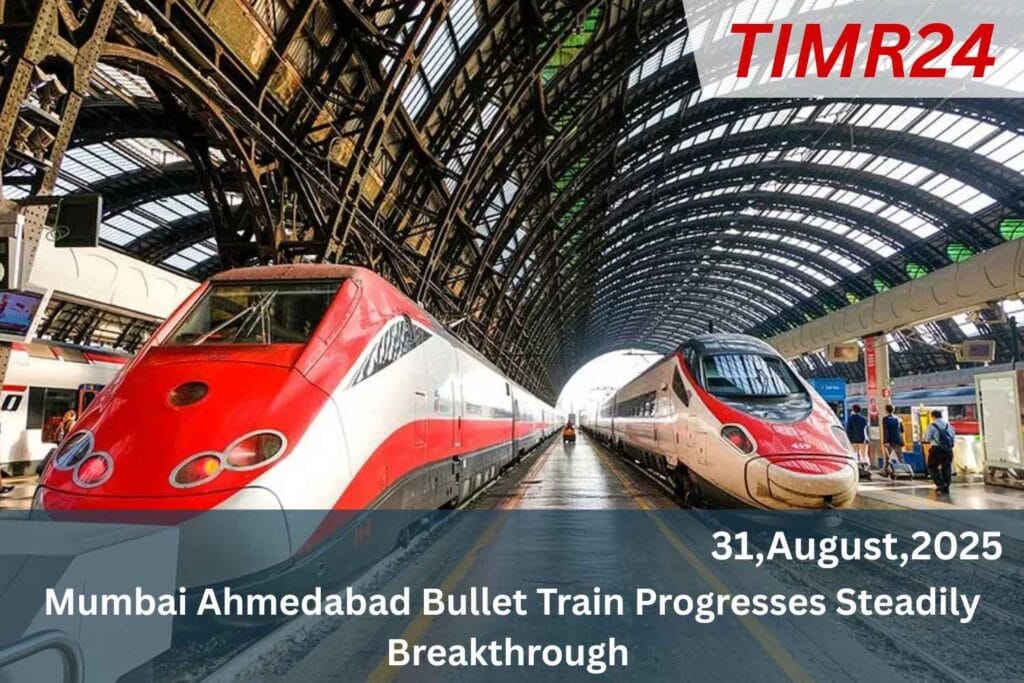
The Mumbai-Ahmedabad High-Speed Rail (MAHSR) project, funded by Japan, is advancing with significant progress in civil works, station foundations, river bridge construction, and tunnelling. The 508-kilometre bullet train corridor spans Gujarat, Maharashtra, and the Union Territory of Dadra & Nagar Haveli. As of June 30, 2025, the project has incurred a cumulative expenditure of Rs 788.39 billion. Land acquisition and statutory approvals have been completed, and construction is underway on the 21-kilometre undersea tunnel segment. The Mumbai Ahmedabad Bullet Train project, India’s first high-speed rail corridor, has been progressing steadily despite multiple challenges, and recent updates highlight significant breakthroughs that could transform the way people travel between.
The financial capital Mumbai and the business hub Ahmedabad. The project, officially known as the Mumbai-Ahmedabad High-Speed Rail (MAHSR) corridor, is being developed by the National High-Speed Rail Corporation Limited (NHSRCL) with technical and financial support from Japan through its Shinkansen technology. Covering a distance of approximately 508 kilometres, this project promises to reduce the current 6–7 hour journey by train to just about 2 hours, offering a seamless travel experience and marking a new era of connectivity in India. The latest updates suggest that key civil engineering milestones such as viaduct construction, bridge foundation work, and tunnelling activities are progressing rapidly.
Especially after the finalization of land acquisition, which had earlier posed a major hurdle. With more than 98% of land acquisition completed across Maharashtra and Gujarat, the stage is now set for major construction activity to gain momentum In terms of infrastructure development, (NHSRCL) has confirmed that over 200 kilometres of pier and viaduct work has already been completed, including several river bridges and station structures in Gujarat. The Mumbai-Ahmedabad Bullet Train will have 12 stations in total, including important hubs like Mumbai, Thane, Virar, Surat, Vadodara, and Ahmedabad, all designed with world-class passenger facilities. These stations are not just meant for boarding and deboarding but are being conceptualized as integrated transport hubs.
Which will seamlessly connect to metro rail, local trains, and bus services, boosting urban connectivity. The use of cutting-edge Japanese technology ensures not just speed but also safety, reliability, and energy efficiency, making this project a landmark in India’s rail modernization efforts. A major breakthrough has been achieved in tunnelling works near Mumbai, particularly the 21-km long tunnel between Bandra-Kurla Complex (BKC) and Shipmate, which also includes a 7-km undersea tunnel beneath the Thane Creek the first of its kind in India. This engineering feat demonstrates India’s ability to execute highly complex infrastructure projects, combining advanced engineering with environmental safeguards. The tunnel will significantly reduce travel time and enhance the passenger experience.
By offering a smooth high-speed transit option under dense urban and coastal areas Parallelly, viaduct construction across the Narmada River and other critical sections has also reached an advanced stage, further underscoring the steady progress of the project On the economic front, the bullet train project is expected to generate massive employment opportunities, both direct and indirect, across states. With thousands of workers, engineers, and contractors engaged in construction, allied sectors like cement, steel, and machinery manufacturing are also witnessing growth. Additionally, this project is creating a robust supply chain of local vendors who are being trained in Japanese Shinkansen standards, which will contribute to skill development and technology transfer.
The Indian government has emphasized that this is not merely a transportation project but a national Development mission that can elevate India’s global image by demonstrating its capacity to execute world-class infrastructure The environmental benefits of the Mumbai Ahmedabad Bullet Train are also noteworthy. High-speed trains, powered by electricity, emit far less carbon per passenger compared to cars or flights, making this an eco-friendly transportation mode. Moreover, energy-efficient station designs, solar panel integration, and sustainable construction practices are being adopted to minimize the project’s carbon footprint. As India continues its commitment to climate change mitigation, projects like MAHSR play a vital role in reducing dependence on fossil fuels and promoting green mobility.
When we look at the financial structure, the bullet train project is largely funded by a soft loan from Japan International Cooperation Agency (JICA), which covers nearly 81% of the project cost at very low interest rates with a repayment period of 50 years. This financing model ensures that the burden on Indian taxpayers remains minimal while enabling long-term benefits from advanced rail infrastructure. However, delays and cost escalations have been reported, especially during the initial land acquisition phase, which sparked political debates. Yet, with the recent acceleration in construction, the project is firmly back on track, and authorities are optimistic about achieving the revised completion targets.
The strategic significance of the Mumbai Ahmedabad Bullet Train cannot be overstated. By connecting Mumbai, India’s financial hub, with Ahmedabad, Gujarat’s industrial powerhouse, the project is expected to boost trade, tourism, and cultural exchange between the two states. The corridor passes through key business cities like Surat, a global diamond-cutting center, and Vadodara, known for its industrial base, which will significantly benefit from improved connectivity. Faster travel will encourage businesses to expand operations, investors to explore opportunities, and professionals to commute efficiently, thus strengthening regional economic integration.
From a global perspective, India is joining the elite group of countries like Japan, France, and China that operate bullet trains. This not only enhances India’s image as an emerging global power but also strengthens Indo-Japanese relations. The project has already set a benchmark in international collaboration, where India’s manpower and resources are being blended with Japan’s Shinkansen expertise. Over time, this collaboration may lead to indigenous production of high-speed rail components, paving the way for future bullet train corridors across India, including planned routes like Delhi–Varanasi and Chennai–Bengaluru.
The challenges that remain primarily revolve around land issues in Maharashtra, environmental clearances in coastal regions, and the need for skilled labor capable of working on high-speed rail technology. However, authorities are addressing these hurdles with continuous stakeholder consultations, environmental mitigation strategies, and workforce training programs. For passengers, the affordability of tickets remains a question, but officials assure that fares will be competitive with air travel, striking a balance between accessibility and financial sustainability.
In terms of future vision, the Mumbai Ahmedabad Bullet Train is just the beginning of India’s high-speed rail journey. The government envisions a nationwide high-speed rail network, and the success of this project will serve as a blueprint for upcoming corridors. Improved connectivity will also promote regional development, decongest urban centers, and offer a viable alternative to air and road travel. With advancements in technology, India could eventually emerge as a global hub for high-speed rail research and innovation, turning this project into a long-term catalyst for progress.
For readers interested in detailed updates, you can explore related developments on (Indian Railways) and which provide a broader context to the ongoing transformation of India’s mobility landscape. The Mumbai Ahmedabad Bullet Train project stands as a shining example of ambition, resilience, and progress, reflecting India’s journey toward becoming a modern, interconnected, and sustainable economy.
Q1 When will the Mumbai Ahmedabad Bullet Train start operations?
The first phase is expected to begin in the late 2020s, with trial runs scheduled before that.
Q2 What is the expected travel time between Mumbai and Ahmedabad?
The train will cut the journey to under three hours compared to the current 6-7 hours.
Q3 Which technology is being used for the bullet train?
It uses Japan’s Shinkansen high-speed rail technology.
Q4 How will the bullet train benefit the Indian economy?
It will create jobs, boost real estate, enhance connectivity, and strengthen regional economies.
Q5 Is the bullet train eco-friendly?
Yes, it reduces dependence on road and air travel, lowering emissions significantly.