












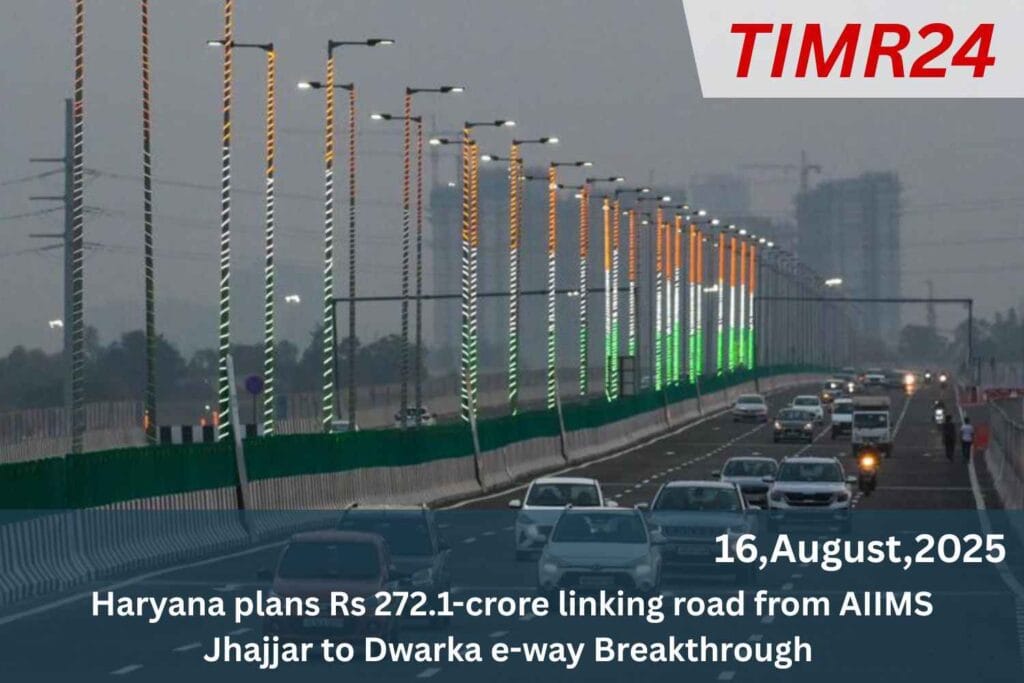
Haryana government plans to construct a 9km road, costing around Rs 272.1 crore, linking AIIMS’ National Cancer Institute to Delhi and IGI Airport via the Dwarka Expressway. The Haryana government has announced a major infrastructure upgrade with the approval of a ₹272.1-crore project to construct a direct linking road from AIIMS Jhajjar to the Dwarka Expressway. This strategic project aims to bridge a crucial connectivity gap between one of India’s premier healthcare institutes and the rapidly developing Dwarka Expressway corridor, offering faster, more reliable, and congestion-free travel for patients, doctors, and residents of Delhi NCR.
The AIIMS Jhajjar campus is a critical extension of AIIMS Delhi, hosting specialty facilities like the National Cancer Institute. However, its connectivity to central and south Delhi, as well as Gurgaon and Dwarka, has long been hampered by indirect routes and traffic bottlenecks. The new linking road is expected to change this landscape by providing a seamless travel route directly to the Dwarka Expressway, which itself is being positioned as a high-speed urban corridor connecting Delhi, Gurgaon, and surrounding NCR regions This improved connectivity is not just about reducing travel time it’s also about strengthening healthcare access.
Project Details and Design
The proposed road will be developed with modern engineering standards to ensure safety, durability, and smooth traffic flow. It will integrate with the Dwarka Expressway’s eight-lane design and include service lanes, proper signage, and drainage infrastructure. The Haryana Public Works Department is expected to oversee the project, ensuring coordination with the National Highways Authority of India (NHAI) to align with the expressway’s traffic patterns. Land acquisition processes will be streamlined to (Dwarka Expressway). prevent delays, and there is an emphasis on minimal disruption to existing residential and agricultural areas. Given the cost estimate of ₹272.1 crore, the project is set to be one of the more significant intra-state connectivity investments in recent years.
The AIIMS Jhajjar–Dwarka Expressway link is more than just a road—it’s a potential economic corridor. By directly connecting Jhajjar district to one of the busiest infrastructure spines in Delhi NCR, the project is expected to attract real estate growth, commercial development, and healthcare-related businesses. Property markets along the route may see increased demand, while local businesses will benefit from improved accessibility. Furthermore, this new road will complement Haryana’s broader road network upgrades, including the KMP Expressway and planned rural road enhancements, creating a more integrated state-wide mobility system. For commuters, it means more route options and less dependency on congested highways like NH-48.
The direct road link will be a game changer for patients and healthcare professionals. AIIMS Jhajjar, home to cutting-edge treatment facilities, attracts thousands of patients daily. The current road network forces many to take detours through Gurgaon or rural backroads, often adding 30–40 minutes to the journey. Once the new link is operational, travel times from Dwarka, Gurgaon, and West Delhi could be cut significantly, improving medical accessibility and emergency response times. The project also supports Haryana’s vision of enhancing social infrastructure alongside economic growth. With better access to healthcare, educational institutions, and employment hubs, residents of Jhajjar and surrounding areas will have improved quality of life.
Synergy with Dwarka Expressway Development
The Dwarka Expressway, nearing completion in phases, is already poised to transform NCR’s transport dynamics. Linking AIIMS Jhajjar directly to this expressway means the hospital will be part of a high-speed urban mobility chain that connects to the IGI Airport, Delhi Metro’s upcoming Silver Line, and the Delhi–Mumbai Expressway. This integrated approach ensures that the new road is not an isolated project but part of a wider, future-ready network Internal connectivity improvements like this also support sustainable urban growth, (Airport) as they help disperse traffic loads and reduce pressure on single routes. The combination of healthcare access and improved logistics for goods and services strengthens both public welfare and economic resilience.
With approvals in place, the next steps include finalizing detailed engineering designs, securing land rights, and starting construction. If executed on schedule, the road could be operational within 2–3 years, aligning with the final phases of the Dwarka Expressway project. For Haryana, this is not just an investment in concrete and asphalt—it is an investment in faster healthcare access, regional growth, and the long-term integration of Jhajjar into the NCR’s economic map. As the Dwarka Expressway reshapes connectivity patterns, the AIIMS Jhajjar link will stand out as a vital artery in the network.
Q1. What is the estimated cost of the AIIMS Jhajjar–Dwarka Expressway linking road?
The project is estimated at ₹272.1 crore.
Q2. Which areas will be connected by this road?
It will link AIIMS Jhajjar directly to the Dwarka Expressway.
Q3. What is the main purpose of this road project?
To improve healthcare accessibility and ease traffic between Jhajjar and Delhi NCR.
Q4. Who is developing the project?
The Haryana government is implementing the project.
Q5. How will it benefit commuters?
It will cut travel time and provide a direct, faster route to AIIMS Jhajjar.