



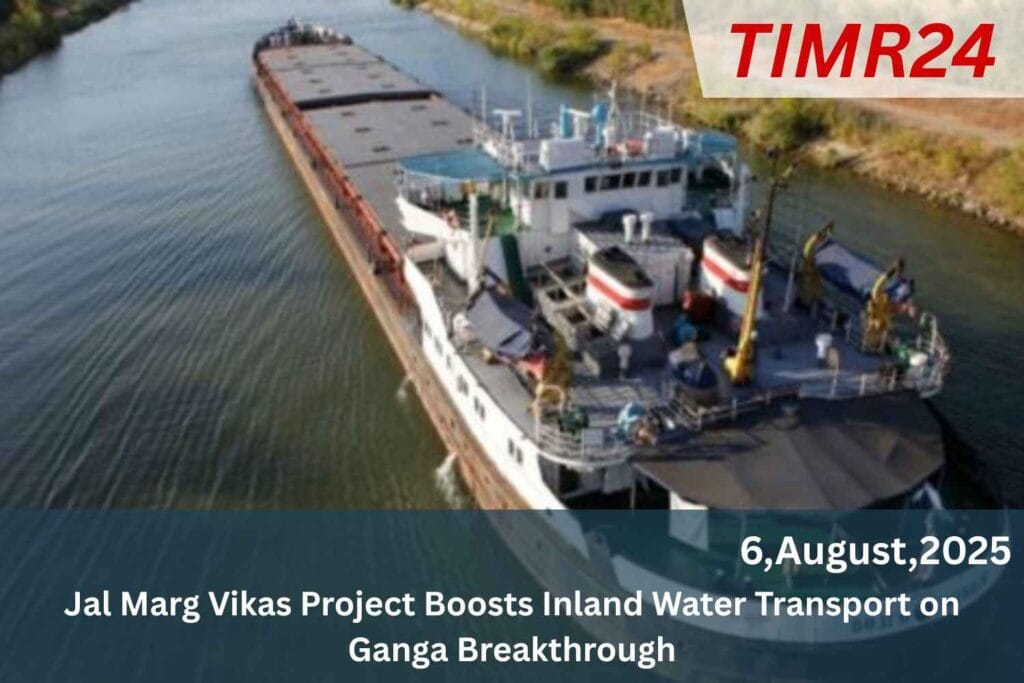
The Ganga Inland Waterways Authority of India (IWAI) is implementing the World Bank-assisted Jal Marg Vikas Project (JMVP) to improve cargo movement and infrastructure along National Waterway-1 (NW-1), spanning 1,390 km from Varanasi to Haldia via the Ganga-Bhagirathi-Hooghly river system. Key infrastructure developed under JMVP includes three multimodal terminals, one intermodal terminal, a new navigational lock, two quick pontoon opening mechanisms, and 53 community jetties. The project has seen a significant increase in cargo traffic on NW-1, with an investment of approximately ₹3,600 crore so far. IWAI has invested ₹661.44 crore in completed and ongoing projects in Uttar Pradesh, promoting water transport through the Uttar Pradesh Inland Waterways Authority Act, 2023 and the Inland Waterways Rules, 2025.
India’s inland water transport sector is receiving a transformative boost through the Jal Marg Vikas Project (JMVP), a flagship initiative by the Inland Waterways Authority of India (IWAI) under the Ministry of Ports, Shipping and Waterways. Designed to develop National Waterway-1 (NW-1) on the Ganga River between Varanasi and Haldia, the project covers a stretch of 1,390 km. It aims to enhance the navigability and efficiency of freight movement through riverine systems, reducing logistics costs and traffic pressure on rail and roads. the project is being implemented with technical and financial assistance from the World Bank.
Infrastructure Development and Modern Facilities
One of the key components of JMVP is the construction of multi-modal terminals at Varanasi, Sahibganj, and Haldia, along with inter-modal terminals, Ro-Ro terminals, and freight villages. These terminals are being equipped with modern cargo handling systems, container yards, and barge loading facilities to streamline operations. The Varanasi terminal is already operational, enabling direct water-based cargo movement to Kolkata and further to the Northeast. This infrastructure is also aligned with broader projects like the (Sagarmala Programme) and the Bharatmala Pariyojana, promoting integrated logistics across roadways, railways, and waterways.
Economic Impact and Regional Growth
The development of NW-1 under JMVP has vast economic implications, particularly for eastern India. The improved waterway will significantly reduce the cost of transporting bulk goods such as coal, cement, food grains, and fertilizers. Local industries, especially in Bihar, Jharkhand, and West Bengal, stand to benefit from increased trade access and lower logistics costs. The project is expected to create thousands of jobs, directly and indirectly, through port operations, barge construction, and allied services. This mirrors the economic stimulus seen in other infrastructure developments (Waterways Authority of India).
Environmental Benefits and Sustainable Transport
By shifting a significant portion of freight movement from road to water, JMVP supports India’s climate goals. Inland water transport is far more fuel-efficient and produces fewer emissions compared to trucks and trains. With the Ganga River being central to India’s cultural and ecological identity, the project has adopted measures to minimize its environmental footprint. This includes river training works, real-time dredging, and compliance with pollution control norms under The use of LNG-powered barges is also being explored to make inland shipping cleaner and more efficient.
Future Outlook and Expansion
Phase II of the Jal Marg Vikas Project will expand the network further to include tributaries and other stretches like the Gandaki, Kosi, and Ghaghara rivers. The long-term goal is to connect the North Indian heartland to ports on the east coast, enabling direct exports and imports via inland waterways. Additionally, JMVP will complement other national logistics strategies such as seamless multimodal transport corridors that drive India’s economic growth for decades to come.
q1. What is the Jal Marg Vikas Project (JMVP)?
JMVP is a government initiative to develop National Waterway-1 (NW-1) on the Ganga River for efficient inland water transport.
q2. Which stretch does the JMVP cover?
It spans 1,390 km from Varanasi (Uttar Pradesh) to Haldia (West Bengal) along the Ganga River.
q3. What are the key infrastructure components of JMVP?
Major developments include multi-modal terminals at Varanasi, Sahibganj, and Haldia, along with Ro-Ro services and freight villages.
q4. How does JMVP benefit the economy?
It reduces logistics costs, supports bulk cargo transport, generates employment, and boosts trade in eastern India.
q5. Is the project environmentally sustainable?
Yes, JMVP promotes eco-friendly transport with lower emissions, adaptive dredging, and LNG-powered barges.