

















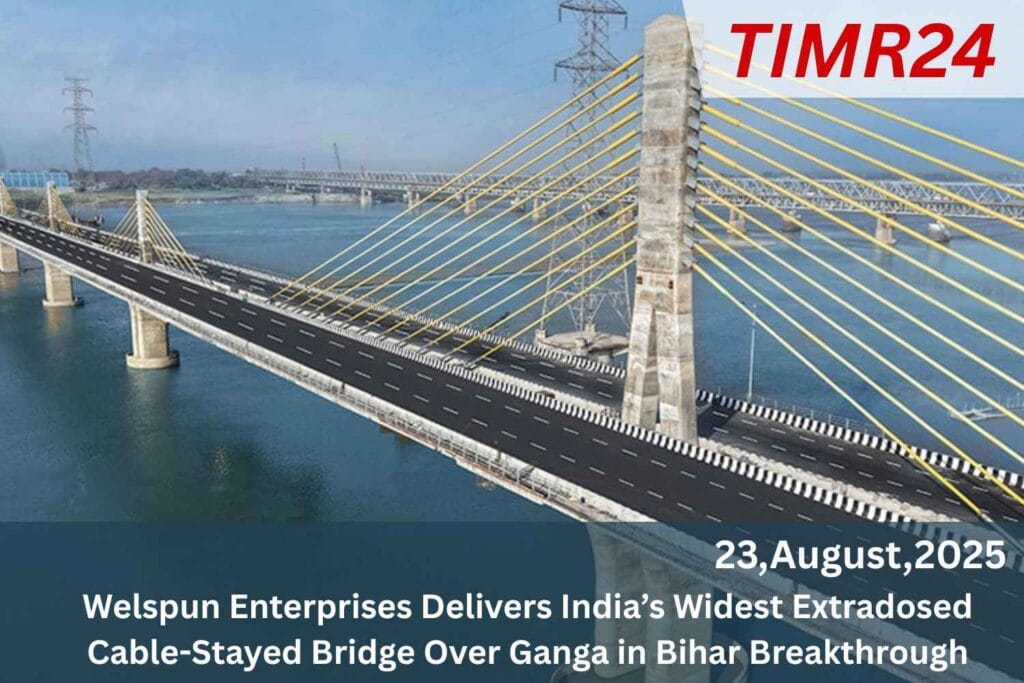
India’s Welspun Enterprises Limited (WEL), India’s infrastructure arm, has completed the Aunta-Simaria Ganga Bridge Project in Bihar, India’s widest extradosed cable-stayed bridge across the River Ganga. The 1.8-km-long bridge, part of the 8.15-km project, connects Aunta in Patna district with Simaria in Begusarai district, reducing travel time by over an hour. The bridge, designed to withstand heavy vehicular loads, is a modern and robust alternative to the 70-year-old Rajendra Setu Bridge. The project was developed in partnership with the Government of Bihar and the National Highways Authority of India (NHAI), marking a milestone in Bihar’s infrastructure growth.
The improved link is a game-changer for Bihar’s agribusiness sector, particularly the makhana industry, which received a ₹100 crore boost during the recent Union Budget. The project also boosted local enterprises and industries, enhancing connectivity to industrial hubs the (Infrastructure) like Barauni and unlocking new avenues of commerce across North and South Bihar The state of Bihar has marked a historic moment in infrastructure development with the inauguration of India’s widest extradosed cable-stayed bridge over the Ganga, executed by Enterprises. This engineering marvel is more than just a transportation facility; it is a symbol of progress.
Connectivity, and economic transformation. Built with state-of-the-art design and execution, the bridge is set to redefine travel and logistics across the region while highlighting Bihar’s growing importance in India’s infrastructure map The uniqueness of this bridge lies in its extradosed cable-stayed design, a modern architectural approach that combines durability with aesthetic appeal. Unlike conventional suspension bridges, the extradosed structure reduces the number of cables required while allowing for longer spans, ensuring both efficiency and beauty. At the same time, its sheer width makes it a national record-holder, enabling seamless passage for high traffic volumes.
Boosting Connectivity Across Bihar and Beyond
Connectivity has always been a challenge in Bihar due to the expanse of the Ganga and other major rivers. With this project, a long-standing gap has been bridged, literally and figuratively. The new structure is expected to significantly reduce travel time between Patna and surrounding districts, opening new avenues for trade, education, and healthcare. The bridge also serves as a crucial link between northern and southern Bihar, thereby integrating rural and urban economies. Internally, this development connects with earlier initiatives such as the Yamuna Water Transfer Project in Haryana and Rajasthan, highlighting India’s broader mission of linking infrastructure growth with regional balance.
The socio-economic impact of the bridge will be far-reaching. By enhancing access to markets, farmers and local entrepreneurs will now be able to transport their goods more efficiently, cutting down on logistical costs. Industrial clusters near Patna, as well as the emerging sectors in Gaya and Bhagalpur, will benefit immensely from the improved road infrastructure. This ties into India’s larger vision where projects like the FASTag Annual Pass scheme are simplifying transport, making road travel across states more affordable and efficient. Such interlinked initiatives underline how transportation reforms go hand in hand with ground-level infrastructure projects like the Ganga bridge.
Enterprises has consistently demonstrated its role as a pioneer in infrastructure, handling projects ranging from highways to water management. With this bridge, the company cements its position as a key player in nation-building. Their focus on innovation, timely delivery, and quality execution resonates with India’s aspiration to modernize its infrastructure in line with global standards. Looking at recent developments such as Ammann India’s rural infrastructure transformation in Mehsana or Titagarh Rail Systems’ expansion into marine engineering, it becomes evident that private enterprises are complementing government efforts to accelerate India’s development story.
In an era where infrastructure projects are closely scrutinized for their environmental footprint, the Ganga bridge stands out for adopting eco-sensitive measures. Careful planning ensured minimal disruption to the river ecosystem, and advanced construction technology reduced material wastage. This aligns with India’s commitment to sustainable infrastructure, as seen in other collaborations like the India-Netherlands water partnership, which focuses on climate-resilient projects. For Bihar, this bridge could pave the way for future developments such as smart highways, green logistics hubs, and digital tolling systems, ensuring that progress is both inclusive and sustainable.
The successful completion of India’s widest extradosed cable-stayed bridge is not just a technical accomplishment—it is a statement about Bihar’s readiness to embrace modernization. Once considered a lagging state in terms of development, Bihar is now positioning itself as a hub (NHAI) for growth through landmark projects like this. With every milestone, the state is bridging not just rivers but also the gap between aspiration and achievement. The Ganga bridge will thus remain a testament to resilience, ambition, and collective progress, reflecting the promise of a new Bihar aligned with the vision of a stronger India.
Q1. What makes this bridge unique?
It is India’s widest extradosed cable-stayed bridge, built with advanced engineering.
Q2. Where is the bridge located?
The bridge is constructed over the Ganga River in Bihar.
Q3. Who built the bridge?
Welspun Enterprises executed the project.
Q4. How will the bridge benefit Bihar?
It will enhance connectivity, reduce travel time, and boost trade.
Q5. Is the bridge environmentally sustainable?
Yes, eco-sensitive methods were used to minimize impact on the river ecosystem.