
















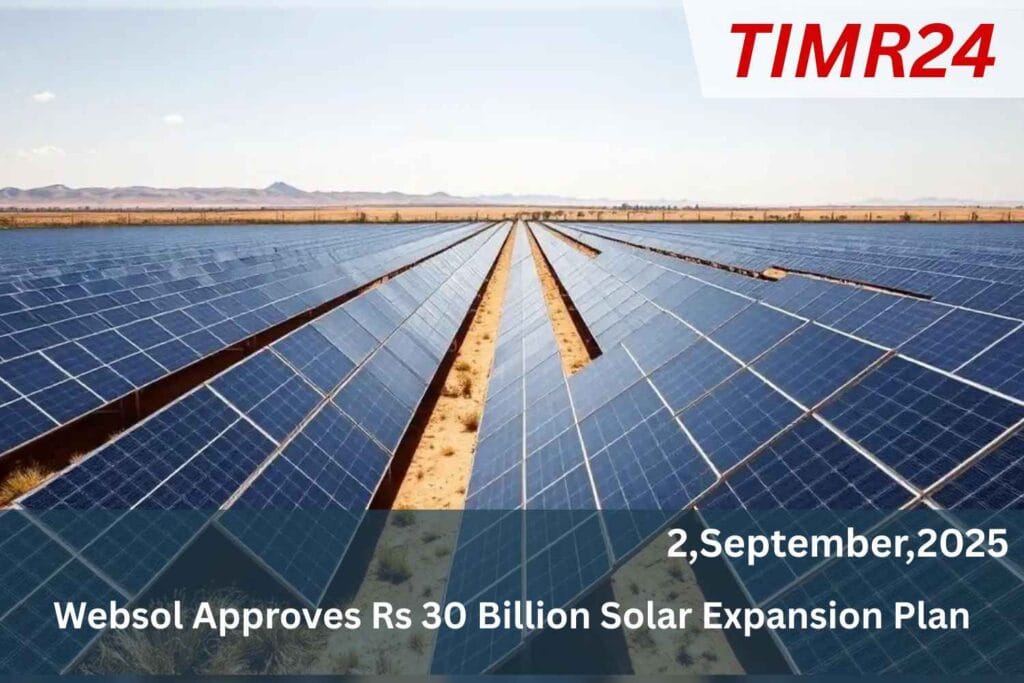
Websol Energy System Ltd has announced a Rs 30 billion investment in its solar manufacturing capacity, including 4 GW of solar cells and 4 GW of modules. The expansion builds on the company’s existing facilities in Falta, West Bengal, which currently operate a 600 MW solar cell line and a 550 MW solar module line. Phase III and Phase IV will add 2 GW solar cell and 2 GW solar module lines, each incorporating Topcon technology. The total manufacturing capacity will reach 5.2 GW for solar cells and 4.5 GW for modules by 2028, contributing to India’s renewable energy target. The renewable energy sector in India continues to attract significant investments,
With major players expanding their capacities to meet the country’s clean energy goals In this direction, Websol Energy System Ltd, a leading solar photovoltaic cell and module manufacturer, has approved a massive Rs 30 billion solar expansion plan that will strengthen its presence in the green energy segment. This development not only reflects the company’s ambition to become a large-scale contributor to India’s renewable energy ecosystem but also highlights the growing demand for solar power solutions amid the government’s push for sustainable energy. Web sol’s decision to allocate Rs 30 billion for expansion underscores its strategy to scale operations and improve manufacturing capabilities.
Websol’s Strategic Move in the Solar Sector
The company has consistently focused on technological upgrades and efficiency improvements in solar PV manufacturing, and this investment marks a new era of growth By enhancing its module and cell production lines, Websol aims to increase output significantly while ensuring higher-quality solar solutions for both domestic and international markets. This strategic move will allow the company to compete with other global solar leaders, positioning itself as a reliable player in the industry. India has set ambitious targets for renewable energy, aiming to achieve 500 GW of (Solar Energy) clean energy capacity by 2030. Solar power is expected to contribute the largest share in this journey, and companies like Websol are critical to achieving this vision.
The Rs 30 billion expansion will help reduce the country’s reliance on imported solar equipment, aligning with the government’s ‘Make in India’ and ‘Atmanirbhar Bharat’ initiatives. By strengthening its domestic manufacturing base, Websol will not only support self-reliance but also provide employment opportunities and boost local economies. The new expansion plan is expected to increase Websol’s solar cell and module manufacturing capacity to record levels. Currently, the company has a strong presence in the crystalline solar PV segment, but with this investment, it plans to incorporate advanced technologies such as PERC (Passivated Emitter and Rear Cell) and Topcon (Tunnel Oxide Passivated Contact), which offer higher efficiency.
The company aims to scale up to multi-gigawatt capacity in the coming years, ensuring that it meets the rising domestic and export market demand Moreover, the expansion will be designed with automation and AI-driven monitoring systems to reduce costs and enhance operational efficiency.
Expansion Plan Details and Production Capacity
With global demand for solar power growing rapidly, Websol’s expansion will not only cater to domestic projects but also strengthen India’s export portfolio. Many international markets are seeking reliable solar module suppliers, and India has emerged as a potential hub for exports due to its competitive manufacturing costs and skilled workforce. Websol’s larger capacity will allow it to secure long-term supply contracts with global renewable energy developers, further enhancing its brand recognition. Additionally, the expansion will help India reduce its dependence on Chinese imports, a major challenge that the solar industry has been facing for years.
The announcement of Websol’s Rs 30 billion expansion is part of a larger trend in India’s renewable energy market, where private and public sector players are making significant investments. Investors are increasingly confident in the long-term profitability of clean energy, especially solar, given government incentives and global climate change commitments. This expansion will encourage other players to accelerate their growth plans, leading to a more competitive and dynamic renewable energy market in the country. Websol’s decision to expand also aligns well with government policies such as the Production Linked Incentive (PLI) Scheme, which supports.
Government Support and Policy Alignment
The establishment of high-efficiency solar PV modules in India. The PLI scheme, along with subsidies and tax incentives. Makes it feasible for companies to invest in large-scale manufacturing facilities. By capitalizing on these initiatives, Websol will not only enhance its production but also qualify for financial benefits that will improve its profitability. This kind of government-industry synergy is crucial to achieving India’s renewable energy roadmap One of the most important aspects of this expansion is its impact on employment. Large-scale manufacturing projects like Websol’s require skilled and semi-skilled workers across different levels, from R&D to production and logistics. This project is expected to create thousands of jobs directly and indirectly, thereby boosting the local economy.
In addition, allied sectors such as transportation, infrastructure, and services will benefit from the economic activity generated around the new facilities. Beyond expansion, Websol is also focusing on integrating sustainable practices into its manufacturing process. The company is expected to adopt eco-friendly measures such as water recycling, waste reduction, and renewable energy usage within its plants. By embedding sustainability in production, Websol is not only contributing to clean energy supply but also reducing its carbon footprint. This focus on sustainability also resonates with global investors who prioritize ESG (Environmental, Social, Governance) factors when choosing companies to back.
Challenges and Competition in the Solar Industry
Despite the positive outlook, Websol will also face challenges in scaling up its capacity. The global solar industry is highly competitive, with countries like China, the U.S., and South Korea leading in production. Maintaining cost competitiveness while ensuring quality will be crucial for Websol. Additionally, fluctuating raw material prices, especially polysilicon, can affect margins. However, the company’s focus on advanced technologies and government support will help it overcome these challenges and maintain a strong growth trajectory The Rs 30 billion expansion marks a milestone not just for Websol but also for India’s solar manufacturing industry as a whole. With this development, India is one step closer to becoming a global solar hub.
For Websol, the expansion means stronger revenue streams, improved market position, and long-term growth sustainability. For the industry, it signals rising confidence and the possibility of India emerging as a global leader in solar exports. Websol’s Rs 30 billion solar expansion plan is more than just a corporate growth story it is a significant step forward in India’s clean energy transition (Renewable Energy) By enhancing manufacturing capacity, adopting advanced technologies, and aligning with national policies, Websol is positioning itself as a central player in the solar sector. The move will strengthen domestic production, reduce reliance on imports, create jobs, and open new export opportunities. As India works toward its 2030 renewable energy goals.
Q1. What is the total investment approved by Websol Energy for solar expansion?
Websol has approved a ₹30 billion expansion plan to boost its solar capacity and production capabilities.
Q2. How will this expansion benefit India’s renewable energy sector?
It will contribute to India’s clean energy mission, reduce dependence on fossil fuels, and create new job opportunities.
Q3. What technologies will Websol use in this solar expansion project?
Websol plans to adopt advanced photovoltaic technologies, including high-efficiency solar cells and modules.
Q4. When is the Websol solar expansion project expected to begin?
The implementation is set to begin in phases, with the first stage starting in 2025.
Q5. How does this investment align with India’s 2030 renewable targets?
It supports India’s goal of achieving 500 GW of renewable capacity by 2030, boosting sustainability.