


















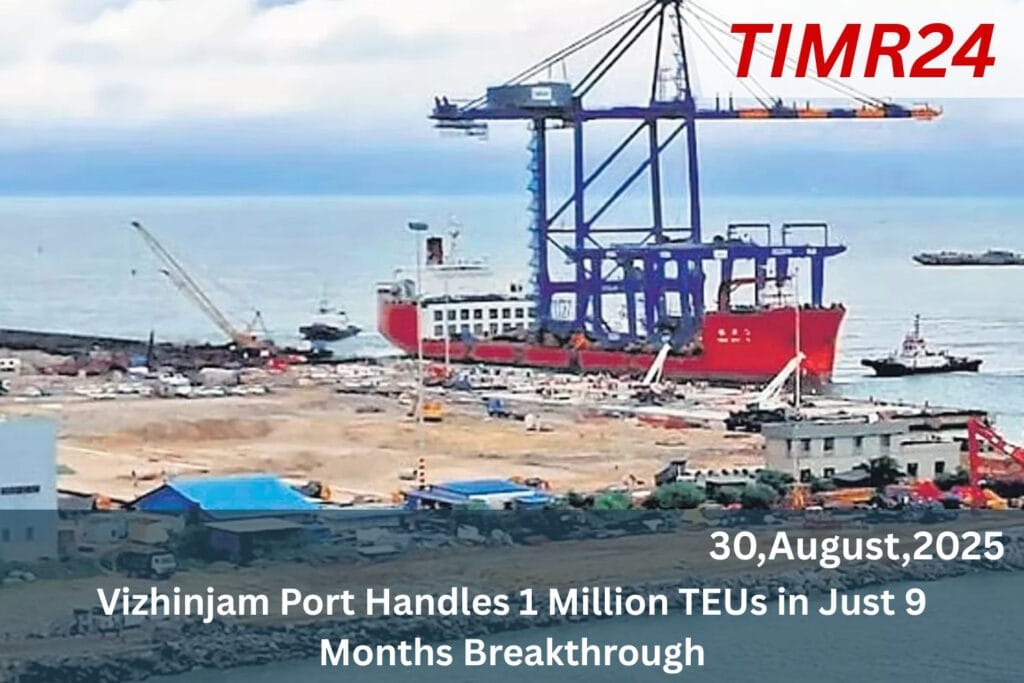
Vizhinjam International Seaport in India has handled over 1 million TEUs of cargo within nine months of launching commercial operations, exceeding its first-year target of 300,000 containers. The current figure stands at 1.012 million TEUs, setting a new benchmark for performance by a greenfield port in India. Ports Minister V. N. Vasavan described the milestone as a “world-class milestone” and praised the port’s rapid growth, placing it in direct competition with global ports like Colombo, Singapore, and Dubai. The port is South Asia’s first automated port, featuring 24 automated yard cranes and eight semi-automated ship-to-shore cranes.
The achievement of Vizhinjam International Seaport handling 1 million TEUs within just nine months of operations has positioned India’s maritime sector at a new global benchmark. Situated in Thiruvananthapuram, Kerala, the port is already being hailed as a game-changer for India’s logistics and trade infrastructure. Its rapid rise not only strengthens India’s shipping capacity but also reduces the country’s (Indian Ports) reliance on transshipment hubs like Colombo, Singapore, and Dubai, which previously handled a significant portion of India’s container traffic. This breakthrough is particularly significant as it directly contributes to the goals of the Sagarmala Project and the larger vision of transforming India into a global maritime power. You can explore more on.
One of the primary reasons behind Vizhinjam’s success is its geostrategic location, lying just 10 nautical miles away from one of the busiest global shipping lanes that connect Europe, the Middle East, and Southeast Asia. This proximity allows ultra-large container vessels to dock without deviation, saving valuable time and reducing shipping costs. Unlike most Indian ports that face the challenge of shallow waters and require extensive dredging, Vizhinjam boasts a natural draft of over 20 meters, making it one of the few ports in Asia capable of accommodating the world’s largest container ships. This unique advantage is expected to make Vizhinjam not only a national asset but also a major global transshipment hub. To understand more about India’s port ecosystem.
The infrastructure and facilities at Vizhinjam have also played a critical role in this achievement. Equipped with advanced container handling systems, automated cargo processes, and large-scale storage areas, the port has been designed as a next-generation logistics hub. Backed by Adani Ports and SEZ Limited, Vizhinjam benefits from global expertise in port management and supply chain efficiency. According to the official (Adani Ports), their focus on efficiency, digital integration, and sustainable practices has accelerated the port’s handling capacity, enabling it to cross the 1 million TEU mark in record time.
The economic impact of Vizhinjam’s operations is far-reaching. By diverting transshipment cargo from foreign ports, India is set to save billions of dollars annually in logistics costs. The port is expected to reduce the burden on ports like Kochi, Mumbai, and Chennai, while also acting as a catalyst for regional development in Kerala. The success of Vizhinjam ties into the government’s vision of an Atmanirbhar Bharat, where India strengthens its trade autonomy and enhances its global competitiveness. With direct access to global shipping routes, exporters across industries, including textiles, manufacturing, and electronics, will benefit from reduced shipping times and costs. For deeper insights into the global shipping market.
Connectivity plays a crucial role in maximizing the port’s efficiency, and Vizhinjam is being integrated with dedicated freight corridors, national highways, and railway lines to ensure smooth inland cargo movement. Plans are also underway to establish logistics parks and warehousing hubs in Kerala, which will complement the port’s operations. This development mirrors infrastructure upgrades seen across India, such as similarly focuses on seamless connectivity and modern transportation networks. Together, such projects highlight India’s strategy of integrating ports, roads, and railways into a unified economic growth framework.
Sustainability is another dimension where Vizhinjam sets an example. With minimal dredging needs due to its natural depth, the environmental footprint of the port is significantly lower compared to other Indian ports. Additionally, the integration of renewable energy systems, green logistics practices, and eco-friendly port management aligns Vizhinjam with global standards of sustainable shipping. The International Maritime Organization (IMO) has emphasized the importance of green shipping, and Vizhinjam is a step in the right direction. More about sustainable maritime practices can be found at.
Looking ahead, industry experts predict that Vizhinjam could handle over 5 million TEUs annually in the next few years, given its infrastructure and strategic advantages. This will not only boost India’s cargo handling capacity but also establish Vizhinjam as South Asia’s most important transshipment hub. With growing international trade, India’s position in the global shipping industry is set to strengthen, and Vizhinjam will remain at the heart of this transformation. Readers interested in broader developments can check our detailed coverage The handling of 1 million TEUs in less than a year is more than just a statistical achievement; it is a symbol of India’s rising maritime power. With Vizhinjam now emerging as a credible alternative to international transshipment hubs,
India is set to claim a stronger voice in global trade logistics. Its success story demonstrates how strategic location, world-class infrastructure, and forward-looking policy support can converge to create a milestone in economic development. India’s maritime sector achieved a significant breakthrough as Vizhinjam International Seaport handled 1 million Twenty-Foot Equivalent Units (TEUs) within just nine months of commencing operations. This milestone positions Vizhinjam as one of India’s fastest-growing ports and highlights its potential to transform the country’s role in global shipping and trade. Vizhinjam Port, located in Thiruvananthapuram, Kerala, is strategically placed just 10 nautical miles from the busiest international shipping route connecting Europe.
Q1. What is the significance of Vizhinjam Port crossing 1 million TEUs?
It shows the port’s rapid rise as a major transshipment hub in India within just 9 months of operations.
Q2. Where is Vizhinjam Port located?
It is located in Thiruvananthapuram, Kerala, strategically close to international shipping lanes.
Q3. Why is Vizhinjam considered India’s gateway port?
Its deep draft, minimal dredging needs, and proximity to global trade routes make it ideal for mega container ships.
Q4. Who operates Vizhinjam Port?
The port is developed under a PPP model, with Adani Ports and SEZ Limited as the main operator.
Q5. How will Vizhinjam Port impact India’s economy?
It reduces dependency on foreign ports like Colombo and Singapore, saving logistics costs and boosting exports.