







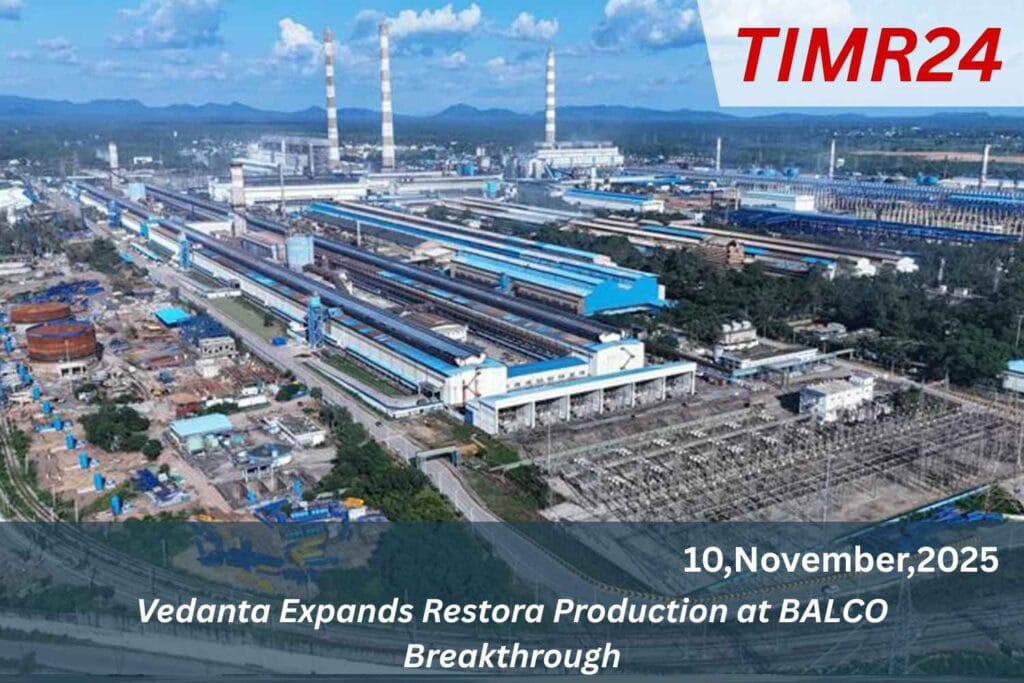
Vedanta Aluminium has expanded its low-carbon product portfolio by launching the Restora range at Bharat Aluminium Company (BALCO) in Chhattisgarh, contributing to its goal of achieving Net Zero Carbon by 2050. Restora, produced using renewable energy, has a verified GHG emission intensity below 4 tonnes of CO₂ equivalent per tonne of aluminium, aligning with global low-carbon benchmarks. The expansion aligns with rising demand for sustainable materials and supports sectors like automotive and renewable energy. CEO Rajiv Kumar emphasized Restorer’s role in India’s sustainable manufacturing growth, while BALCO’s CEO Rajesh Kumar highlighted its potential in enabling greener value chains.
Vedanta Aluminium aims to continue its decarbonisation strategy by improving operational efficiency and increasing clean energy usage The recent strategic announcement by Vedanta Aluminium that its subsidiary Bharat Aluminium Company (BALCO) in Korba, Chhattisgarh has started manufacturing its low-carbon aluminium brand Restora marks a defining moment in India’s transition to sustainable industrial manufacturing. According to industry press, Restora is produced using renewable energy and boasts a verified GHG emission intensity of below 4 tonnes of CO₂ equivalent per tonne of aluminium, thereby meeting international benchmarks for low-carbon aluminium.
Traditionally, aluminium production has been energy-intensive and associated with significant greenhouse-gas emissions. The decision by Vedanta Aluminium to roll out Restora through BALCO amplifies its commitment to decarbonisation across its value chain, aiming for net-zero carbon by 2050 At a time when global supply chains increasingly demand sustainability credentials, this move places India in a favourable position to serve industries seeking greener inputs From an operational standpoint, BALCO adopting Restora ingot production is a key step. While the company’s Jharsuguda smelter had already produced Restora (and its ultra-low-carbon variant, Restora Ultra) since early 2022, extending.
Renewable Energy, Vedanta Aluminium Aligns
The brand to the Korba unit broadens the footprint and scale of low-carbon aluminium manufacturing The expansion to BALCO also signals readiness to service varied industry sectors beyond ingots. According to statements from company leadership, while the initial focus is on ingots, product forms will be added in sync with customer and industry requirements One of the noteworthy aspects of this development is the as part of the production process. By producing Restora using renewable energy, Vedanta Aluminium aligns with international low-carbon standards and demonstrates how aluminium, often dubbed the “metal of the future”, can play a role in enabling clean-energy systems, electric mobility.
Sustainable infrastructure fact, the company reports a reduction in GHG intensity of approximately 8.96% since FY21, underscoring a tangible progress in its sustainability trajectory a value-chain perspective, Restorer’s appeal lies in its ability to help downstream industries build greener value chains. For sectors such as automotive, construction, packaging, electricals and renewables, sourcing low-carbon aluminium becomes a key differentiator as regulatory and market pressures increase. As quoted in the coverage, Vedanta’s leadership emphasised that Restora enables customers to transition to responsible manufacturing Incorporating the company’s manufacturing expansion provides further background.
The company’s broader journey is detailed in our article on expansion of wire-rod production at BALCO as part of India’s 5G infrastructure boom (see our piece on Vedanta Aluminium’s BALCO wire rod expansion). Through that lens, this latest Restora production is a complementary step in the company’s dual focus on both scale and sustainability Economically and strategically, situating Restora production at BALCO serves several advantages. First, it leverages BALCO’s existing infrastructure and captive resources to scale low-carbon production. Second, it positions India to reduce dependence on imported low-carbon metals or supply from overseas, thereby enhancing domestic industrial sovereignty.
Third, it bolsters Chhattisgarh’s role in India’s aluminium-metals ecosystem and the government’s vision of “Make in India” for strategic and sustainable manufacturing the sustainability narrative, aluminium’s role in enabling renewable energy infrastructure, electric vehicles, lightweight construction and aerospace makes it central to the low-carbon transition. By offering a product such as Restora (Digital) and expanding its reach, Vedanta Aluminium is signalling to the market that low-carbon aluminium is not just a niche but a scalable industrial offering. The company’s Centre of Excellence, designed to accelerate product innovation for emerging sectors like electric mobility, renewables and aerospace, becomes instrumental in this journey.
Looking ahead, the success of Restora at BALCO will depend on several factors: the pace of expansion into value-added product forms beyond ingots; securing customer uptake in high-growth segments; ensuring renewable-energy supply remains robust; maintaining the verified low-carbon emission intensity; and managing the global aluminium supply chain pressures including raw-material constraints and energy costs. For stakeholders such as OEMs, packaging companies and construction firms, early engagement with suppliers of low-carbon aluminium can provide a competitive edge in meeting regulatory and ESG mandates industries sourcing aluminium today.
Vedanta Aluminium Shape Tomorrow’s
The availability of Restora from two major smelters of Vedanta Aluminium offers choice and scale. It enables manufacturers to differentiate their products, access a more sustainable input stream, and potentially command premium pricing or brand value by virtue of possessing low-carbon credentials. As more end customers from automotive OEMs to packaging companies to renewable-energy component makers demand greener materials, suppliers like Vedanta Aluminium will shape tomorrow’s sustainable metal ecosystem. The expansion of Restora production at BALCO by Vedanta Aluminium marks a significant milestone in India’s industrial transition.
It blends scale with sustainability, domestic manufacturing strength with decarbonisation ambitions, and responds to a global shift in demand for low-carbon building blocks. For companies working across metals, energy, manufacturing and supply chains, this development is both (Aluminium) a signal and an opportunity: a signal that low-carbon materials are increasingly mainstream, and an opportunity to align supply-chains accordingly. With the backing of full-sized industrial capacity and a track record of sustainability improvement, Vedanta Aluminium is advancing the case for India-based low-carbon metal production.
Q1. What is Restora?
Restora is a low-carbon aluminium brand produced by Vedanta Aluminium, characterised by a verified greenhouse-gas (GHG) emission intensity below 4 tonnes of CO₂ equivalent per tonne of aluminium.
Q2. Where is the new production being initiated?
Production of Restora is now also being commenced at BALCO’s plant in Korba, Chhattisgarh, a subsidiary of Vedanta Aluminium.
Q3. Why is this expansion significant?
This move strengthens India’s role in climate-conscious manufacturing, supports global decarbonised supply chains, and aligns with Vedanta’s net-zero by 2050 ambition.
Q4. Which industries can use Restora?
Restora is designed for sectors such as automotive, construction, electricals, packaging, renewable energy wherever low-carbon aluminium is valued.
Q5. What next for the product range?
While BALCO begins with Restora ingots, plans are in place to expand into value-added product forms under the brand as demand evolves