















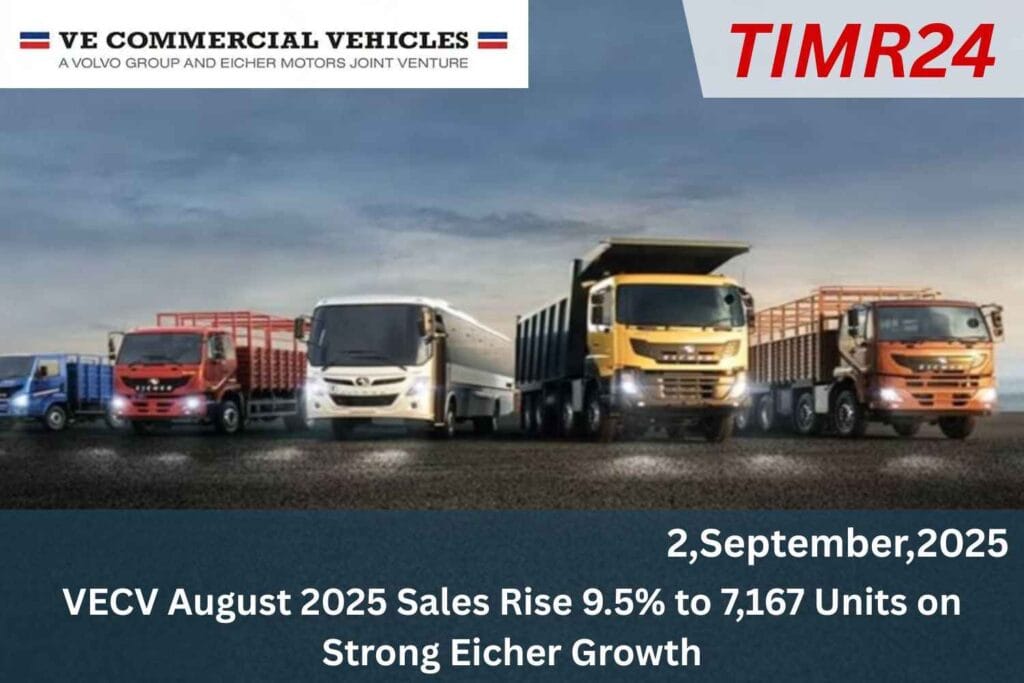
VECV Commercial Vehicles Ltd a joint venture between Volvo Group and Eicher Motors, reported sales of 7,167 units in August 2025, up 9.5% from 6,543 units in the same month last year. Eicher trucks and buses saw a 10.2% growth, while Volvo trucks and buses saw a 6.5% decline. The commercial vehicle market in India is experiencing significant growth in 2025, with VE Commercial Vehicles (VECV) emerging as a standout performer. In August 2025, VECV reported a 9.5% year-on-year sales increase, selling 7,167 units compared to 6,543 units during the same period last year This robust performance highlights not only the company’s strength in catering to rising demand
Across domestic and international markets but also its ability to adapt to changing industry trends A deeper look at the figures and underlying factors reveals how VECV, powered by its Eicher brand trucks and buses, continues to consolidate its position in India’s highly competitive commercial vehicle sector The strongest contributor to VECV’s August 2025 performance was the Eicher brand, which has become synonymous with reliability, fuel efficiency, and operational cost-effectiveness. Known for its adaptability across multiple segments from light and medium-duty trucks to buses the brand has found increasing acceptance among small businesses, fleet operators, and logistics providers.
Eicher trucks are particularly popular in the e-commerce delivery ecosystem, where fuel economy and durability are critical for cost efficiency. The company’s buses also cater to school transport, intercity travel, and staff mobility services, ensuring a diversified demand base. The steady growth in Eicher sales is also tied to India’s ongoing logistics expansion. With increasing online retail penetration and supply chain digitization, demand for reliable trucks is stronger than ever. Readers can explore more about how have shaped this transformation and continue to be a core pillar of VECV’s success.
Domestic Market Drivers and Infrastructure Push
India’s commercial vehicle industry is undergoing a strong rebound in 2025, supported by government initiatives, infrastructure spending, and private sector logistics expansion. The growth of expressways, regional highways, and metro city freight corridors has directly boosted the demand for commercial transport solutions. VECV, with its wide product range and established dealer network, has successfully capitalized on this trend. The rise of e-commerce and last-mile delivery networks has also been a game-changer. Small and medium-scale transporters are increasingly upgrading their fleets with Eicher vehicles to meet rising customer demand.
Moreover, state and central government projects for urban development and rural connectivity have created new opportunities for heavy-duty trucks and construction vehicles. A broader overview of these developments can be found in our detailed analysis of the (Eicher), where commercial vehicles are expected to remain one of the fastest-growing segments While the domestic market is a strong growth driver, VECV has also expanded its presence globally. Exports of trucks and buses to countries in Asia, Africa, and the Middle East have played a critical role in sustaining momentum. Many developing economies are looking for affordable yet durable vehicles.
That can withstand rough terrains and diverse operating conditions. Eicher vehicles, known for their robust build and cost efficiency, fit perfectly into these markets. International expansion has also helped VECV offset domestic market fluctuations. As Indian companies increasingly explore global supply chain partnerships, the demand for reliable trucks has grown beyond national borders. This not only brings in foreign revenue but also strengthens the company’s long-term sustainability goals. For readers interested in detailed industry-level export figures, the provides comprehensive insights into India’s growing role as a global commercial vehicle hub.
Sustainability, Technology, and Future-Ready Solutions
Another major factor behind VECV’s growth trajectory is its consistent focus on innovation and sustainability. The company has been investing heavily in alternative fuel technologies, including CNG, LNG, and electric mobility solutions. With increasing emphasis on reducing carbon emissions and aligning with India’s clean energy roadmap, VECV is positioning itself as a future-ready manufacturer. The company has already introduced electric buses and plans to scale production in alignment with government policies promoting clean transport. Additionally, fuel-efficient engines, telematics, and smart fleet management solutions are helping VECV’s customers reduce operational costs.
While ensuring environmental compliance. For a deeper dive into India’s sustainability-driven automotive revolution, check our feature on which covers how leading companies, including VECV, are shaping the clean transport landscape. The commercial vehicle market in India is highly competitive, with Tata Motors, Ashok Leyland, Bharat Benz, and Mahindra also fighting for leadership. However, VECV’s balanced strategy of focusing on mid-range trucks and strong brand loyalty has carved a niche for the company. Unlike some rivals that focus heavily on the heavy-duty truck market, VECV’s wide portfolio gives it flexibility across multiple demand segments.
Competitive Landscape and Market Positioning
Additionally, its joint venture structure combining Volvo’s global technological expertise with Eicher’s deep Indian market presence has given the company a competitive edge. This unique positioning has allowed VECV to not only strengthen its domestic market share but also expand steadily into international territories. Readers can explore more comparative insights in our coverage of (Manufacturers) where VECV continues to secure a strong spot among market leaders. Looking ahead, the future appears promising for both VECV and India’s commercial vehicle industry. Analysts project that the sector will maintain double-digit growth over the next three years, supported by rising freight.
Demand, infrastructure expansion, and government-led green mobility initiatives. VECV’s strategic focus on new product launches, sustainable transport solutions, and international market penetration ensures that the company will continue to grow its footprint The company’s emphasis on innovation will also pay dividends, as customers increasingly seek vehicles equipped with telematics, safety features, and energy-efficient engines. As India prepares for an era of smart transport, VECV’s balance of affordability and innovation positions it well to lead the transformation.
Conclusion
The 9.5% sales growth in August 2025, taking VECV’s tally to 7,167 units, is more than just a monthly achievement—it reflects the company’s resilience, adaptability, and strong market positioning in a competitive sector. With the Eicher brand driving demand, export expansion adding stability, and technology investments ensuring future readiness, VECV is shaping the trajectory of India’s commercial vehicle industry. The combination of domestic market strength, international outreach, and sustainable innovation makes VECV not just a leader for today but also a key player in India’s transport future. By staying aligned with market trends, government policies, and customer needs, VECV has positioned itself as a reliable growth driver in India’s economy.
Q1. What were VECV’s total sales in August 2025?
VECV sold 7,167 units in August 2025, marking a 9.5% YoY growth.
Q2. Which brand drove the majority of growth?
The Eicher brand trucks and buses contributed significantly to sales growth.
Q3. How did August 2025 sales compare to last year?
Sales increased from 6,543 units in August 2024 to 7,167 units in 2025.
Q4. What factors supported VECV’s growth?
Rising infrastructure development, logistics demand, and exports boosted performance.
Q5. How does this growth impact India’s commercial vehicle market?
It reflects strong recovery in the CV sector, signaling positive demand momentum.